
Putting a Wine Cooler in the Living Room: What to Check Before Storing Your First Bottle
You’ve spotted the wine cooler, measured the wall space next to the couch, and one question keeps coming up: Will it hum during movies, heat up the room, or clash with the decor? The living room is one of the most common places to install a wine cooler—and, on paper, one of the worst. Heat, light, foot traffic, noise. Let’s take a look at what this choice really entails, how to decide between a freestanding and a built-in unit, and above all, a question no one asks: are you going to keep that wine, or are you going to drink it?

Where should you place a wine cooler in a living room?
Wine should be stored in a cool, dark, stable, and quiet room. A living room, on the other hand, is heated in the winter, lit all day long, constantly filled with people, and noisy. The contradiction is stark. It’s not a deal-breaker, but it requires being honest about what the unit will have to endure.
What room temperature should be expected?
An electric wine cooler is a cooling system. It does not create cold from nothing; rather, it extracts heat from its interior and releases it into the room. The higher the room temperature rises, the harder it has to work to maintain its storage temperature of 12 to 14 °C. A living room that gets very hot in the summer keeps the unit running constantly.
This is where the climate class—listed on the product specifications sheet—comes into play. It tells you the range of room temperatures within which the manufacturer guarantees the advertised performance. Check this rating if your living room has a sloped ceiling, faces south, or gets very hot during heat waves. Conversely, a living room that’s heated in the winter rarely has a problem with the cold, unlike a garage or laundry room: it’s in these unheated rooms that a winter mode—or dual heating and cooling control—becomes necessary.
Just as important as the absolute value is the fluctuation. A room whose temperature fluctuates between 17 and 26 °C throughout the day puts more strain on the system than a room that remains stable at 22 °C.
Light, the Silent Enemy
Light damages wine: the famous “light taste” is caused not only by UV rays, but also by the blue part of the visible spectrum. A glass door looks nice, and that’s precisely why people put a wine cellar in their living room. High-quality models feature tinted glass with UV protection, which effectively limits exposure without completely blocking all visible light.
Based on this criterion alone, a solid door offers better protection: a glass door is a deliberate aesthetic choice. And no amount of glass can replace common sense—avoid walls that get direct afternoon sun.
The same logic applies to LED interior lighting, which looks particularly attractive in the evening. It’s meant to be admired for a few minutes, not left on from morning to night.
Are vibrations really a problem?
The topic comes up everywhere, often with a doomsday tone. Let’s be specific. Published studies have measured the effect of sustained vibration on red wine over a period of eighteen months: beyond a certain intensity threshold, the wine’s chemistry changes, the acids evolve, the aromas diminish, and the effect increases with intensity. The risk is therefore not imaginary.
What has not been established, however, is that the micro-vibrations in a living room (a step on the hardwood floor, a speaker, the compressor of a properly installed modern wine cooler) reach an intensity that is transmitted to the glass. No one loses a case of Bordeaux just because someone walked by. The right response is not to panic, but to remain level-headed.
Here are some common-sense tips: Don't place the wine cooler next to a vibrating appliance; set it on a level, stable surface; and make sure it stands upright on its adjustable feet.
- Place the device against a radiator or above a heat source.
- Place it inside a closed cabinet with no airflow at the back.
- Place it in front of a south-facing picture window.
- Choose a wine cellar to store this week's bottles.
- Forget about the outlet and end up with an extension cord running across the living room.
The noise from the air conditioner in the room where you're watching TV
That’s the question product descriptions often gloss over—and one you’ll find yourself asking every night. A compressor-based wine cooler works just like a refrigerator: it starts up, runs, and shuts off. In a kitchen, no one notices it. But three meters away from a couch, in the middle of a quiet scene in a movie, it’s a different story.
2 Things to Consider Before Buying Your Electric Wine Cooler
Noise class. It appears on the European energy label, rated from A to D. This classification is governed by European Regulation 2019/2016, which has been in effect since March 2021: Class A corresponds to appliances below 30 dB(A), while Class D corresponds to those that reach or exceed 42 dB(A). So you don’t have to pry this information out of a salesperson—it’s required on both the label and the product sheet. It’s the only piece of information that’s truly comparable across models, and in a living space, it’s the factor that should carry the most weight.
Technology. Three types, not to be confused. Absorption-type wine coolers operate without a compressor or moving parts: they are the quietest, but the selection is limited. Thermoelectric wine coolers (Peltier effect) also do away with the compressor, but they rely on fans, which aren’t always quiet. Most importantly, they only cool to about 10 to 12 °C below room temperature: in a living room at 28 or 30 °C in the middle of summer, a thermoelectric wine cooler will never maintain a proper storage temperature. This is the deciding factor, and it rules out this technology for most living rooms. That leaves compressor-based wine coolers, which can reach low temperatures and maintain them, though at the cost of intermittent operating noise. For aging wine in a living room, a compressor-based model is usually the necessary choice, provided it has the lowest possible noise rating.
One last tip—and it’s free: don’t place the subwoofer directly in line with the sofa. Move it a meter or two to the side, position it in a corner rather than against a wall facing the armchair, and the rumbling will fade into the background.
Freestanding or built-in: Which wine cooler should you choose for your living room?
Many buyers choose the model first, then try to figure out where to put it. Do the opposite. The type of installation determines the possible location, the budget, and the final look.
Three families—and they're not all the same.
| Free-standing installation | Built-in | Custom Dog House | |
|---|---|---|---|
| Principle | The unit is floor-mounted, freestanding, and movable | Designed to be slid under a countertop or into a cabinet | Carpentry work designed around a predetermined framework |
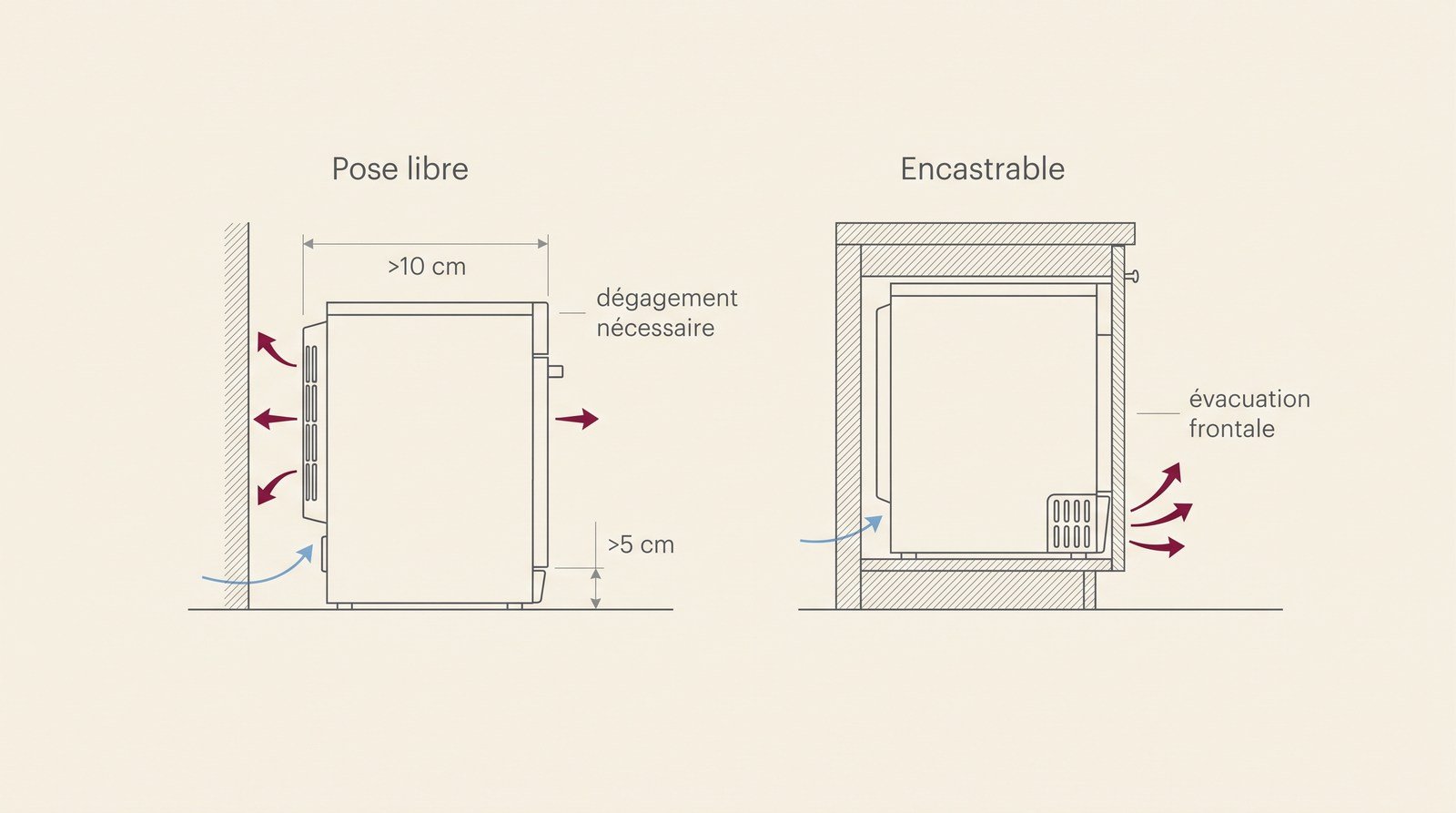
| Ventilation | Exhaust through the rear and sides: sufficient clearance is required around the unit (see the manufacturer's instructions) | Front-facing exhaust, low-profile: can be flush-mounted in a cabinet, provided that the front grille remains completely unobstructed | Depends on the model chosen; a built-in unit is practically a must |
| Construction | None | None if the niche is already there; otherwise, cut out a section of the cabinet | Carpentry, and sometimes electrical work |
| Total cost | The lowest | A more expensive device for the same volume | The highest (appliance + carpenter) |
| Reversibility | Total: Things Are Moving Along | Well, if the niche remains standard | Low: The niche is on the sides of the device |
| Rendered in a living room | A piece of furniture that's on display—and should be embraced as such | Seamless design, blending seamlessly with the furniture | Seamless integration, "custom-made furniture" look |
| Who is it for? | Renter, on a tight budget, looking to spruce up the basement | Already furnished living room, existing bookcase or low cabinet | Comprehensive development project; renovation in progress |
Why are freestanding refrigerators never built into a cabinet?
This is the most common—and most costly—mistake. A freestanding wine cooler dissipates heat through the back or sides. If you enclose it in a custom-built cabinet, it reheats its own exhaust air. As a result, it runs continuously, consumes more energy, wears out faster, and eventually can no longer maintain the desired temperature. The wine, meanwhile, is subjected to these temperature fluctuations.
And here’s the deciding factor: installing a freestanding appliance as a built-in unit voids the warranty with most manufacturers. Not only do you lose performance, but you also lose your recourse.
The minimum clearance requirements vary from manufacturer to manufacturer. They are listed in the instruction manual; they are there to be followed, and no DIY solution can replace them. If your project requires an enclosed enclosure, choose a built-in model that vents air through the front panel. That is exactly what it is designed to do.
Where exactly should you install a wine cooler in a living room?
Once you've decided on the type of layout, there are still a few placements that actually work well in a living room.
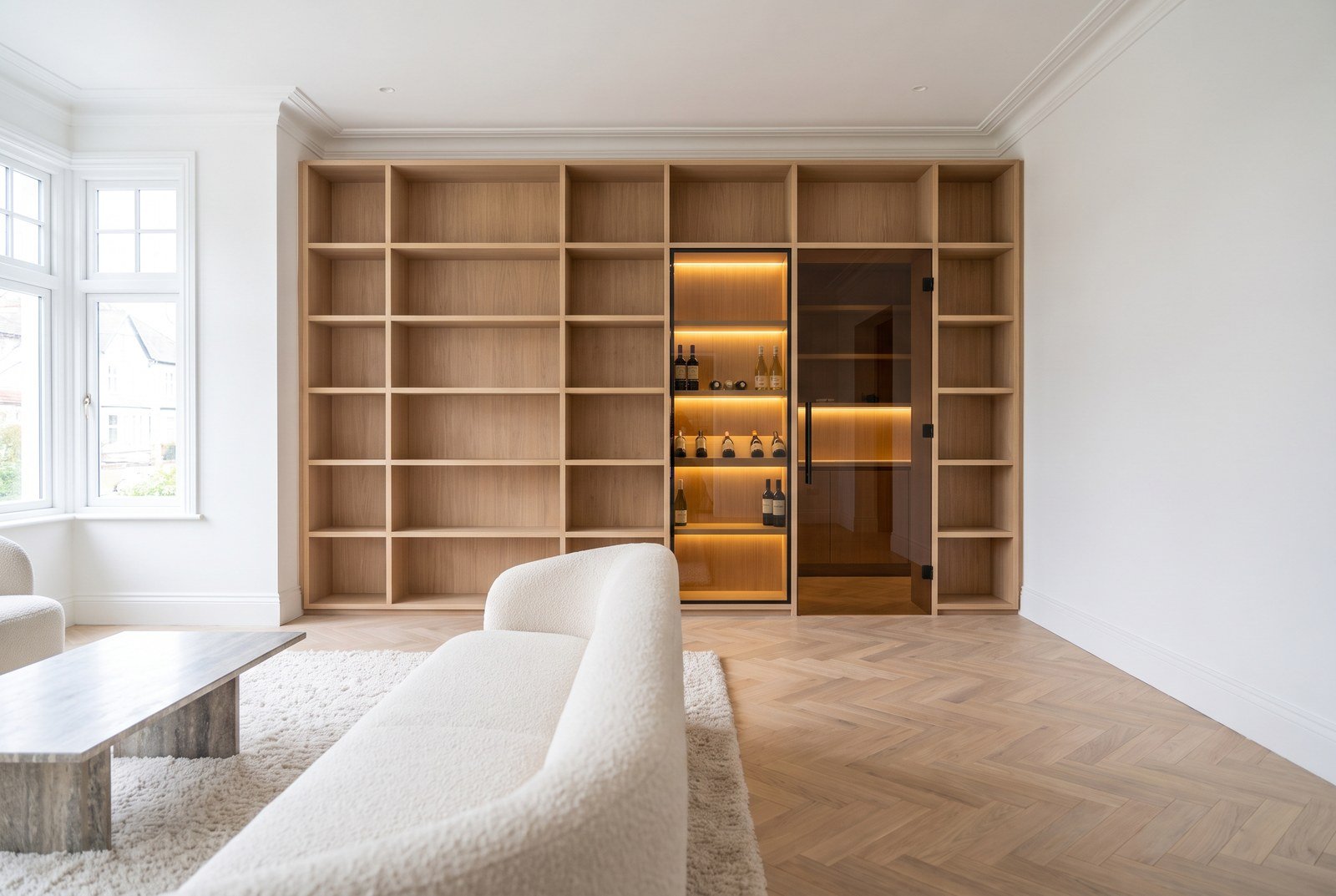
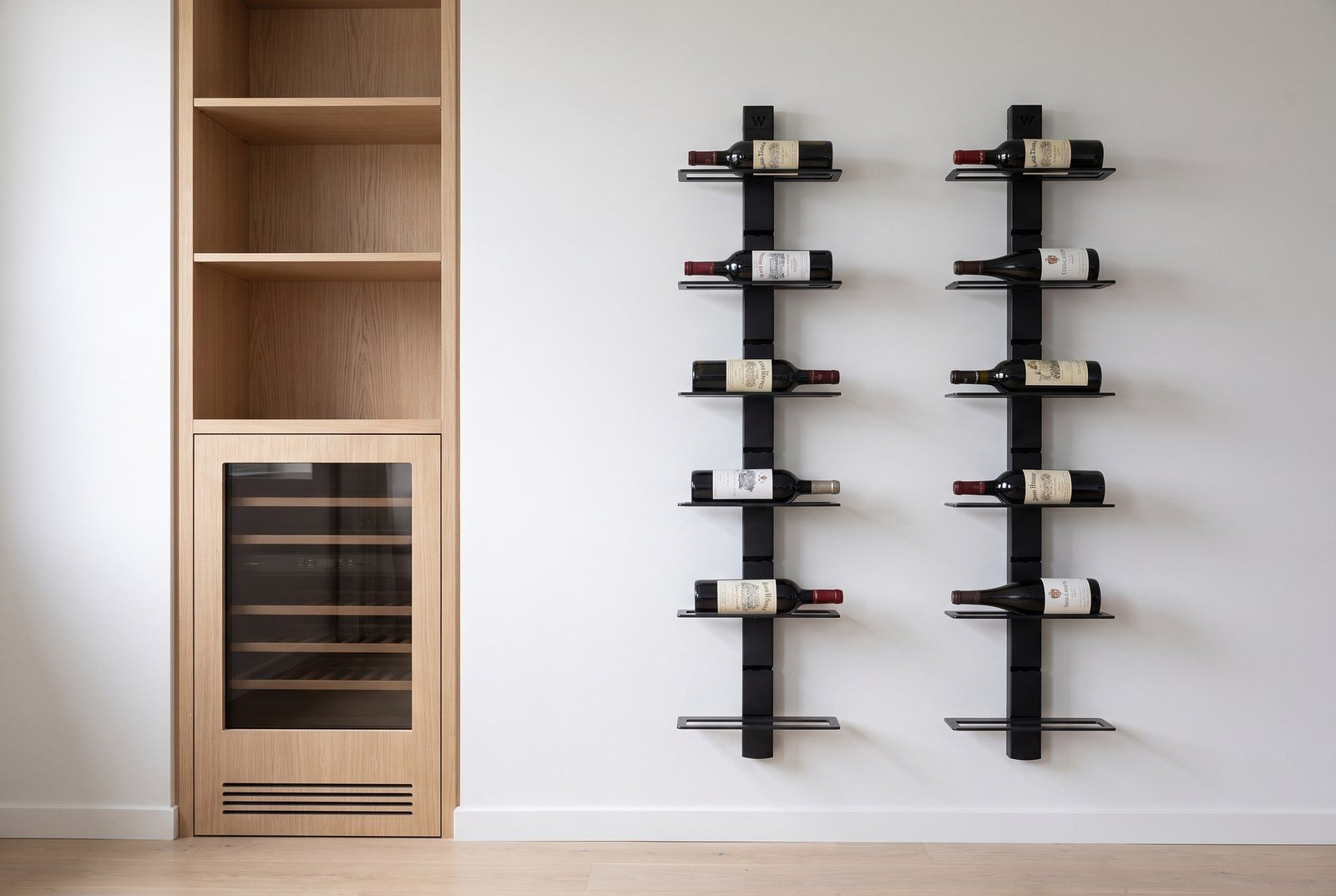
In a bookshelf or existing low cabinet. The classic option. A built-in wine cooler takes the place of a cabinet compartment, the line of the furniture remains unbroken, and the appliance blends seamlessly into the unit. Check the available depth before buying—that’s often where things get tricky.
At the end of the TV stand, or in a corner. The wall perpendicular to the sofa offers a good balance between visibility and sound distance. You can see the soundbar, but you hear it much less clearly.
In an existing niche. An old duct, a wall recess, or under a staircase that opens onto the living room. These unused spaces make excellent locations, provided you take ventilation seriously.
Against an interior wall, never against an exposed exterior wall. A shared or partition wall remains more temperature-stable than a wall that is exposed to the sun all day.
One thing people consistently overlook: the outlet. Make sure you have a grounded outlet that remains accessible once the wine cooler is installed. Manufacturers advise against using extension cords and power strips, and an extension cord snaking under the rug is neither elegant nor safe.
Then there’s the issue of space. A floor-level wine cellar takes up floor space, and in an apartment, floor space is a scarce resource. That’s often where the wall comes into play: a modular wall-mounted wine rack frees up floor space and makes use of vertical space that no one else is using. We’ll come back to this later, because it serves a different purpose.
How can you avoid the “refrigerator effect”?
A wine cooler in a living room is still a household appliance. It has a door, a handle, and a control panel. Three design elements that help it blend into the room.
Framing. A wine rack standing alone against a large empty wall looks out of place. When framed by a piece of furniture, a bookcase, or a piece of woodwork, it becomes a design element.
Material continuity. Black, stainless steel, or glass doors: choose based on what’s already in the room, not on what looks nice in a photo on the manufacturer’s website. In our opinion, matte black is the easiest finish to coordinate.
Light. The interior lighting of a glass-fronted display cabinet is a real decorative asset in the evening. Use it as a focal point of light, just like a lamp, not as a constant neon light.
A wine cellar for aging or for serving?
Do you really need a wine cellar for aging wine if you plan to drink the bottles within the year?
Not all of your bottles serve the same purpose. Some are meant to age: they need a stable temperature of around 12 °C, darkness, a humidity level of around 70% to keep the cork moist, and a quiet environment. That’s exactly what a single-zone, constant-temperature aging cellar is designed to do. No piece of furniture, no shelf, and no storage solution can do this job for it.
The others—you’ll open them. Within the week, the month, the season. The summer rosé, the two bottles brought back from a vineyard, the ones we keep within reach for friends who drop by. Those bottles don’t need an aging system. A serving wine cellar, on the other hand, features several zones at different tasting temperatures: that’s a whole different ballgame. And very often, these bottles mainly need to be visible, accessible, stored on their sides to keep the cork moist, and arranged so they aren’t forgotten at the bottom of a case.
This distinction solves many layout problems. A 100-bottle wine cooler in a living room—40 of which will be consumed within six months—means you’re paying for refrigerated space you’re not using. A more compact wine cooler for aging, supplemented by wall-mounted display shelving for bottles to be served, takes up less floor space and is easy to survey at a glance.
Can a wall-mounted storage unit complement a wine cellar?
Let's just put it out there. A wall-mounted wine rack doesn't keep wine cold. It doesn't regulate humidity. It doesn't filter light. It's no substitute for a wine cellar, and no one should try to sell you on the idea that it is.
What it does very well: it stores bottles on their sides, with the labels facing forward, in a vertical space that doesn’t take up any floor space. On an interior living room wall, out of direct sunlight, it makes an excellent serving station.
The Wine Line® system is a modular wall-mounted wine rack made of 2 mm steel: 118 cm high, 30 cm wide, and only 14.8 cm deep, holding up to 22 bottles per module with double shelves. The shelves snap into place without tools and can be repositioned as your collection changes. One person is all it takes to install it; a drilling template is included.
View the complete lineup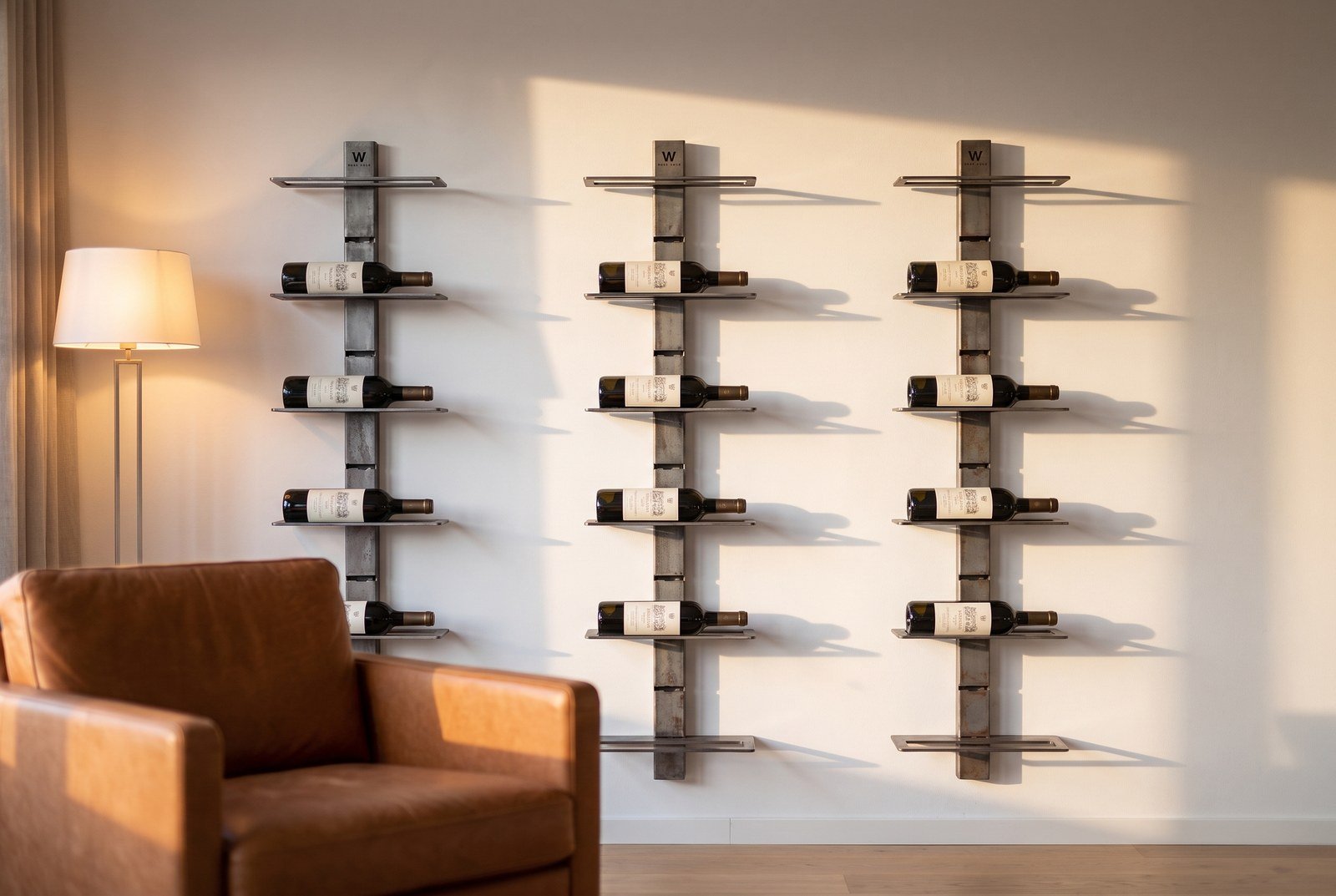
Frequently Asked Questions
Can you put a wine cooler in an unheated room?
It depends on the unit’s climate class. A garage, pantry, or laundry room where temperatures drop very low in the winter may fall outside the manufacturer’s specified operating range. Some models do not handle low ambient temperatures well because they lack a built-in heating system (the so-called “winter mode”). In a house, a heated living space is more predictable than an uninsulated garage.
Can you install a wine cooler next to a radiator?
No. Any nearby heat source (radiator, fireplace, oven, exposed window) forces the unit to constantly compensate. Move it, even if only a few dozen centimeters, or move it to a different wall.
How long should you let a wine cooler sit before plugging it in?
After transport, leave the unit standing upright and turned off until the compressor oil—which may have migrated into the system during transit—returns to the oil pan. Plugging it in too soon will cause the compressor to start up with insufficient lubrication. The exact duration varies by manufacturer; it is specified in your model’s manual, and that is the only source you should follow.
Can you hide a wine cooler behind a closet door?
No, unless it’s a model specifically designed for that purpose. A standard built-in model vents air through a grille at the bottom of the front panel: a solid cabinet door in front of it blocks this grille just as effectively as a closed cabinet stifles a freestanding range. To disappear completely behind a cabinet front, you need a built-in model—known as a “decorative door”—designed and ventilated to accommodate a front panel.
Wine Cellar in an Apartment: What Precautions Should You Take?
Space and noise are the two real constraints. Choose a model with a low noise rating, an interior wall rather than a glass-fronted one, and a reasonable capacity: it’s better to have a small, well-placed wine cellar than a large unit crammed into a hallway. Wall-mounted storage is the best option for service bottles.
Do you need a wine cellar if you drink your bottles within a year?
Honestly, not always. A wine that’s meant to be opened in the coming months mainly needs a cool, dark, and stable place—not a wine aging machine. Save that investment for the bottles that deserve it.
A wine collection that grows at your own pace.
Modular wall-mounted shelves in raw or lacquered steel. Holds up to 22 bottles per module, 2-year warranty, free shipping on orders over €350.
Explore the collectionExcessive alcohol consumption is harmful to your health. Please drink responsibly.