
How to Set Up a Wine Bar at Home: Storage, Decor, and Practical Tips
One meter of wall space, 30 cm wide per module, and you already have enough room to store a year’s worth of wine for tastings. Most home wine bars fall short on this very point: you spruce up the counter, line up the glasses, and the wine ends up in a box under the stairs. Here, you’ll see just how many bottles a wall can actually hold, how much they weigh, how to store them without knocking everything over, and at what temperature they remain drinkable.

What sets a real wine bar apart from a bar area?
A bar area has everything you need: gin, whiskey, syrups, a shaker. A wine bar is home to a living substance that hates three things: heat, direct light, and vibration. Place your bottles on top of a radiator or against a south-facing window, and your finest bottle will be ruined before you even open it.
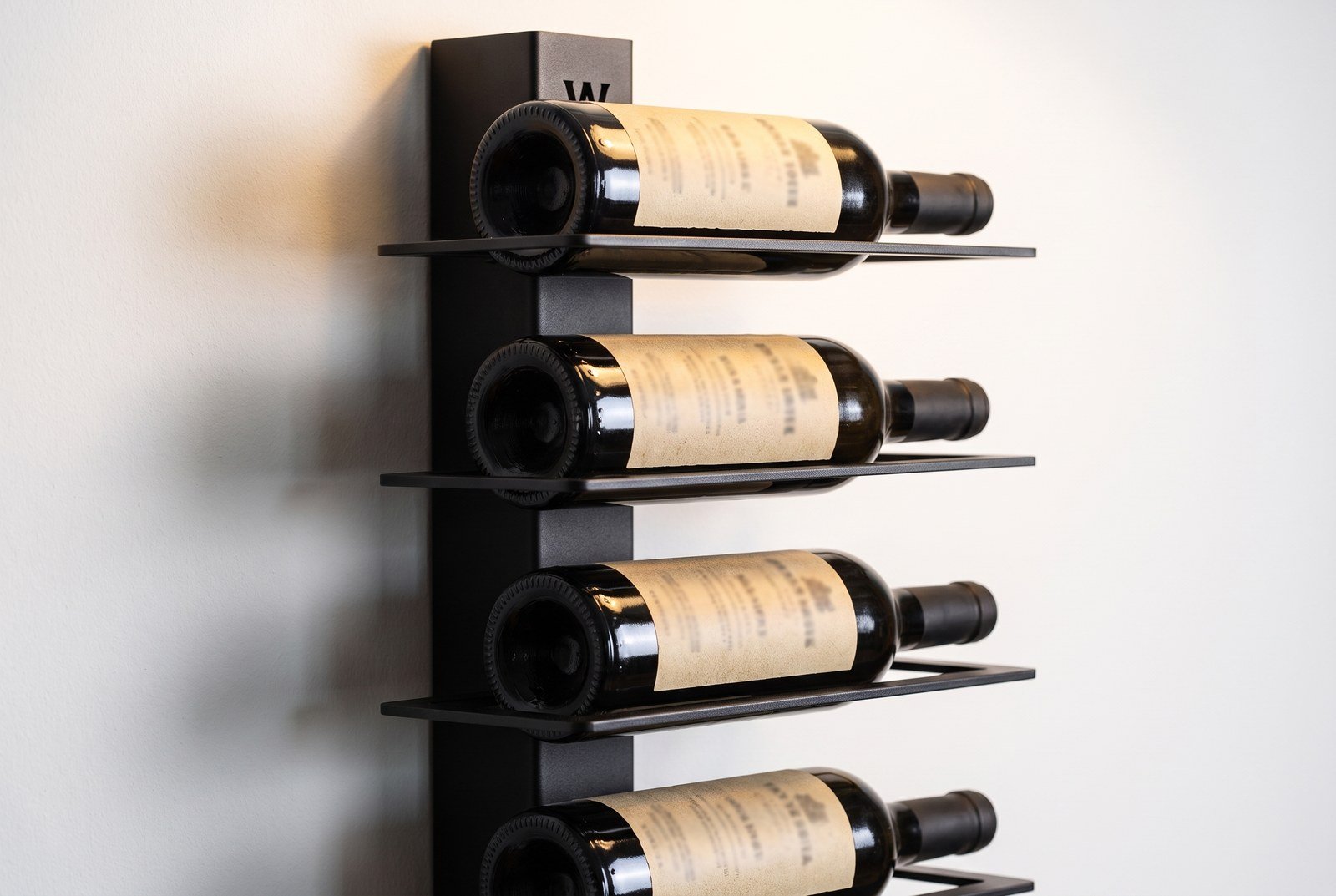
The other difference is visual. In a traditional bar, the bottles are on display. In a wine bar, the labels are on display. That’s what makes a wine cellar easy to navigate: being able to see at a glance what you have, what’s reaching maturity, and what you should drink this month.
Why go with a wall of bottles?
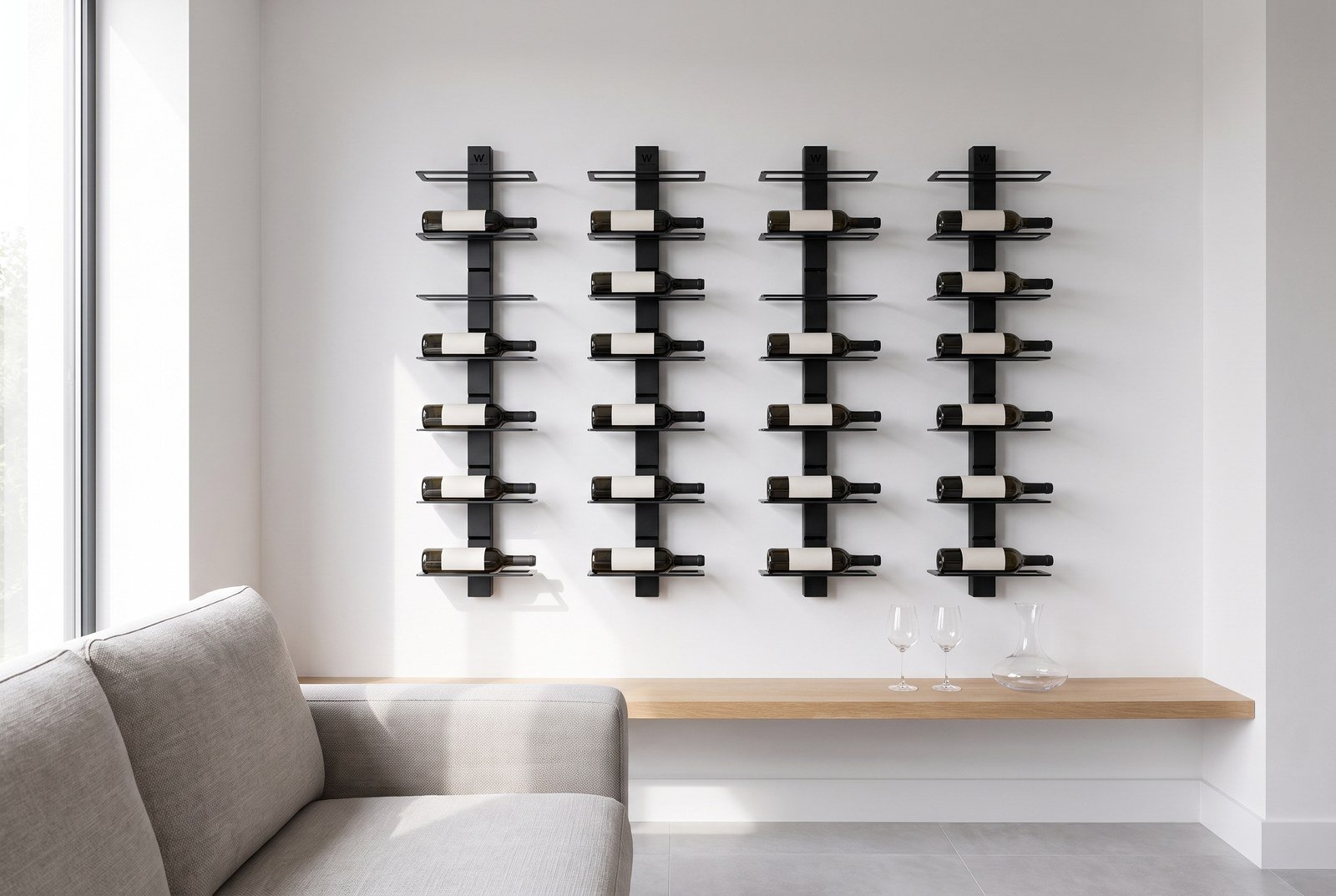
This is the key feature. A bulk wine cellar is hidden away, while a wall of bottles takes shape. And unlike a wine cabinet, it doesn’t take up floor space: the Wine Line® system is just 14.8 cm deep—less than a bookshelf.
Before drilling, do two calculations, not just one. The first one, which everyone does, is how many bottles. The second one, which almost no one does, is how many kilograms. One module is 118 cm high by 30 cm wide, offers 11 single-shelf spaces and 22 double-shelf spaces, and the manufacturer specifies a maximum load of 25 kg per module.
However, a full 75-cl bottle weighs between 1.2 and 1.6 kg, depending on the thickness of the glass. In other words, 25 kg is equivalent to 15 to 20 bottles, not 22. An available slot is never a guarantee of the maximum load capacity: it’s the manufacturer’s specified limit that determines the load, not the number of slots.
How many bottles are on your wall, and how many kilos?
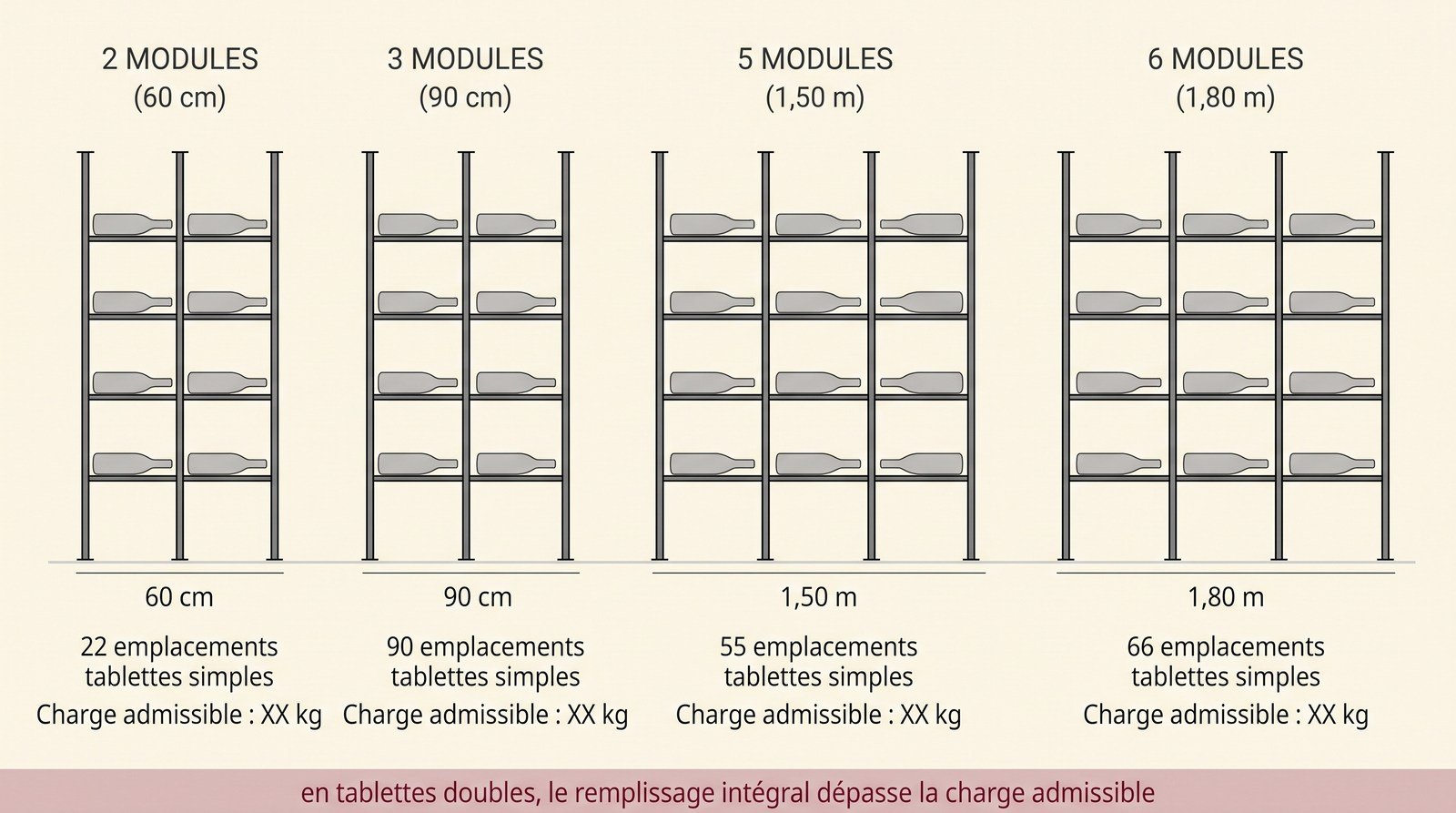
The table below shows both pieces of information side by side. This allows you to see, line by line, where the theoretical capacity is limited by the load.
| Width Occupied | 30-cm modules | Pitches (single / double) | Weight when filled to 75 cl (single / double) | Rated Load |
|---|---|---|---|---|
| 60 cm | 2 | 22 / 44 | 26 to 35 kg / 53 to 70 kg | 50 kg |
| 90 cm | 3 | 33 / 66 | 40 to 53 kg / 79 to 106 kg | 75 kg |
| 1,50 m | 5 | 55 / 110 | 66 to 88 kg / 132 to 176 kg | 125 kg |
| 1,80 m | 6 | 66 / 132 | 79 to 106 kg / 158 to 211 kg | 150 kg |
There are two possible interpretations.
With standard shelves, you're in the clear with any configuration: the load remains well below the specified limit, even with heavy glass bottles.
With double shelves, a fully stocked rack exceeds the weight limit. A six-module wall stocked with 132 bottles weighs 158 to 211 kg, compared to the advertised 150 kg. Double shelves are therefore meant to increase the density in part of the wall, not to fill it from top to bottom: mix up the sections, leave some space, or reserve the double shelves for half-bottles and lighter-weight bottles. And in any case, never exceed the maximum load specified by the manufacturer.
Finally, two installation considerations. The widths listed above are the spaces occupied by the modules, with no clearance: allow a few millimeters between each structure, so the wall should be slightly wider than the total. And don’t forget the weight of the steel structure itself, which adds to the weight of the cylinders.
Which wall supports what?
A wall full of bottles weighs between 100 and 200 kg hanging from a vertical surface. Check the wall’s structure before drilling the first hole.
- Concrete, solid brick, stone: the most secure substrates, requiring anchors suited to the material (expansion anchors or chemical anchors for crumbly substrates). On the other hand, hollow brick, hollow concrete blocks, and plasterboard are not “no-prep” substrates: they are hollow, so a standard anchor will not hold, and specific anchors or chemical anchors are required.
- Solid wood, 22 mm OSB: also excellent, and much faster.
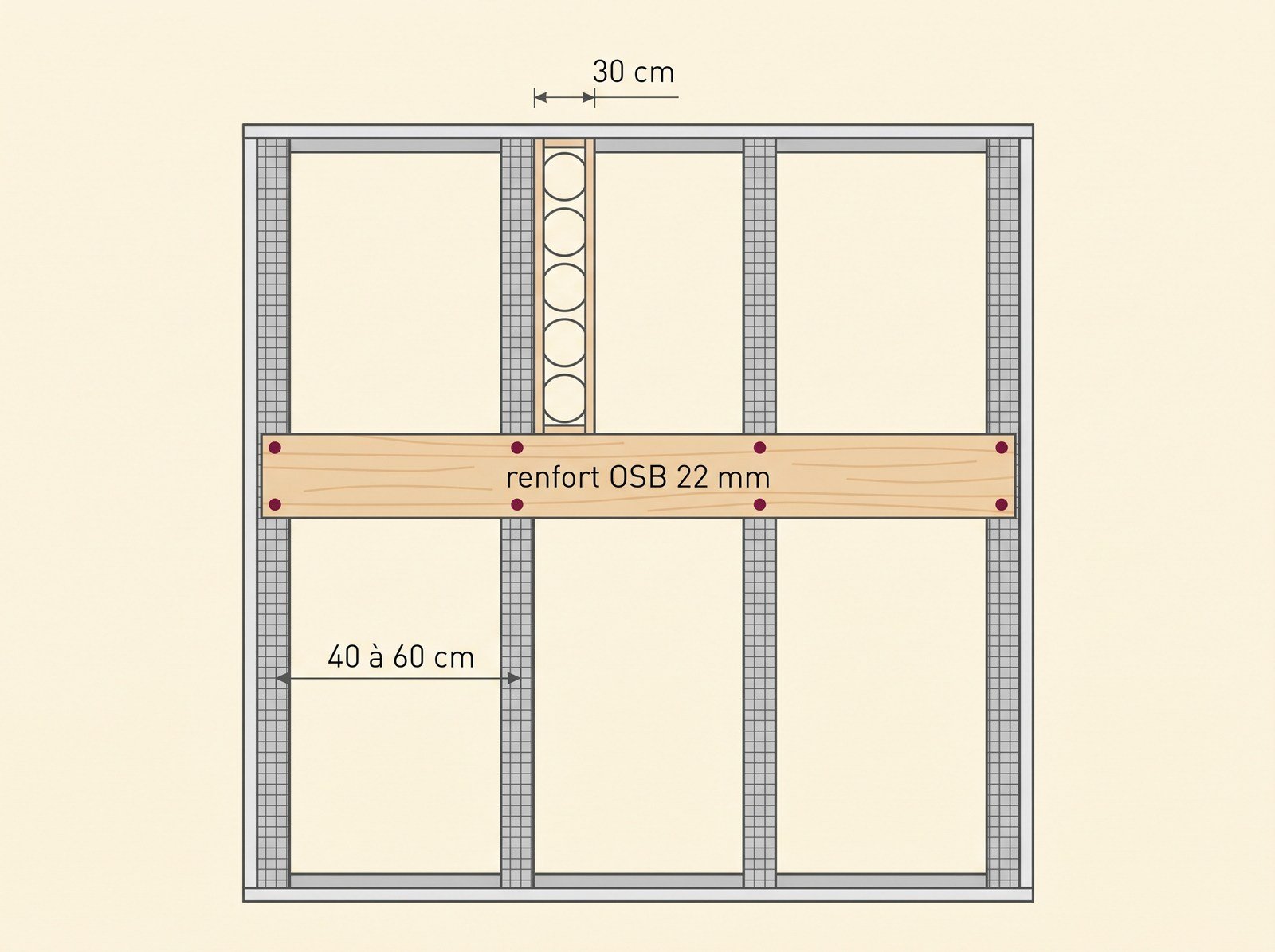
- Standard drywall: the weak link. A heavily loaded shelf is cantilevered, and it’s the pulling force that causes it to fail, not the raw weight. Don’t rely on wall anchors alone. First, screw a 22-mm OSB or plywood brace into the studs of the framing, then secure the structure to it. Avoid MDF, which swells and loses its screw-holding strength as soon as the air becomes humid.
- Pay attention to the stud spacing. The studs in a partition wall are spaced 40 or 60 cm apart; a module is 30 cm wide. There’s no guarantee that it will line up with a stud. That’s exactly what the reinforcement is for: to span at least two studs and distribute the load rather than concentrating it on a single sheet of drywall.
- Damp areas (cellar, basement, pantry): opt for a lacquered finish. Raw steel, on the other hand, develops a patina that changes over time, which looks beautiful in dry conditions but is less appealing in a humid room.
Installation is done using 5 × 50 mm screws, with a drilling template provided. Maximum load: 25 kg per module, including the structure. Distribute your bottles evenly; do not overload a single structure just because it looks sturdy. And for a wall holding several dozen bottles, as soon as the total weight exceeds 100 kilograms or if you have even the slightest doubt about the wall’s structure, have a professional inspect and approve the mounting. At that weight, it’s no longer a DIY project.
Visible label
Visible labels are a key feature of a wine bar. You sacrifice a little storage density, but you gain an immediate overview of your wine collection, and you can handle each bottle without disturbing the five above it. For bottles you’ll drink within the year—the ones you reach for every week—the label should be showcased.
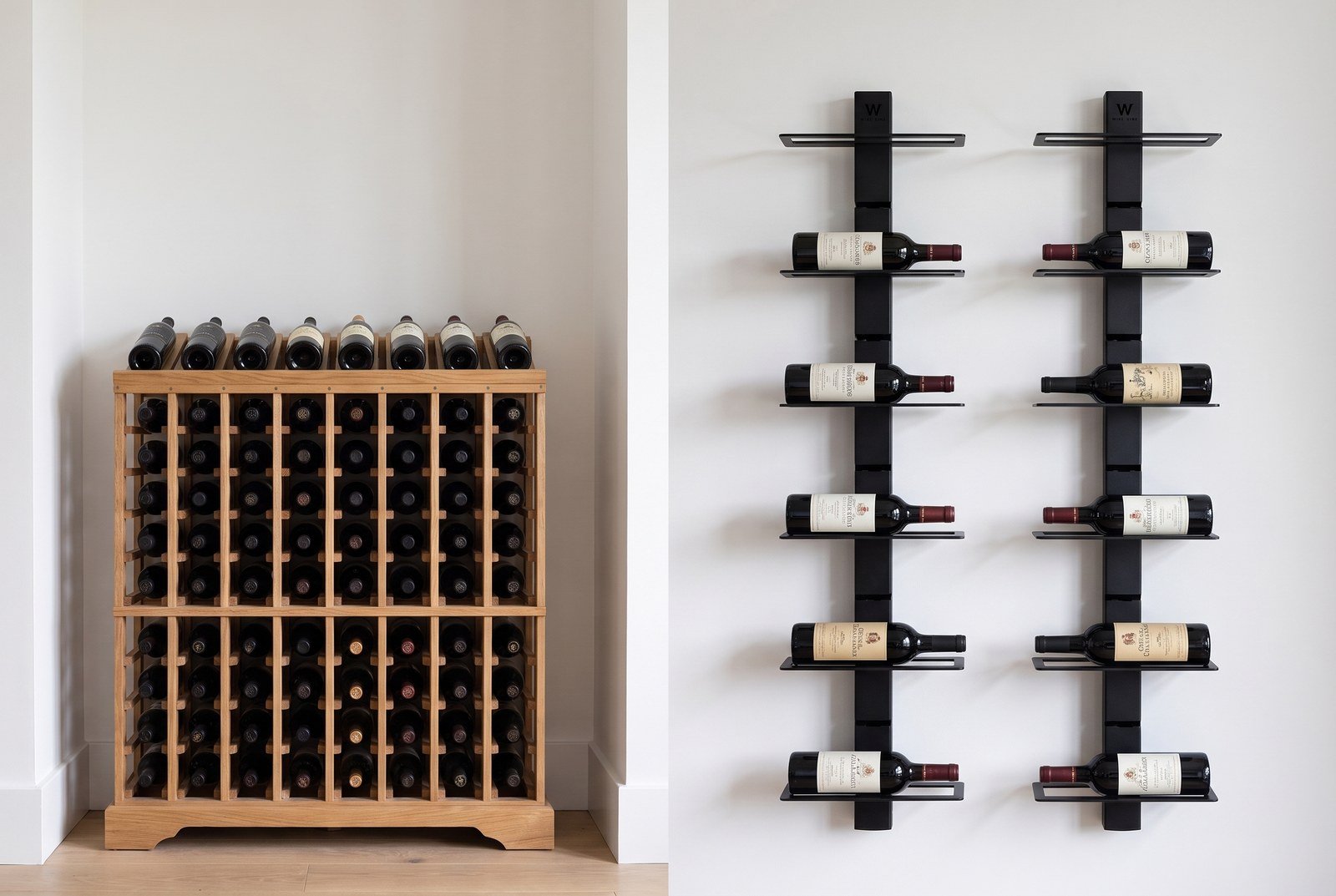
The Wine Line® system is 30 cm wide, can be placed side by side as many times as your wall allows, and its shelves clip into place without tools: you start with 11 compartments and can expand without replacing anything, up to the specified weight limit.
View the entire line of wall-mounted wine racksHow do you store wine in a wine rack at home?
A wine bar isn’t a climate-controlled wine cellar—and that’s just fine. But you still need to know what to put in it. First, a word about terminology, because it’s often used incorrectly: a serving cellar is a temperature-controlled space that brings bottles to their optimal serving temperature, around 8 to 18 °C depending on the wine. A wall of bottles in a living room at 21°C is not a wine cellar. That’s storage at room temperature, which is perfect for wines you’ll drink right away, but a deal-breaker for those that need to age.
| Wine cellar | The wall of your bar (room-temperature storage) | |
|---|---|---|
| Role | To age | Have on hand |
| Temperature | 12 to 14 °C, stable above all | Room temperature, 18 to 22 °C |
| Horizon | Several years | A few weeks to a year, but no longer than that |
| What goes into it | Wines with long aging potential, full-bodied wines, vintages worth waiting for | Bottles to drink within the year |
| Storage | Bottles stored on their sides, deep inside | Wall sign, facade label |
| Main Enemy | Temperature differences | Oblivion, and the warmth of the living room |
So your wall is neither a long-term storage cellar nor a serving cellar: it’s for your short-term rotation. Bottles that need to age for ten years have no place in a living room at 21 °C. Whites, rosés, and champagnes can stay there for a few weeks, but they’re the most sensitive to heat and light: chill them before serving and don’t leave them for months on a lighted shelf.
Three simple precautions are all it takes. Keep the wine away from any heat sources (radiators, ovens, vents). Avoid direct light, especially from the south: a “taste of light” is a real flaw, and it affects whites and sparkling wines first and foremost. Finally, prolonged vibrations are thought to accelerate certain reactions, especially in wines meant for long-term aging; as a precaution, avoid placing the bottle against a wall shared with a washing machine.
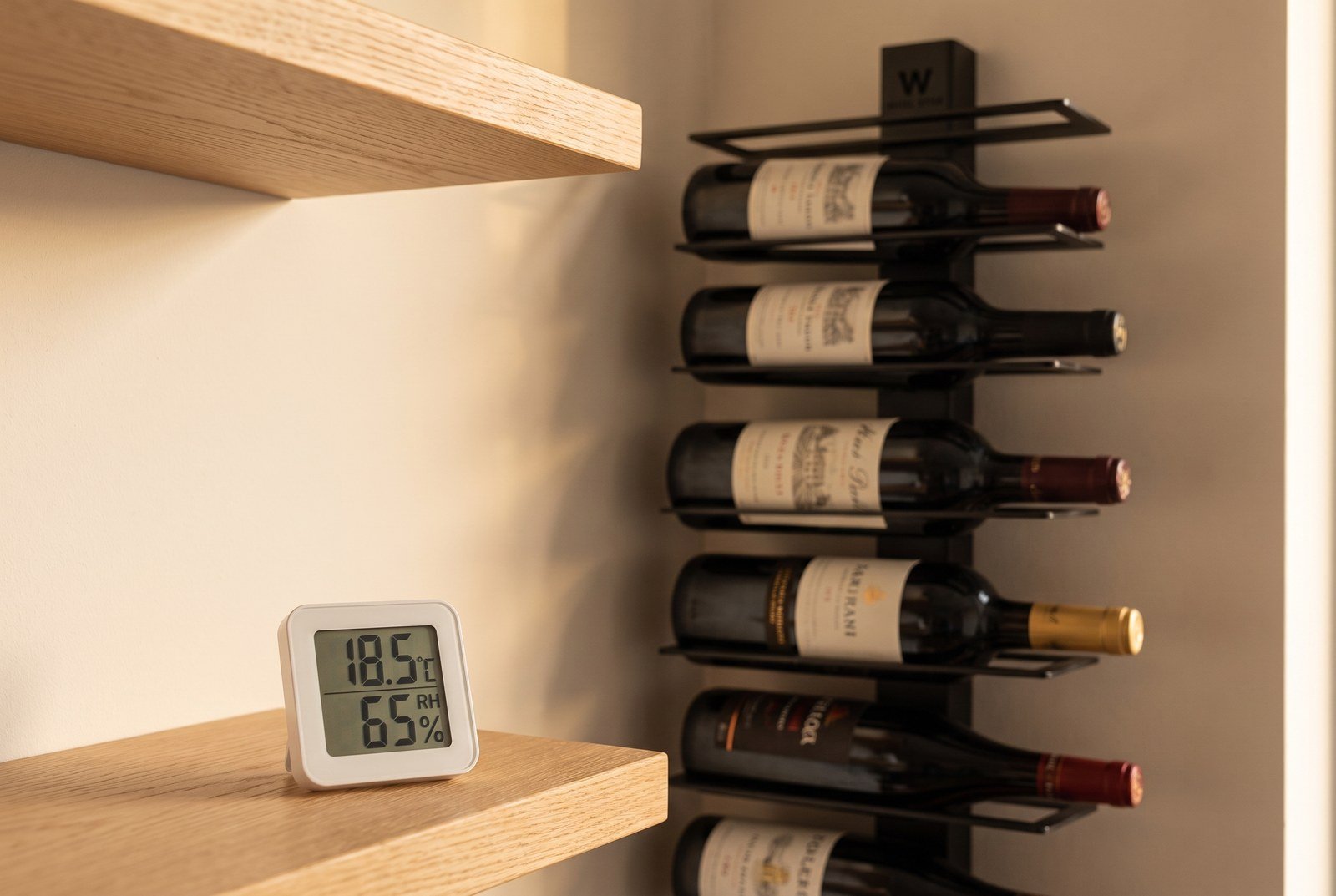
As for humidity, a living room is suitable for bottles meant to be drunk within the year. Over the long term, however, it’s a different story: a heated living room often drops to 30 or 40 percent humidity in the winter, which eventually dries out the corks. A damp cellar presents the opposite problem.
Bordelaise, Burgundian, or Magnum: What Sizes?
This is the objection that causes many storage purchases to fall through. Helpful details:
- Bordelaise: distinct shoulders, about 7.5 to 8 cm in diameter. The most common size.
- Bourguignonne: sloping shoulders, about 8 to 8.5 cm. Just one centimeter more, and many crates would already get stuck.
- Magnum: About 10 to 11 cm, 1.5 liters. The size that puts most store-bought containers to shame.
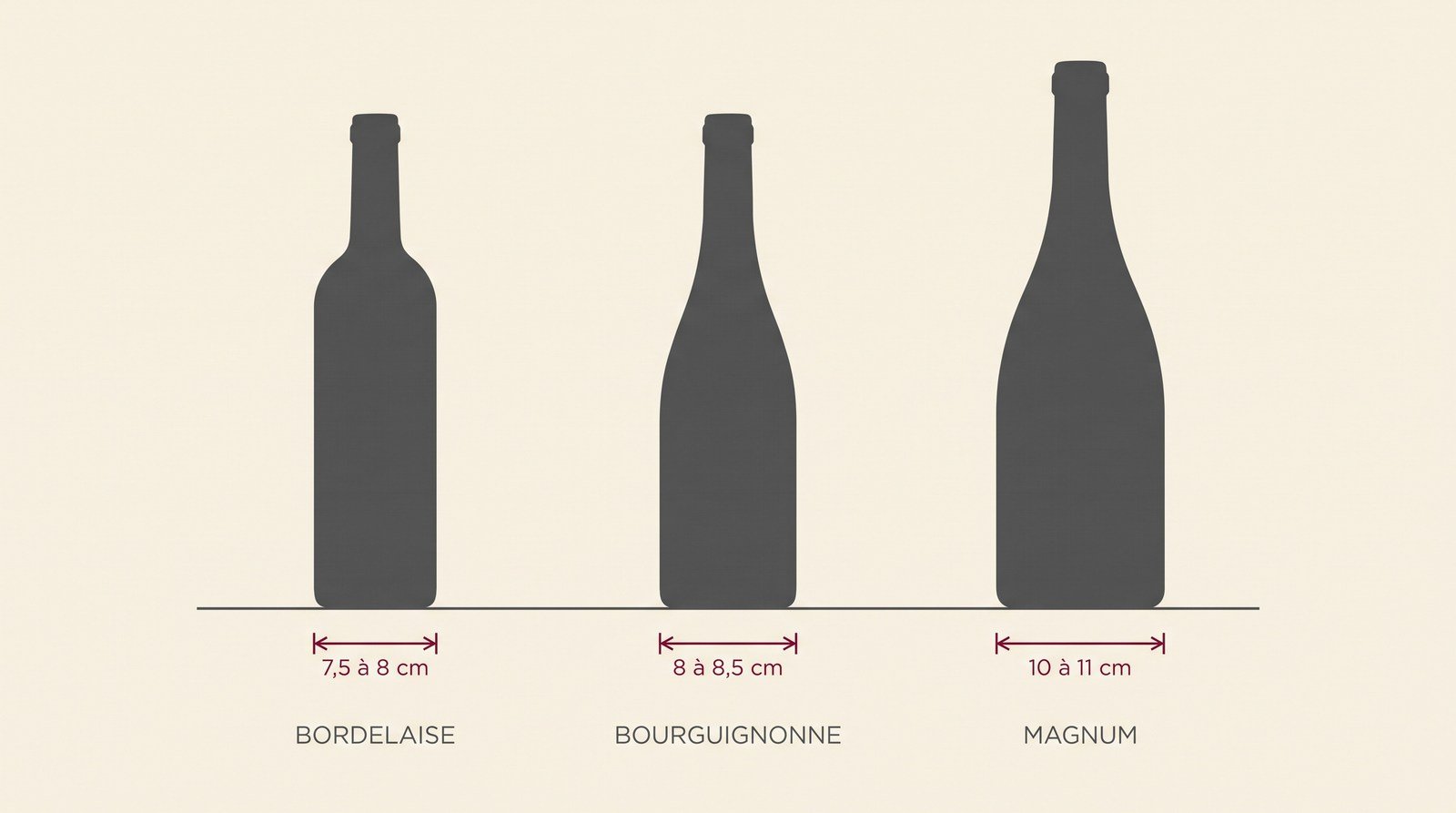
Check this before buying any bottle rack, and measure rather than relying on the size designation. A storage solution designed exclusively for Bordeaux bottles will leave you with no choice but to store your Burgundies upright on the counter and your magnums in their boxes. Wine Line® shelves accommodate everything from 75 cl bottles to magnums, and from champagne to spirits, as long as the bottle fits securely in the opening.
Here’s a tip for arranging the display that also applies to weight limits: don’t mix bottle sizes randomly. Group the magnums together in a single row, preferably at the bottom. A full magnum weighs nearly 2.5 kg, while a standard bottle of champagne weighs about 1.7 kg: a single row of large-format bottles can quickly reach a module’s weight limit. Count them separately.
How should I arrange the counter, the glasses, and the lighting?
Furniture matters, but it comes second.
A 40-cm-deep countertop is enough to hold two glasses, a carafe, and a corkscrew; a true bar counter, on the other hand, is typically around 60 cm deep. A rolling serving cart works very well in a small living room. For everything related to countertops, stools, and traffic flow, we’ve covered the topic in detail elsewhere: see “Creating a Bar Area at Home.”
Next, the glasses. A versatile set of tall-stemmed glasses will cover most uses. Store them out of the way of dust—never above a stovetop.
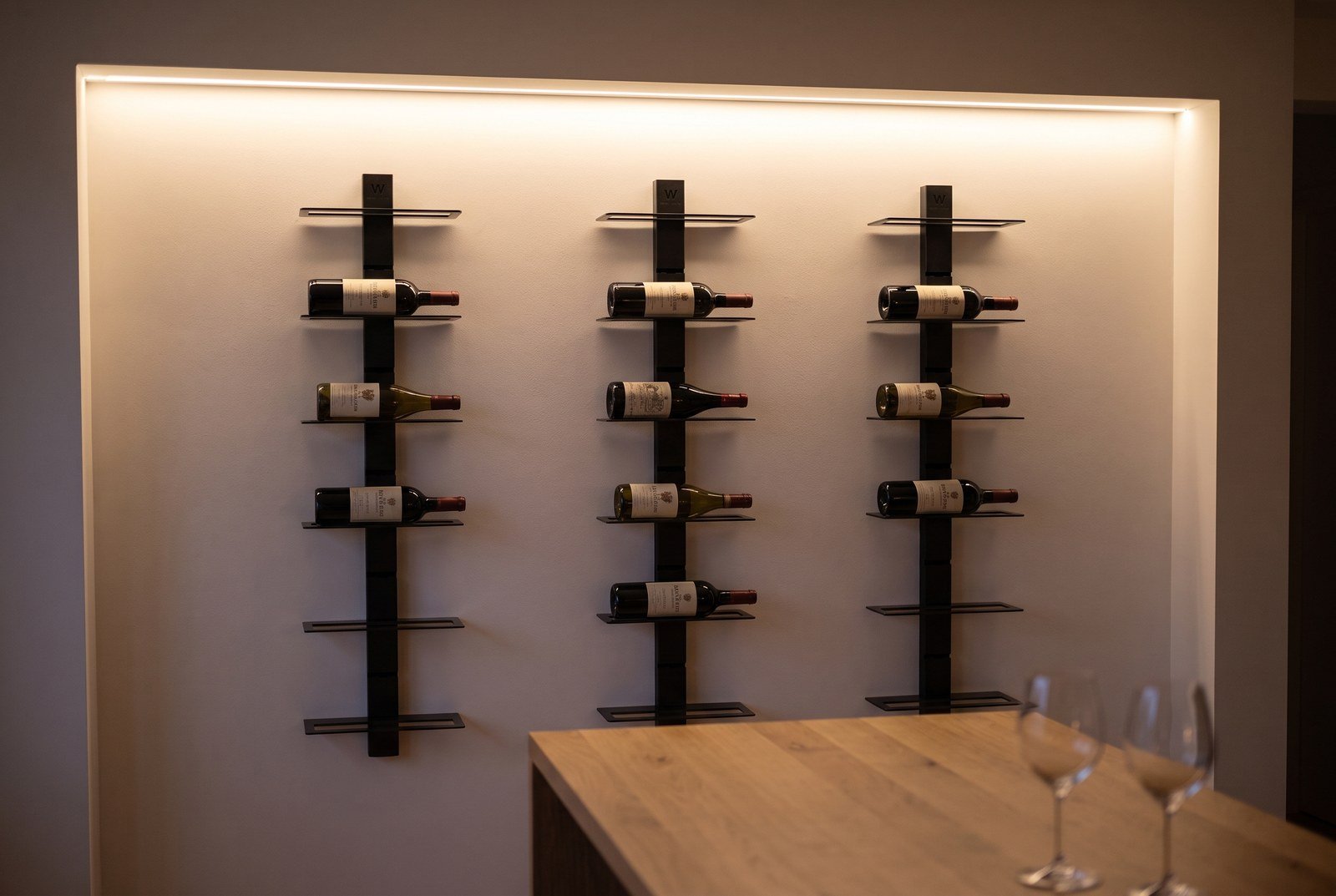
Finally, the lighting. There’s only one rule: the light should gently wash over the labels, not blind them. A low-profile LED strip at the top of the wall, angled downward. Warm, low-intensity light—never a powerful spotlight aimed directly at the glass.
How do you set up a professional wine bar?
The reasoning simply shifts to a different scale.
Behind the bar, the wall becomes a sales tool. A label that can be read from three meters away works in your favor. Place your current selection at eye level, between 1.20 m and 1.60 m above the floor: this is the area customers look at first and where the server can reach it without bending down.
Two challenges unique to professionals:
- Rotation. The menu changes, and new items arrive. A fixed shelving system forces you to reorganize everything every season. Clip-on shelves can be repositioned in seconds, without tools.
- Shelf space. Whether in a store or a room, the wall is often the only available surface. At 14.8 cm deep, it doesn't get in the way of foot traffic.
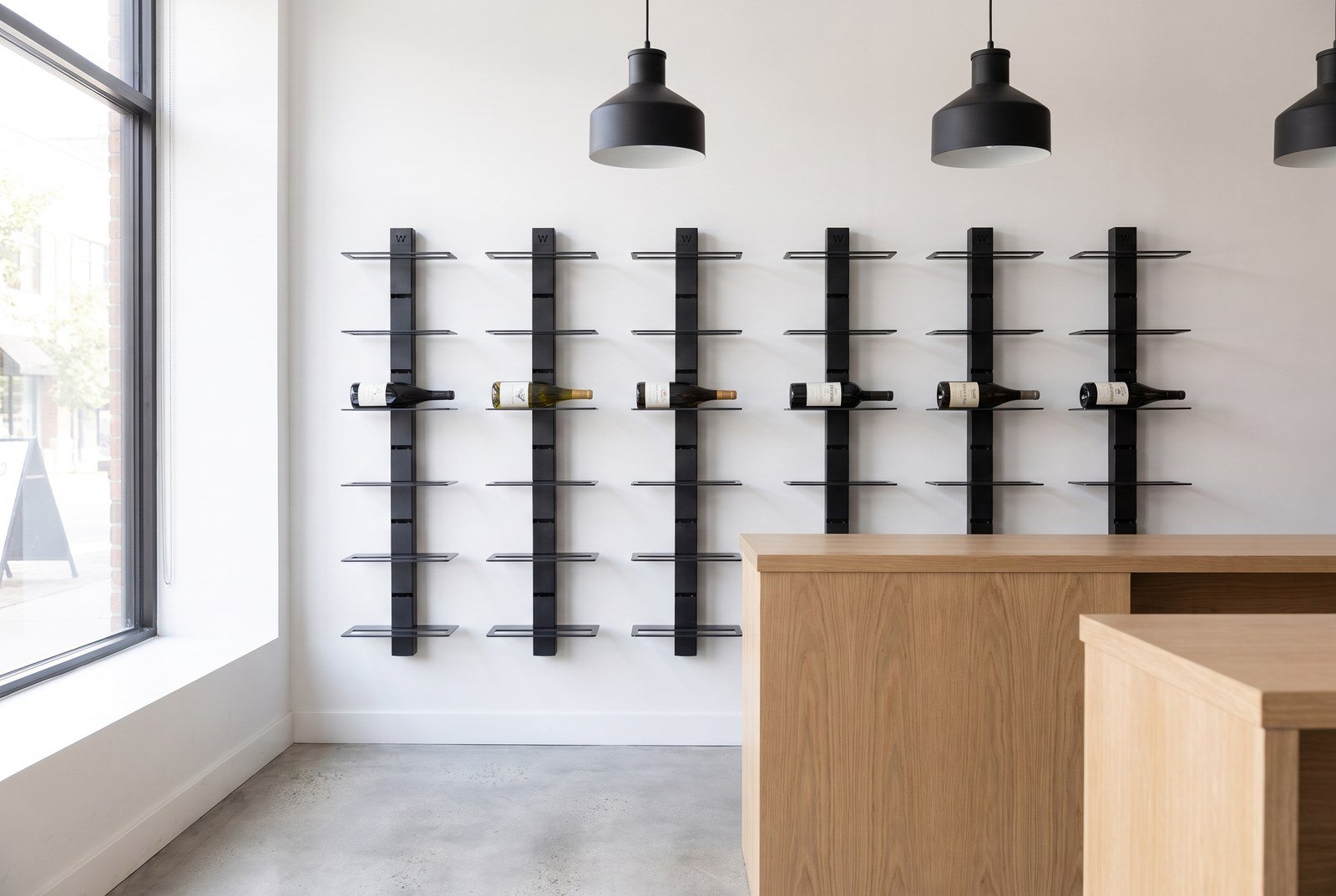
Modular structures, tool-free adjustable shelves, 2-mm steel, documented load capacity and drilling template: the system adapts to changing requirements.
Discover the Wine Line® SystemFAQ
How can you set up a wine bar at home when you're short on space?
Make use of the wall space. A wall-mounted storage unit that’s 14.8 cm deep keeps the floor completely clear, and its 60 cm width provides 22 single-shelf storage spaces. Check the weight limit before filling it: 22 full bottles weigh 26 to 35 kg. A rolling serving cart completes the setup without requiring any mounting.
Can you mount a wine rack on drywall?
Yes, but not directly. Screw a 22-mm OSB or plywood brace (not MDF, since it swells when exposed to moisture) across at least two studs in the framing, then secure the structure to this brace.
What's the best way to store wine?
It depends on how long you plan to keep it. For long-term storage, a wine cellar at 12–14 °C. For wine you’ll drink within the year, store it on a wall rack with the labels facing out: that way, you can see what you have and drink it at the right time.
Will a magnum bottle fit in a standard storage unit?
Rarely. A magnum has a diameter of 10 to 11 cm, compared to 7.5 to 8 cm for a Bordeaux-style bottle, and there is no standardized diameter. Always measure the opening before buying. Wine Line® racks accommodate them, taking into account their weight, which is nearly double that of a standard bottle.
What are some decor ideas for a great wine bar?
Focus on the material rather than the accessories. Raw steel develops a patina that changes over time and looks great on a light-colored wall or brick. Matte lacquer is well-suited to contemporary interiors and damp rooms. Your labels are what complete the look.
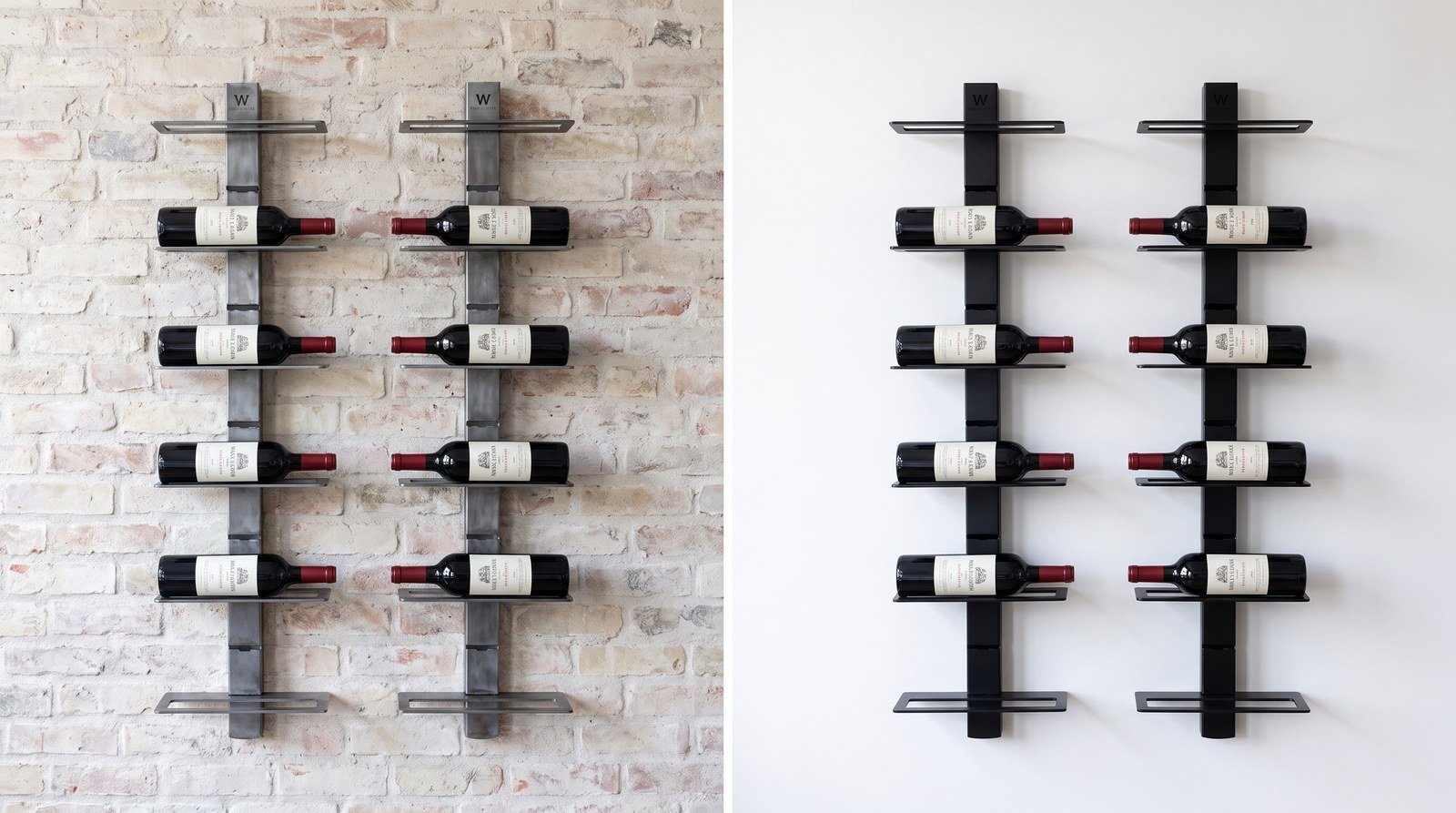
A wine collection that grows at your own pace.
Modular wall-mounted shelves in raw or lacquered steel. Holds up to 22 bottles per module, 2-year warranty, free shipping on orders over €350.
Explore the collectionExcessive alcohol consumption is harmful to your health. Please drink responsibly.