Storing magnums and large-format bottles: something most wine racks aren't designed for
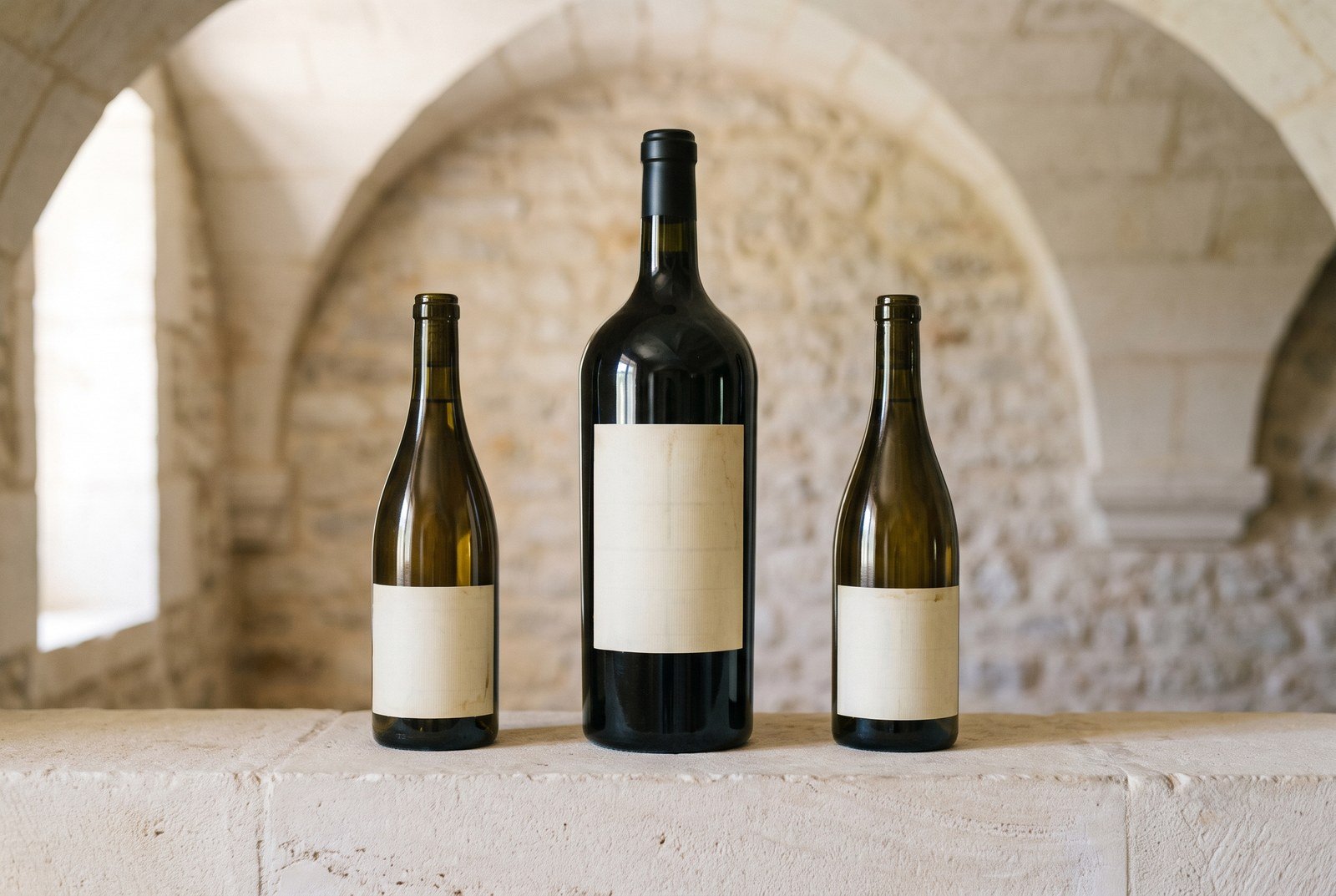
Your wine cellar is organized. Bordeaux wines lined up in rows, vintages labeled, every bottle within reach. And then there are these four: two magnums, a large-format bottle of champagne, and a bottle brought back from a winery. They’re standing in their box at the back of the garage, because no shelf will have them. It all comes down to a few centimeters in diameter, and no one has ever given you the exact measurement.
Why does wine last longer in a magnum bottle?
The neck of a magnum bottle is standardized to be the same as that of a 75 cl bottle: the same neck ring and the same cork in virtually all cases. However, oxygen enters through the cork in roughly the same amount regardless of the bottle size. In a magnum, this same amount of oxygen is distributed over a volume of wine that is twice as large, and the aging process occurs at about two-thirds the rate of a 75-cl bottle.
The second factor, which is less often mentioned, is thermal inertia. A larger volume of wine responds more slowly to temperature fluctuations in the room. Sudden temperature spikes are smoothed out. A large container can better withstand an imperfect storage environment than a 75 cl bottle.
These large containers are purchased to be stored, often for ten years or more. If you’re wondering which wines are worth storing, large-format bottles quickly come up in the conversation. These bottles won’t be moved for years. Storing them properly is no small matter in a wine cellar.
What Each Large Format Actually Contains
A wine's appellation alone isn't enough to identify it. You also need to know the region.
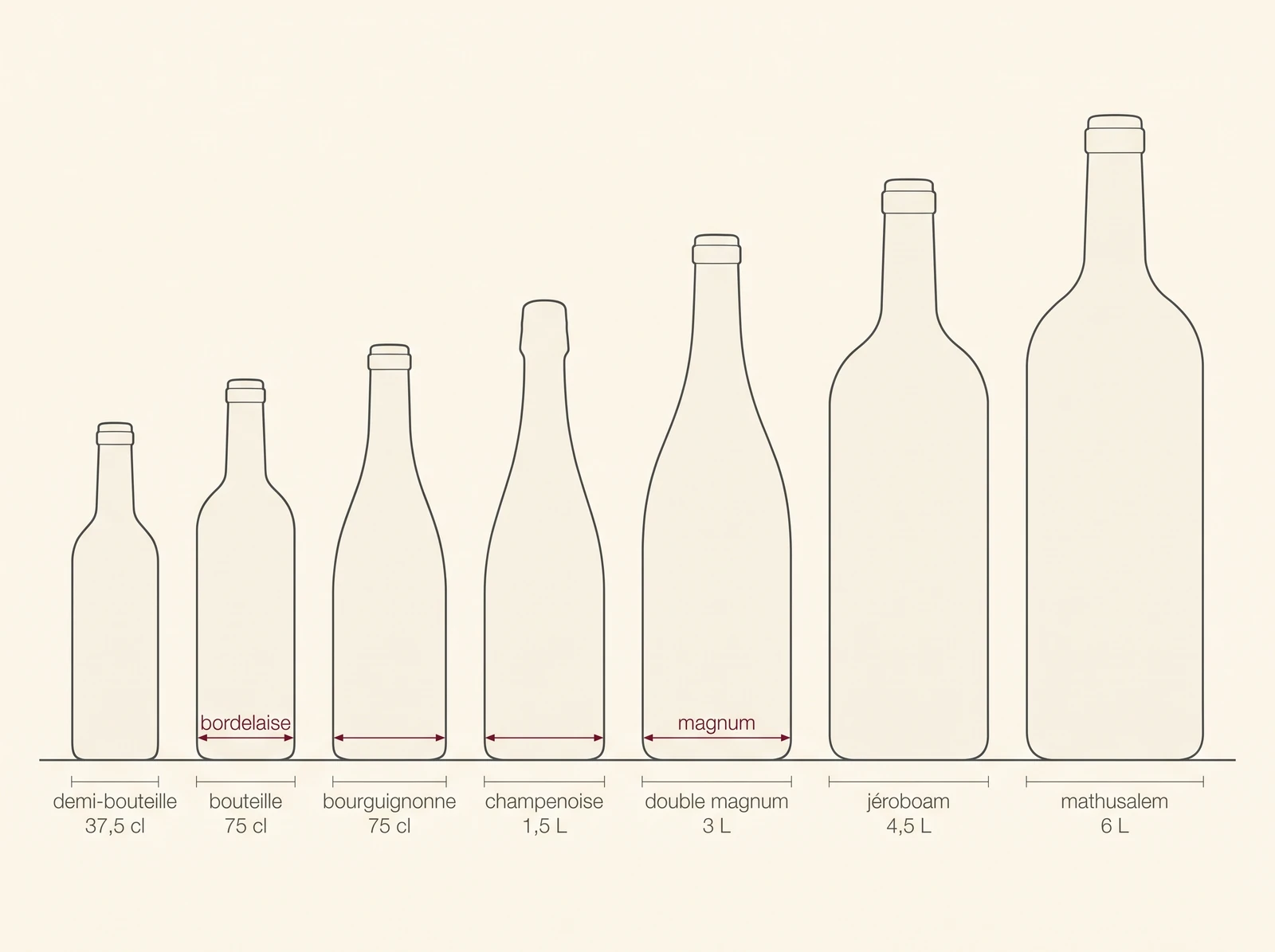
| Capacity | Surnames in Champagne and Burgundy | Name in Bordeaux | Equivalent to 75 cl | Glasses served (12.5 cl) | For which table? | Body Diameter |
|---|---|---|---|---|---|---|
| 37.5 cl | half-bottle | half-bottle | 0,5 | 3 glasses | A dinner for two | About 6 cm, up to 7 cm depending on the shape |
| 75 cl | bottle | bottle | 1 | 6 glasses | A dinner for four | 7.5 cm for Bordeaux-style wine, 8.5 to 9 cm for Burgundy-style and Champagne-style wines |
| 1,5 L | magnum | magnum | 2 | 12 glasses | A table of eight | About 10 cm in the Bordeaux style, up to 13 cm in the Burgundy or Champagne style |
| 3 L | Jeroboam | double magnum | 4 | 24 glasses | A family meal | About 12 to 13 cm |
| 4,5 L | Rehoboam | Jeroboam | 6 | 36 glasses | Twenty to twenty-five guests | About 14 to 15 cm |
| 6 L | Methuselah | imperial | 8 | 48 glasses | A banquet, a birthday | About 15 to 16 cm |
Three bottle sizes are the source of all the confusion. For 3 liters, Champagne and Burgundy call it a “jeroboam,” while Bordeaux calls it a “double magnum.” For 4.5 liters, what Champagne calls a “rehoboam” is called a “jeroboam” in the Gironde region. At 6 liters, the Champagne “Methuselah” is called an “impériale” in Bordeaux. Ordering by name alone, without specifying the region, means you won’t know what you’ll receive.
Two caveats. Beyond the magnum, there are no standards governing the body diameter: the last three values are just orders of magnitude. And some Bordeaux châteaux bottle their jeroboams in 5-liter bottles, not 4.5-liter ones. All the more reason to specify the capacity in liters before determining any dimensions.
Standard serving size: 12.5 cl—this is the standard serving size for still wine in restaurants. For champagne, served in a 10-cl flute, allow for an additional quarter of a glass.
Next come the Salmanazar, the Balthazar, and the Nebuchadnezzar—banquet wines that one rarely keeps at home.
Does your current wine rack accommodate a magnum bottle?
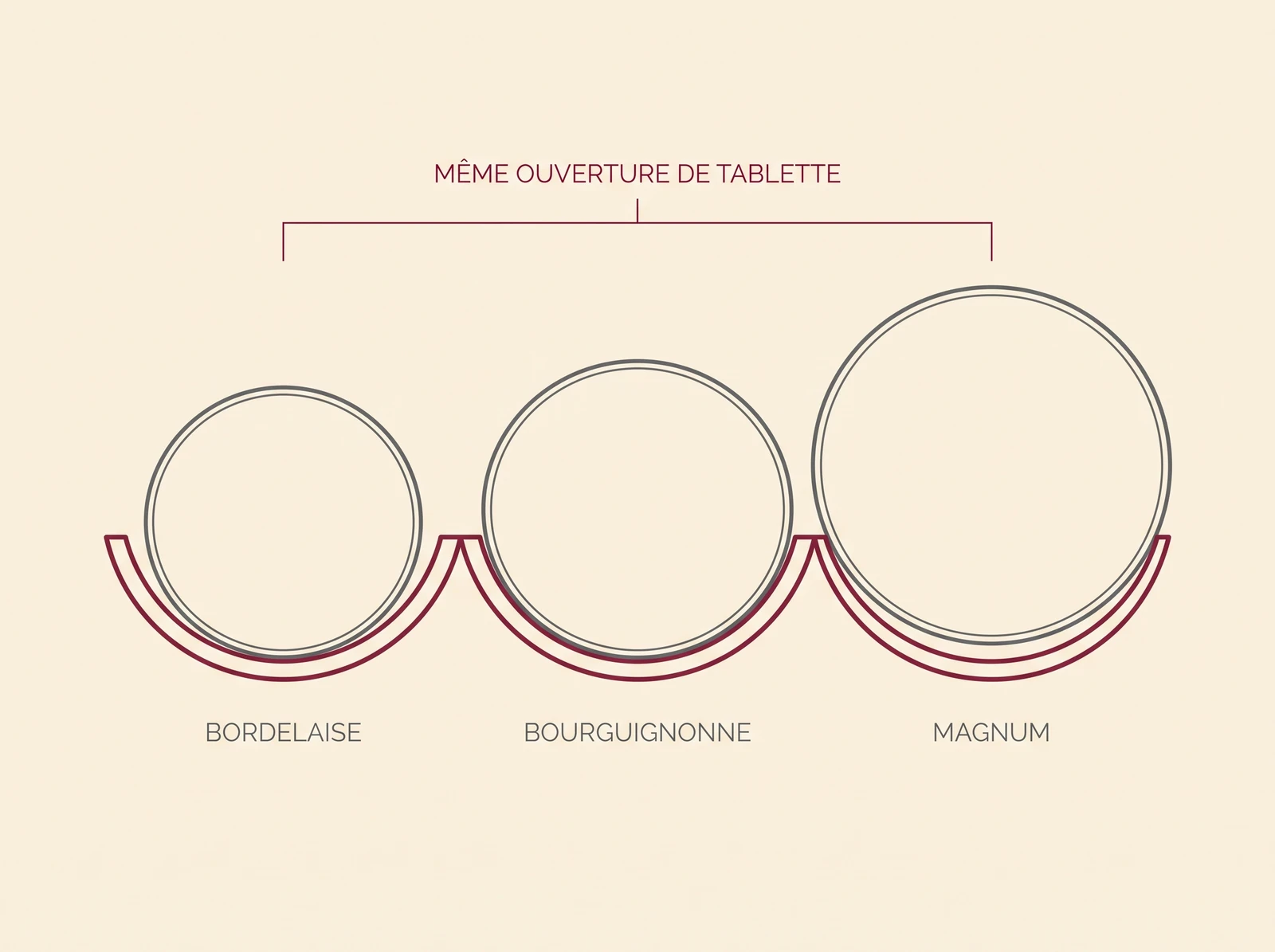
Commercially available shelves and racks are designed around two formats—the “Bordeaux” and “Burgundy” styles—which are the most common in wine cellars. The openings are sized accordingly. A magnum bottle is wider. It either doesn’t fit at all or fits poorly: the bottle sticks out of its slot and sits unsteadily.
The test consists of two parts.
- Using a tape measure, measure the opening of your shelf at its narrowest point.
- Next, measure the body of the bottle: on a magnum, the difference between a Bordeaux-style bottle and a Champagne-style bottle is as much as 3 cm.
- If the difference between the two is zero or negative, the bottle will either be forced through or not at all.
As for Wine Line®, the advertised compatibility covers 75 cl bottles, magnums, and champagne, as long as the bottle is securely seated in the opening. This condition is just as important as the list itself: a bottle that wobbles will eventually roll away. Sets of compatible shelves adjust the spacing as new shipments arrive.
Where to place a large-format piece, and on which wall to hang it
A large bottle takes up more space and has a higher center of gravity. It should therefore be placed in the lower part of the rack, lying on its side, securely supported, and never left hanging over the edge. When laid on its side, the cork stays moist and maintains its seal, which is critical for a bottle intended to be aged for ten years. For more details, see our article on bottle storage positions.
That leaves the wall. That’s where the work happens. The Wine Line® structure is secured with 5 × 50 mm screws and the included drilling template. Concrete, brick, wood, 22 mm OSB: direct mounting is suitable. On a single-layer drywall partition, add a 22 mm MDF or OSB reinforcement panel, then use Moly screws.
Two mistakes come up frequently:
- Place a large container at the top, where the arm applies force during loading;
- Do not place it near a source of vibration, such as a garage door or a washing machine. Vibration can cause the wine to deteriorate over time.
Keep the labels legible and rotate your vintages: a bottle forgotten behind a row will remain forgotten. A stable room temperature of around 12–14 °C, without direct light or excessive humidity, will take care of the rest.
Whether it's three magnums or thirty, the solution changes
With three or four oversized bottles, the original wooden crate placed on the floor is sufficient. It’s stable and protected from light. Its drawback is well known: the label disappears—and so does the bottle.
About ten large bottles mixed in with a collection of 75 cl bottles require the ideal spot—at the bottom—with spacing appropriate for their diameter. The wall-mounted rack has a clear advantage: the label remains facing forward, and the bottle size is immediately apparent at a glance, as explained in our article on showcasing bottles.
My take: If you have more than three or four items, a cardboard box on the floor is a false economy. You end up buying twice—first the cardboard box, then the actual storage solution.
In addition to more than thirty fine wines, several side-by-side display units form a wall of bottles, with the largest bottles grouped at the bottom.
The Wine Line® raw steel mixed set combines 3 single shelves and 3 double shelves on a 118-cm wall-mounted frame. The shelves snap into place without tools: the spacing adjusts to fit your bottle sizes, and the modules can be placed side by side as your wine cellar expands.
View the raw steel mixed pack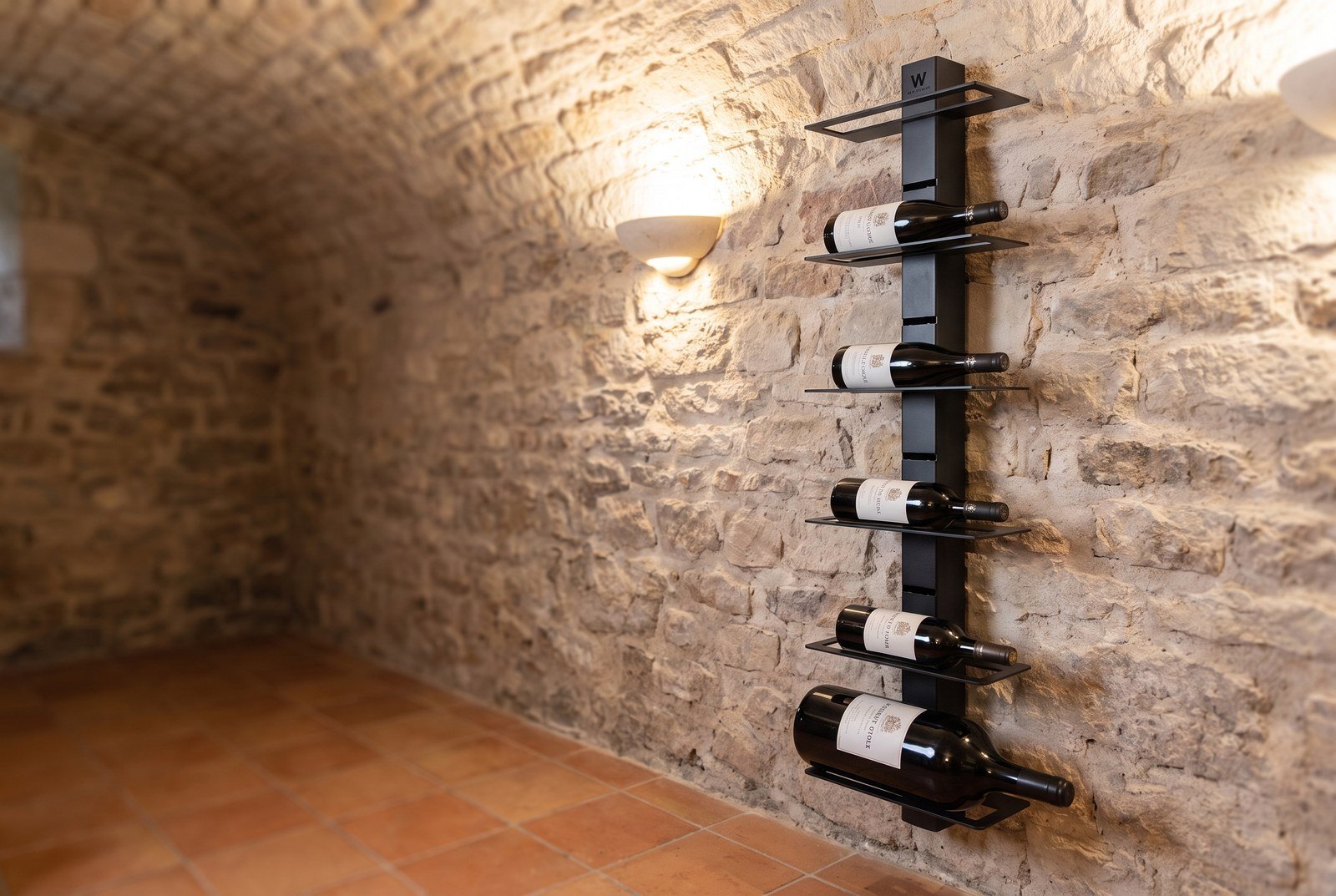
FAQ: Three Questions About Large Formats
Is a jeroboam 3 liters or 4.5 liters?
Both, depending on the region. In Champagne and Burgundy, this term refers to a 3-liter bottle of wine. In Bordeaux, it refers to a 4.5-liter (sometimes 5-liter) bottle, and the 3-liter bottle is called a double magnum. Before making a purchase, be sure to ask for the exact capacity in liters.
How many guests for a magnum, for a jeroboam?
A magnum yields twelve glasses at 12.5 cl each—the ideal size for a table of eight without having to open another bottle. The 3-liter bottle doubles that amount.
Can I hang large-format prints on a drywall partition?
Yes, with the right mounting hardware. On drywall, install a 22-mm MDF or OSB reinforcement panel behind the module, and use Moly screws. The included drilling template marks the holes at the correct center-to-center distance the first time.
One last tip: measure before you buy.
A wine collection that grows at your own pace.
Modular wall-mounted shelves in raw or lacquered steel. Holds up to 22 bottles per module, 2-year warranty, free shipping on orders over €350.
Explore the collectionExcessive alcohol consumption is harmful to your health. Please drink responsibly.