
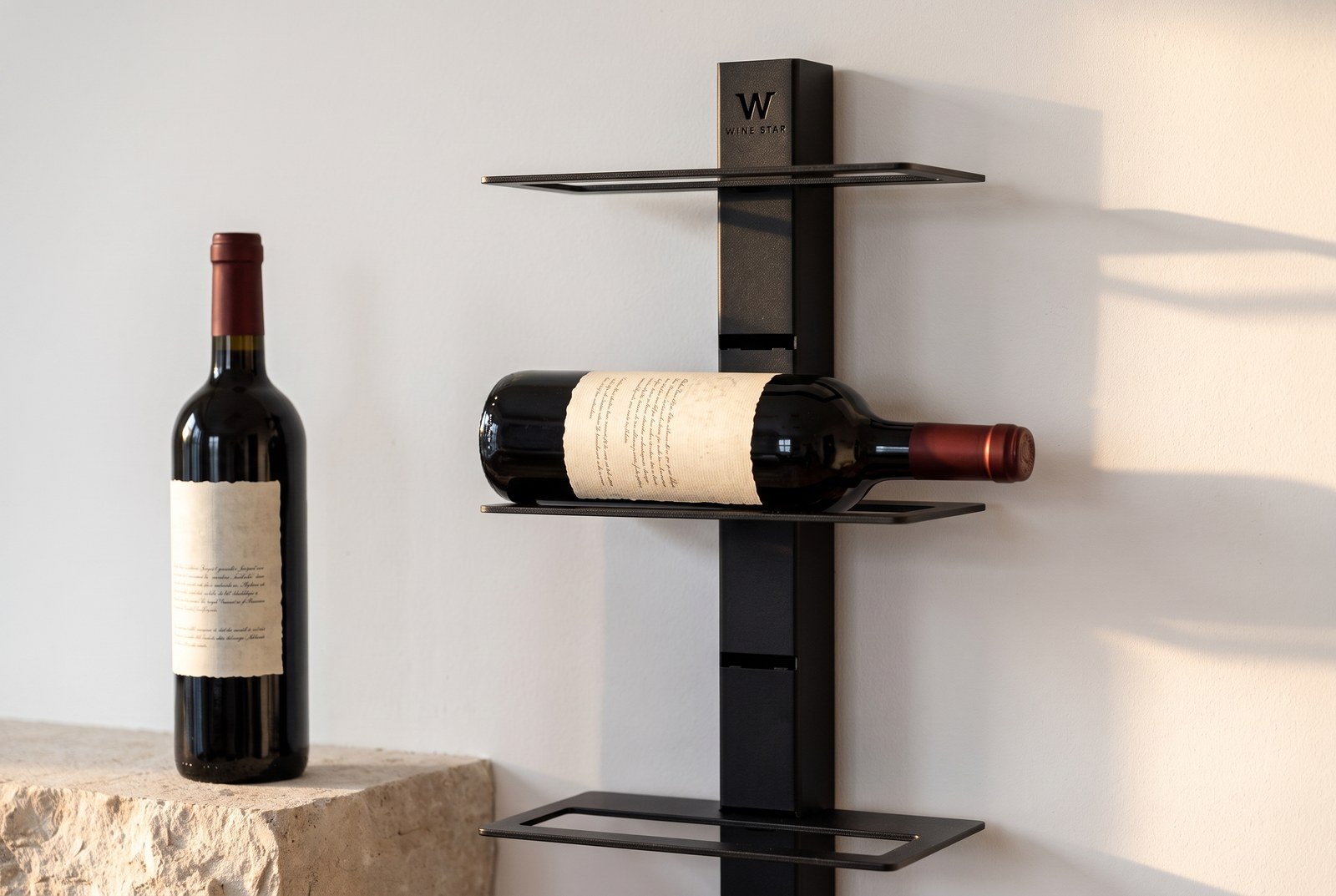
Wine stored on its side or upright: The position depends on the cork, not the wine
You’re standing in front of your bottles, unsure: should you store them on their sides, or can you leave them upright in a cabinet? Most of the answers you’ll find online contradict each other, especially when it comes to champagne and port. And almost all of them justify storing bottles on their sides with the same old story: the cork will dry out if the bottle is stored upright. This explanation is less solid than it seems. The real factor is the cork: what seals the neck of the bottle determines the storage position, not the wine inside. Here’s a table that sets the record straight, explains what the research actually says, and highlights the cases where storing bottles upright is the right choice. Let’s start with the short answer.

The answer at a glance: what your cork reveals
Look at the neck of the bottle before looking at the label. It's the neck that calls the shots.
| Cap Type | Position | Why |
|---|---|---|
| Natural cork | On call | Unanimously accepted practice in the industry, and the only method that protects cork from excessively dry ambient air |
| Plugged cork (natural cork with its pores filled) | On call | Same subject matter, same logic |
| Agglomerated cork and engineered corks (such as Diam) | On call | Cork stoppers made from cork granules, which are more dimensionally stable, but are layered for consistency |
| Synthetic cap | Indifferent | The polymer is not affected by humidity |
| Screw-on cap | Indifferent | The gasket provides a seal on its own |
| Glass cork (Vinolok) | Indifferent | Flexible seal, mechanical seal |
| Champagne and Sparkling Wines | Indifferent | Internal pressure keeps the cap moist and compressed in both positions |
| Vintage Port, Crusted, unfiltered LBV (long cork with corkscrew) | Lying down | These are wines with exceptional aging potential, bottled like a fine wine |
| Tawny port, ruby port, Madeira, and Banyuls with corks featuring a cap | Standing | The cap is not designed to be submerged in liquid |
| Spirits (rum, whiskey) | Standing | Strong alcohol degrades cork upon prolonged contact |
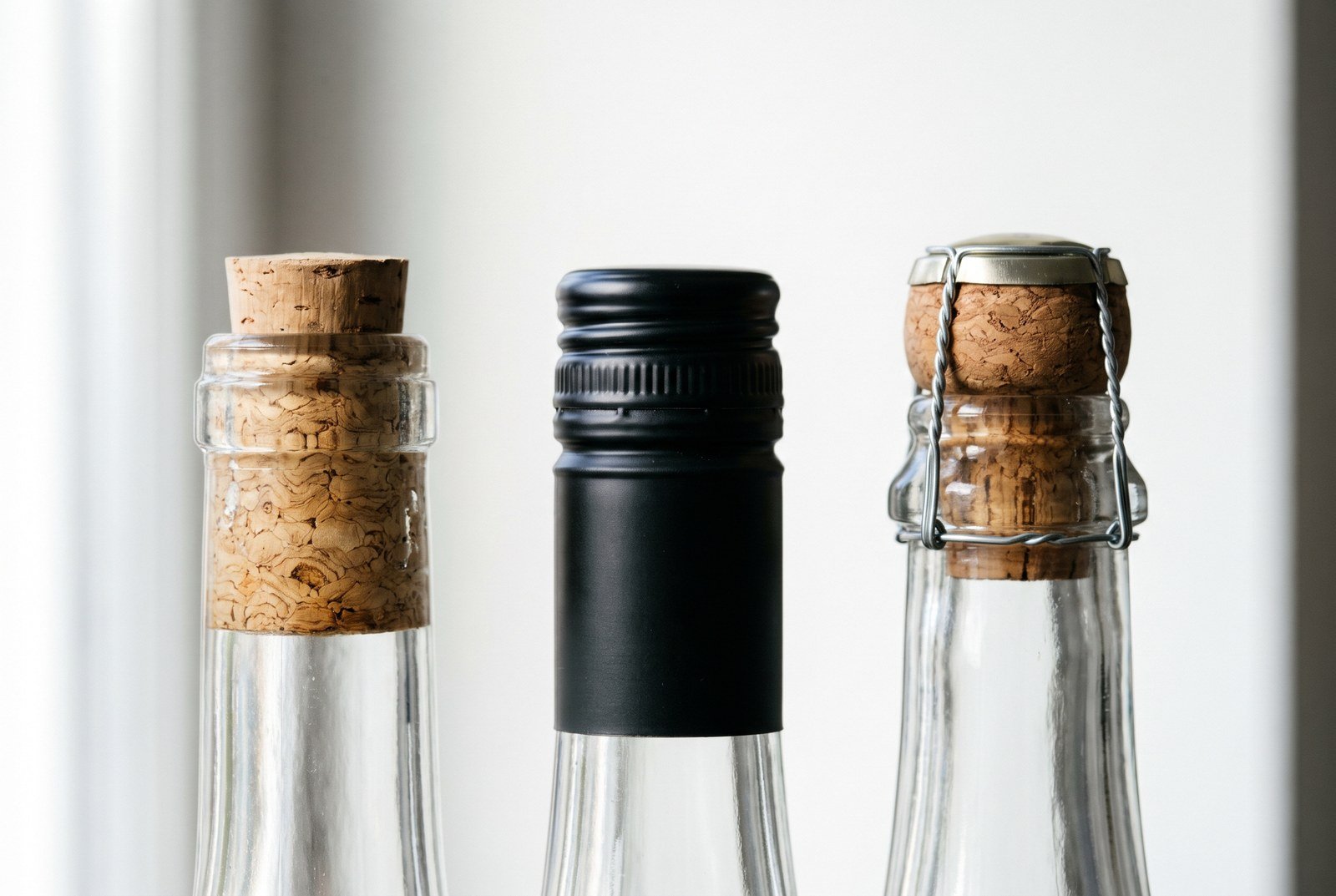
One line sums it up: long cork + guard = lying down. Top-cap, capsule, synthetic, or glass closures: storing them upright poses no problem.
Why Have Sex: What Conventional Wisdom Says, What Research Says
We need to be honest here, because almost no one is when it comes to this topic.
The usual story: the cork dries out, and air gets in
You’ve read it everywhere. When the bottle is stored upright, the wine no longer touches the cork; the cork dries out, shrinks, oxygen rushes in, and the wine oxidizes. It’s simple, it’s easy to visualize, and that’s what has justified the “lie down” rule for decades.
What the research actually shows
The problem is that this mechanism has not been proven.
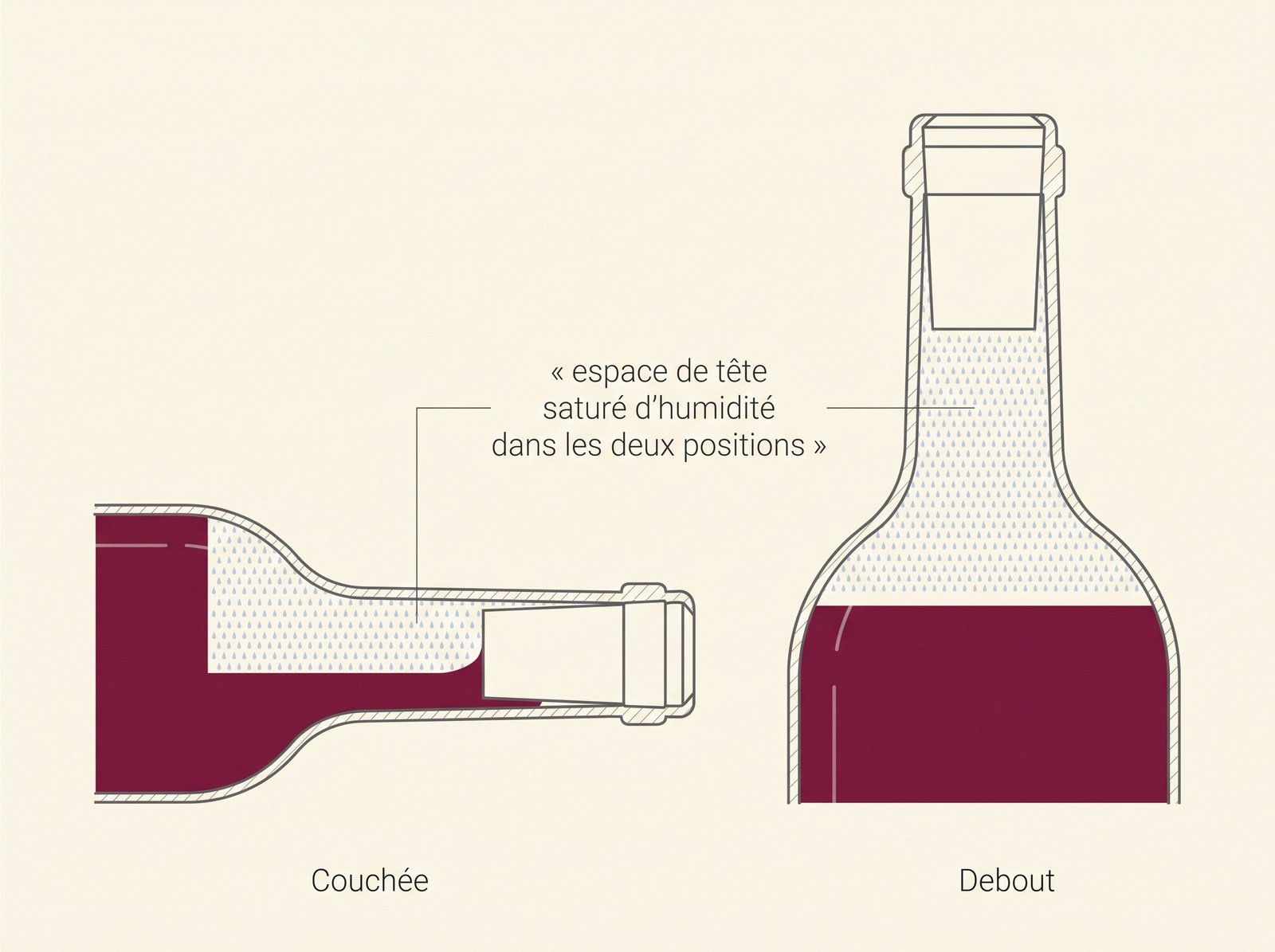
The space between the wine and the cork in a sealed bottle is saturated with moisture, regardless of the bottle’s position. The inner surface of the cork is therefore not exposed to “dry air” simply because the bottle is standing upright. More importantly, a landmark study (Lopes et al., 2006) measured oxygen ingress through various closures: the rates depend on the type of cork, not on the storage position. The Australian Wine Research Institute, based on trials lasting up to five years, reached the same conclusion: storing bottles on their side or upright had very little effect on the wine.
In other words: during the first few years, there is no evidence that a bottle stored upright oxidizes faster than one stored on its side.
So why is everyone sleeping around?
Because there are still good reasons—just not the one people are saying.
Air that is too dry, on the other hand, is a real risk. It is the only truly documented mechanism of drying out, and it originates from outside the cork, not from within. In a dry environment, cork can lose its elasticity and begin to ooze. Storing the bottle on its side keeps the cork moistened by the wine and protects it from this scenario. Over a storage period of ten or twenty years, this precaution costs nothing: it’s a rule of caution, and that’s why the entire industry follows it.
The space savings are enormous. A bottle laid on its side can be stacked, but a bottle standing upright cannot. Given the same surface area, horizontal storage can hold several times as many bottles.
Stability. A bottle lying on its side in a rack won’t fall over, won’t tip over, and won’t transmit vibrations the same way a row of upright bottles does when they’re jostled every time someone walks by.
Access and visibility. You can pull out a bottle that’s lying on its side without disturbing the others, and you can see what you have. A wine cellar you can’t see is a wine cellar you won’t drink from properly.
So the practical conclusion remains the same: write down what you keep. But do so knowing that this is a reasonable precaution, not a law of physics.
Common misconception: No, storing a bottle on its side does not cause a cork taint.
We often hear that a wet cork “contaminates” the wine and causes the infamous cork taint. That’s an oversimplification.
The cork taint flavor comes almost entirely from 2,4,6-trichloroanisole (TCA), a compound produced by mold before bottling—most often in the cork, but sometimes in the cellar environment (wood, pallets, chlorinated products). Storing a bottle on its side does not create TCA. If the compound is present, it was already there.
To be clear: TCA enters the wine through the area of the cork that comes into contact with the liquid. The cork’s horizontal position is therefore the pathway for the transfer, but it is never the cause. And modern technical corks, such as the Diam, are specifically designed to eliminate this risk.
How long can you leave a bottle standing upright?
Honest answer: No specific threshold has been scientifically established. The figures being cited (fifteen days, six months) are not based on any reliable sources. Here is a scale that is generally accepted as such.
| Aging time (cork) | What We Know | Verdict |
|---|---|---|
| A few days to a few weeks | No documented effects | No problem—just put the bottle down wherever you want |
| A few months | Studies lasting 2 to 5 years have not found any significant effect of posture | No known consequences, but you might as well sleep with them if you can |
| 1 to 2 years and beyond | An area where caution prevails | Lie down |
| Long-term storage (5 to 10 years or more) | A practice universally followed by producers | Lying down—non-negotiable |
Practical advice. The bottle you bought on Saturday for Sunday: put it wherever you want. The six bottles you brought back from Burgundy for the holidays: whether you store them upright or on their sides, it won’t make any difference—but store them on their sides mainly because it’s more practical. The case you’ll open in eight years: there’s no reason to store it upright.
One exception where the opposite applies: an aged red wine with sediment is left to stand for 24 to 48 hours before serving, to allow the sediment to settle to the bottom. This is done for serving purposes, not for preservation.
The humidity in the room matters more than the location
A vaulted cellar with 70% relative humidity protects a cork much better than a living room heated to 40%, regardless of how the bottles are positioned. A closet right next to a radiator remains the most hostile environment imaginable: dry, hot, and subject to constant fluctuations.
Standard storage conditions remain essential: a stable temperature of around 12 to 14 °C, humidity of 60 to 70%, darkness (light degrades the aromas), and no continuous vibrations. Proper positioning can never compensate for a poor storage location.
Exceptions: When "standing" Is the Right Answer
Should champagne be stored lying down or standing up?
This is the point on which advice differs the most, and one must be willing to refrain from making a decision.
In a bottle of champagne, the dissolved CO₂ exerts a pressure of about 5 to 6 bars on the cork. This pressure presses the cork against the glass and, according to the Union des Maisons de Champagne (UMC), keeps the cork perfectly moist whether the bottle is stored horizontally or vertically. The UMC even goes so far as to state that the storage position is “of lesser importance” than for still wines. A study by the Comité Champagne published in 1996 even noted advantages to vertical storage: no drying out, no loss of seal, and wines that evolve slightly less than when stored horizontally.
Most wine producers still recommend storing bottles intended for long-term aging on their sides. This is a customary practice rather than a scientific fact.
The takeaway: A bottle of champagne is perfectly safe when stored upright, even for several years. If you store it on its side, do so for space and stability, not because you’re worried about the cork.
Should you store port on its side? It all depends on the cork.
A Vintage Port, a Crusted Port, and an unfiltered LBV are sealed with a long, push-in cork—the kind you remove with a corkscrew. These are wines meant for very long aging, and they are typically stored lying down, often for decades. This is standard practice among Port houses and collectors. Storing a Vintage Port upright for twenty years is exactly what you shouldn’t do.
In contrast, tawny, ruby, and white port wines, as well as Madeira and many naturally sweet wines, are sealed with a cap (the kind you remove by hand and put back on). This short stopper is not designed to sit in the liquid: it softens and deteriorates. These bottles should be stored upright. Moreover, these wines are already oxidative by nature: oxygen does not pose a threat to them as it does to a Bordeaux.
Should spirits be stored upright?
Spirits (rum, whiskey, cognac) should be stored upright—no questions asked. In this case, the argument that alcohol attacks the cork is entirely valid: at alcohol levels above 40% vol., prolonged contact degrades the cork and can impart an off-flavor to the liquid.
The rule can therefore be summed up in one sentence: if the cork is long and has a corkscrew-like shape, lay the bottle down; if the cork has a head, stand the bottle upright.
Screw-on caps, synthetic caps, and glass stoppers: Choose whichever you prefer
None of these closures rely on moisture to remain airtight. The seal on a screw-top cap closes mechanically, the polymer in a synthetic stopper does not dry out, and the Vinolok relies on a flexible seal. Lying them down simply saves space.
An increasing proportion of the white and rosé wines sold in France come with screw caps. If that’s what’s in your wine cellar, the question of how to store them simply doesn’t arise.
Standing, lying down… and leaning?
A slight tilt (with the neck slightly higher than the base) is a common practice among wine merchants. The idea is to maintain contact between the wine and the cork while allowing the sediment to settle at the bottom rather than along the sides of the bottle. With an old, full-bodied red wine, this makes decanting easier.
In practice, a straight horizontal line does the job in the vast majority of cases. Slanting is a matter of refinement, not necessity.
One thing is especially important: avoid moving your bottles of aged wine unnecessarily. Every time you move them, the sediment is stirred up, and it will take time for it to settle again. Choose a position and a spot, and let time do its work.
Storage mistakes that spoil wine
- Store upright in a dry, heated place for years. It’s not the upright position that’s the problem; it’s the dry air on the outside of the cork, plus the heat and temperature fluctuations.
- Stack the bottles without a rack. The weight puts pressure on the ones at the bottom, the labels tear, and you can't reach anything without moving everything.
- Storing a tawny port or whiskey. The cork stopper is not designed for prolonged contact with alcohol.
- Storing a Vintage Port upright for ten years. This common mistake, which happens more often than people realize, is actually much more serious.
- Place the bottles on top of the refrigerator or near the washing machine. Continuous vibrations are a likely factor in the accelerated aging of wine, and avoiding them costs nothing.
- Leave a bottle in direct sunlight. Its position is a minor detail compared to that. The glass heats up, the aromas deteriorate, and no cork can do anything about it.
Storing Bottles Properly on Their Sides: The Stand Matters
Now you know why to lay them flat: as a precaution for long-term storage, and above all for space, stability, and ease of access. That leaves the practical question: on what?
A good horizontal wine rack must fulfill four criteria: It must maintain contact between the wine and the cork; it must remain perfectly stable, without any vibrations transmitted from the wall or floor; it must allow you to remove a bottle without disturbing the ones next to it; and it must keep the label legible.
No one ever mentions this last point, and yet it’s the very problem caused by storing bottles on their sides. A bottle lying on its side in a deep rack shows its base, never its label. As a result, we forget what we have, we open bottles at random, and the wine we were saving for a specific occasion stays at the bottom while the others get picked first.
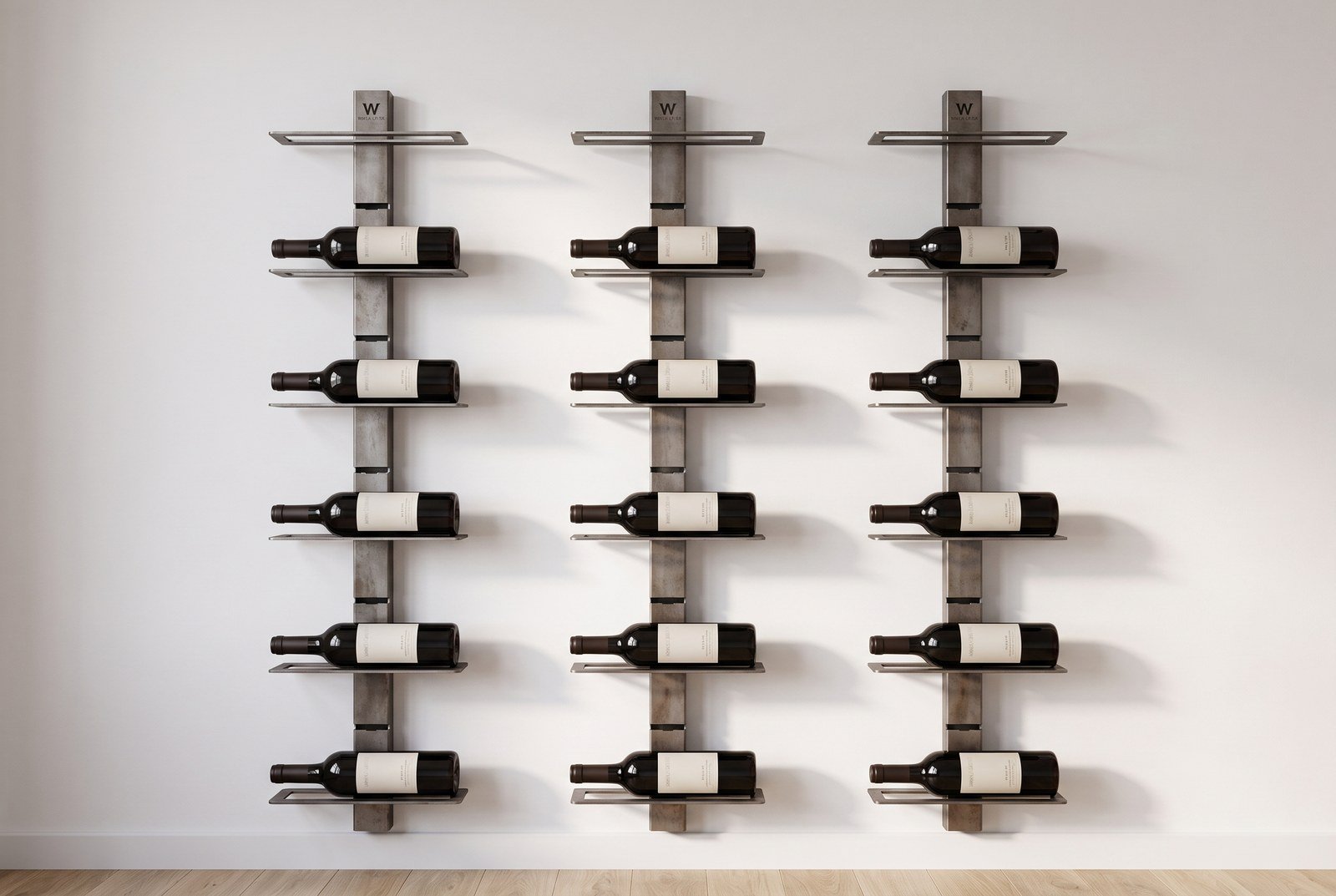
That’s exactly the problem Wine Line® set out to solve: a wall-mounted steel rack that stores bottles on their sides so the corks are down and displays the labels facing forward. Each module holds up to 11 bottles (22 with the double shelves), is 30 cm wide, and less than 15 cm deep—including magnums. It’s useful when you don’t have a wine cellar and need to make the most of a wall space.
If you're interested in this topic, the modular wall-mounted wine rack collection details the possible configurations.
Frequently Asked Questions
How should wine be stored—upright or on its side?
Store the bottle on its side if it has a long cork and is meant for long-term aging. Store it upright if it has a synthetic, screw-on, or glass stopper, or if it has a cap (tawny, Madeira, spirits). Champagne can be stored either way.
How many days can you leave a bottle standing upright?
A few days, a few weeks, a few months: no effects have been documented, even with cork. No specific threshold has been scientifically established. As a precaution, store bottles horizontally after one or two years.
Is it true that the cork dries out if the bottle is left standing upright?
This is the classic explanation, but it is tenuous: the space above the wine is saturated with moisture, and studies (Lopes 2006, AWRI) show no difference in oxygen ingress based on position. The real risk of drying out comes from excessively dry ambient air outside the cork. Storing the bottle on its side remains a good precaution for long-term aging.
Should champagne be stored lying down or standing up?
Both. The internal pressure keeps the cork moist regardless of the bottle's position (Union des Maisons de Champagne). A bottle stored upright is safe, even for several years.
Should port be aged?
It depends on the cork. A Vintage or Crusted port, sealed with a long cork that can be pulled out with a corkscrew, should be stored lying down like a fine wine and will keep for decades. A Tawny, Ruby, or white port with a cap-style stopper should be stored upright.
Should screw caps be laid flat?
No. The seal on a screw-top cap is not affected by humidity. The position makes no difference.
Does storing a bottle on its side cause a cork taste?
No. The cork taint comes from TCA, a molecule that forms before bottling. Lying the bottle down does not create it. The molecule enters the wine through the contact zone, but if it’s present, the bottle was already spoiled.
Should you turn the bottles over from time to time?
No. Every time you handle it, the sediment is stirred up again. Once the bottle is laid on its side and secured, leave it alone.
A wine collection that grows at your own pace.
Modular wall-mounted shelves in raw or lacquered steel. Holds up to 22 bottles per module, 2-year warranty, free shipping on orders over €350.
Explore the collectionExcessive alcohol consumption is harmful to your health. Please drink responsibly.