
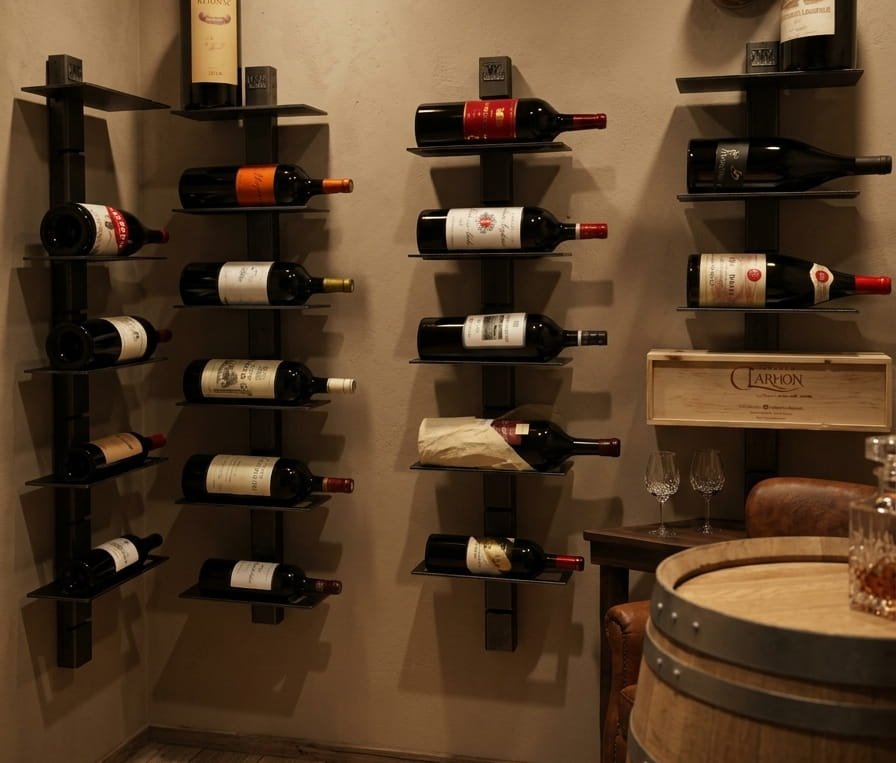
Showcasing Your Wine Bottles: The Right Display Stand
A beautiful wine collection left to gather dust in stacked boxes is a waste. You end up forgetting what you have, you can’t read the labels clearly, and the bottle you were saving for a special occasion comes out covered in dust. Showcasing your wine bottles solves this problem: you can see your collection at a glance, give it a proper place in the room, without compromising on storage conditions. Whether you’re a homeowner finally organizing your collection or a wine merchant curating your display, the principle remains the same. We start with the most important element: the label.
Why Labels Change the Way We Organize
When you line up bottles lying on their sides with the necks facing you, you can’t see anything. Just green cylinders—all identical, all anonymous. The display really comes to life the moment the label becomes legible, right in front of you, at eye level.
This is true at home. It’s even truer behind a bar, where a visible selection serves as a selling point. A wine cellar that’s easy to navigate is one you’ll use more effectively: you can find a specific vintage without disturbing everything else, plan a meal just by glancing at the wall, and avoid that forgotten “ghost bottle” tucked away in the back.
A few guidelines for a well-structured production:
- Place the prettiest bottles at eye level; the rest should be above or below that.
- Labels are visible on the front, aligned, and there's no mix of sizes.
- Soft, indirect lighting rather than a harsh spotlight shining directly on it.
The steel wall shelf: display and organize all at once
That’s the approach we advocate at Wine Line®, and for good reason. The system is wall-mounted, so it doesn’t take up a single centimeter of floor space. It’s modular: clip-on shelves that can be repositioned without tools, and units that can be placed side by side to expand as your collection grows. And it displays each bottle with the label facing forward, secured in the steel opening.
Steel, precisely. It stands its ground against the ubiquitous wood. Raw steel develops a vibrant patina over the months—including the marbling from the rolling process—for a bold, industrial look. This slow oxidation can be set with a colorless wax or oil if you prefer to keep it stable. Lacquered steel, on the other hand, remains matte and stable, and is more resistant to moisture thanks to its finish. In both cases, it’s a 2-mm-thick, understated material that adds structure to the wall without stealing the spotlight from the wine.
Designing Your Bottle Display
A unit measures 118 cm high and 30 cm wide. It holds up to 11 bottles with single shelves, and up to 22 with double shelves. It accommodates magnums and champagne bottles as well. You start with one module, add another the following year, and the wall grows along with your wine collection. To understand how the system works, the Wine Line® concept explains the mechanics of the clip-on shelves. You can choose the rest in the store.
What kind of display should you choose to showcase your bottles?
Not all bottle racks are created equal, depending on what you're looking for: saving space, making a stylish statement, or simply placing a few bottles on a table. Here's what you need to make a decision.
| Support | Space-saving | Highlighting the Label | Preservation | Style |
|---|---|---|---|---|
| Wine Line® Steel Wall Shelf | Excellent (on the wall, nothing on the floor) | Label on the front, at eye level | Bottles stored on their sides, away from direct light | Industrial or minimalist, modular |
| Wooden wine rack | Medium (floor space required) | Neck labels or labels, depending on the model | Coated, but sensitive to moisture | Rustic, cozy |
| Barrel or freestanding display stand | Low (high volume) | Decorative, with few bottles visible | Variable, often upright | Decor, wine cellar vibe |
| Single bottle holder | Very low capacity | 1 to just a few bottles | Depends on the position | Side table, table, or countertop |
A wooden rack is still a safe bet for anyone who loves a warm, inviting look. A barrel makes a great decorative statement. But if you need to display a lot of labels in a small space, a steel wall rack is the better choice. If you’re unsure about the finish, compare raw steel and painted steel: the former for its patina, the latter for damp areas.
Displaying Without Damaging: Light, Position, Temperature
Show it off, yes. Cook your bottles, no. Wine has a few well-known enemies, and even a beautiful display doesn't mean you can ignore them.
Light comes first. We often talk about UV rays, but visible light—especially its blue component, found in neon lights and cool LEDs—stresses wine just as much, and even more so indoors, where there’s almost no UV. White wines and sparkling wines are the first to suffer; reds, which are more tannic, hold up better. The simple rule: the less light, the better. Avoid south-facing areas and bright spotlights shining directly on the bottles; instead, opt for a slightly secluded spot with indirect lighting, ideally using warm-white LEDs rather than cool-white ones. For a bottle left on display for a long time, tinted glass (dark green, amber) offers better protection than clear glass. Darkness remains the best protection.
Next, the position. The bottles are laid on their sides, as is customary for long-term storage: the wine remains in contact with the cork, which is supposed to help it retain its moisture. Modern cork research has added some nuance to this mechanism—a bottle stored upright also keeps the cork moist thanks to the saturated air in the neck—but laying the bottle on its side remains the standard practice and, incidentally, ensures the label faces forward. Note: For screw caps or foil caps, storing the bottle on its side has no impact on its airtight seal; it is simply a matter of storage convenience.
Finally, the temperature. Ideally, it should be stable, without sudden fluctuations. Let’s be clear: Wine Line® is not a refrigerated wine cellar—it’s a storage and display system. For true long-term wine aging, you need a dedicated space that’s cool and temperature-stable. For everyday display and serving, a wall protected from light and vibrations works just fine.
A Few Decorating Ideas Using Empty Bottles
Once the bottle is empty and you’ve shared the story behind the label, it can be given a second life. This is the perfect opportunity for a quick decorative touch, without any complicated DIY projects:
- A candleholder—place a thin candle on the neck; drips are part of the look.
- A vase with a single flower, placed on a table or windowsill.
- A candleholder that covers the glass, creating a soft glow in the evening.
A word of caution regarding candles: the glass of a wine bottle is not designed to withstand heat and may crack if a flame gets too close. Keep the flame away from the side of the bottle, do not insert a lit candle into a narrow neck, and never leave anything burning unattended.
It's nice and it fills up the space. To display the bottles we keep, though, you really need a proper rack.
Showcasing Your Wines in Retail Settings: Wine Shops, Restaurants, and Wine Bars
In the professional setting, showcasing wines has a direct commercial impact. With a selection on display behind the bar, customers can spot a vintage and order it themselves. It also speeds up service: you can grab the right bottle without having to rummage around.
The steel wall display checks all the right boxes for a retail business. It adorns a wall without encroaching on floor space, showcases labels like a display case, and its modular design adapts to restocking needs: shelves can be added as the product selection expands. The wall itself becomes a design element that complements the venue’s ambiance, without the cost of custom-made furniture. Five wineries have already installed it. For a bar, restaurant, or retail wine shop project, explore the entire lineup in the Wine Line® store.
Frequently Asked Questions
How can you showcase your fine wines?
By displaying the labels at eye level on a rack that holds the bottles horizontally. A wall-mounted storage unit with labels visible from the front makes the contents easy to read while adding style to the room.
Can you store wine bottles at room temperature?
It’s fine to drink it in the coming months, yes, provided it’s kept at a fairly stable temperature and in a place away from light. For long-term storage, a cool, temperature-controlled cellar is still best.
How can you display your bottles without damaging them?
They should be stored according to standard storage practices, kept away from direct light—both UV light and bright light—and protected from heat sources and vibrations. White wines and sparkling wines are the most sensitive to light.
What kind of display should you choose to showcase your bottles?
It depends on the available space and the number of bottles. For a large number of bottles in a small space, a steel wall rack is the most efficient option. For just a few bottles, a wooden rack or a bottle holder will suffice.
A steel wall-mounted system, expandable to hold up to 22 bottles per module, with labels on the front and installation in just a few minutes. 2-year warranty, free shipping on orders of €350 or more (including tax).
A wine collection that grows at your own pace.
Modular wall-mounted shelves in raw or lacquered steel. Holds up to 22 bottles per module, 2-year warranty, free shipping on orders over €350.
Explore the collectionExcessive alcohol consumption is harmful to your health. Please drink responsibly.