Which wine should you buy to age it without making a mistake?
The vast majority of bottles sold in France are made to be drunk young. This is a widely accepted observation within the industry, even though there are no statistics to quantify it precisely. Storing them for a long time doesn’t improve them—it causes them to lose their vibrancy. A wine suitable for aging has a specific structure that allows it to evolve rather than fall apart, and this structure can be identified at the time of purchase—first on the label, then in the glass. Here, you’ll learn how to read these signs, which reds and whites are considered suitable for aging, and, most importantly, which wines are best enjoyed right away. This will help you build a practical wine cellar rather than a cluttered one.
A quick note on terminology: a wine meant for aging evolves and gains complexity over the years, while a table wine is best enjoyed when young. This distinction deserves an article of its own, so we’ll come back to it later. Let’s get down to the specifics.
Why Does Aging a Wine Change Its Taste?
In a sealed bottle, wine continues to evolve. Contrary to popular belief, this is not due to oxygen: bottle aging occurs in the absence of air, through slow reactions between the wine’s own compounds. This is the exact opposite of barrel aging, which is highly oxidative.
Tannins—those molecules that make a young red wine feel rough on the tongue—bond together and settle. The astringency subsides, and the texture becomes silky. The aromas of fresh fruit give way to what are known as tertiary aromas: forest floor, leather, truffle, mild spices, and candied fruit. The color also changes; bright red shifts toward garnet and then toward brick red, while white takes on an amber hue.
This process follows a curve. The wine improves, reaches a plateau known as its peak, and then begins to decline. The challenge lies in opening the bottle during this plateau, and no one can pinpoint the exact date: it depends on the wine, the vintage, and the storage conditions.
A wine lacking body has nothing to develop. It simply loses its fruitiness. Hence the importance of the following criteria.
Signs of aging potential, which can be identified before purchasing
Three key elements form the foundation of a wine capable of aging: tannins, acidity, and sugar, along with the wine’s body. A great wine with aging potential combines several of these elements. One alone is never enough.
Let's be honest about what we see on the shelves: the label doesn't tell the whole story, but it does tell us a lot. The table below lists only what you can read or find out before making a purchase.
| Criterion | What We're Looking For | What to Read Before You Buy |
|---|---|---|
| Tannic structure | Prominent, tight tannins that will mellow with time | Tannic grape varieties (Cabernet Sauvignon, Syrah, Tannat, Nebbiolo), barrel aging as indicated on the back label, price range, and appellation |
| Acidity | A lively acidity that gives the wine longevity and prevents it from becoming flat | Grape varieties that are naturally high in acidity (Riesling, Chenin) or varieties grown in cool climates or at high altitudes (Burgundy Chardonnay) |
| Residual sugar | High sugar content, combined with good acidity, which protects the wine | Terms such as "sweet," "semi-sweet," "late harvest," "Sauternes," and "selection of noble grapes" |
| Concentration | A dense material, produced through carefully controlled yields | Designations in boxes: cru classé, premier cru, grand cru. The terms “vieilles vignes” and “cuvée parcellaire” are not regulated: they are the sole responsibility of the producer. |
| Vintage | A year that allowed the grapes to ripen well | Industry associations publish tables of vintage years by region: consult them rather than leaving it to chance |
| Terroir and Appellation | An appellation renowned for its age-worthy wines | Name of the AOC, indication of the cru, level within the appellation's hierarchy |
| The estate's reputation | A winemaker whose wines are known for their aging potential | Guides, wine merchant reviews, and the estate's history regarding older vintages |
| Price | A wine that was expensive to produce | An imperfect indicator, but a very low floor price is rarely compatible with low yields and a long growing period |
This is confirmed only by tasting: the tannins that dry out the mouth in a young wine, the sensation of refreshing crispness, the impression of a wine that’s still closed off, a bit austere, and not yet revealing itself. These are excellent signs, but they require that you’ve opened a bottle. That’s why it’s worth buying several—we’ll come back to that below.
Two false friends. First, the color: a dark, dense red does not indicate any aging potential. Nebbiolo and Pinot Noir, among the world’s most age-worthy wines, are naturally pale. Next, the alcohol content: it really only preserves the wine in fortified wines (Port, Banyuls, Madeira), where the added alcohol blocks all microbial activity. In a dry wine, a high alcohol content is no guarantee of aging potential, and it even becomes overpowering once the fruit fades.
A word of caution: these criteria indicate potential, not a guarantee. Two bottles of the same wine, from the same vintage, stored differently, will not yield the same wine ten years later.
Which red wines should you buy to age?
Red wines suitable for aging share the same core characteristics: tannins and body.
Bordeaux and Cabernet Sauvignon. The historic benchmark. Cabernet Sauvignon contributes firm tannins, while Merlot adds body. The Médoc’s classified growths and the great wines of the Right Bank are renowned for their ability to age over long periods, which varies greatly depending on the vintage and the estate.
Burgundy and Pinot Noir. Less tannic, more refined, and pale in the glass—yet this does not compromise its aging potential. Here, it is the acidity and the precision of the terroir that define the wine. This is particularly true of the Premier Crus and Grands Crus of the Côte de Nuits. A generic regional Burgundy, on the other hand, is best enjoyed young.
The Rhône Valley and Syrah. The wines from the northern part of the valley (Hermitage, Côte-Rôtie, Cornas, Saint-Joseph) offer a spicy, peppery structure that mellows with age. In the south, a Grenache-based Châteauneuf-du-Pape combines high alcohol content and concentration.
The Loire and Cabernet Franc. This grape variety is often underestimated when it comes to aging potential. It all comes down to the soil: on the tuffeau hillsides of Chinon, Bourgueil, or Saumur-Champigny, it produces taut reds that age with elegance. On the gravelly and sandy soils of the plains, which cover most of these appellations, it produces supple wines best enjoyed within five years. In our opinion, it offers one of the best aging potential-to-price ratios in French viticulture today, but that’s just our take—not an official ranking.
Elsewhere: Madiran (Tannat), Cahors (Malbec), Bandol (Mourvèdre), and in Italy, Nebbiolo from Piedmont.
And the white wines, the sweet wines, and the champagnes
The idea that white wines are meant to be drunk young is false for an entire family of them.
- Burgundy Chardonnay: The great white wines of the Côte de Beaune hold up well thanks to their acidity and aging. They develop aromas of hazelnut, honey, and smoke. A reserve to be aware of: vintages from 1995 to 2010 were affected by a wave of premature oxidation—the infamous “premox”—which compromised bottles reputed to have great aging potential. The problem appears to be on the mend, but it calls for caution regarding this period.
- Riesling: whether dry or off-dry, from Alsace or Germany, it has remarkable acidity. As it ages, it develops those petrol-like notes that connoisseurs seek out and others detest.
- Loire Valley Chenin: Vouvray, Savennières, Montlouis. Acidity and body, with excellent aging potential.
- Sweet wines: Sauternes, Barsac, Coteaux du Layon, Jurançon. Sugar preserves the wine, provided it is balanced by high acidity: a sweet wine lacking acidity will not age well. In our view, these are among the most age-worthy wines there are, along with fortified wines.
- Vintage Champagne: Single-vintage Champagnes, aged for a long time on racks, develop greater depth and brioche-like notes. Non-vintage bruts are released ready to drink and require no aging, although an additional two or three years in the cellar often enhances them.
Wines You Shouldn't Age
This is the part that few guides are willing to address. Many bottles go to waste while waiting.
- Rosé wines, with very few exceptions. Their appeal lies in their fresh fruitiness, and the fruit is the first to fade.
- Early-release wines (Beaujolais Nouveau and similar wines), produced to be enjoyed in the months following the harvest.
- Fruity, smooth reds without pronounced tannins: simple Gamay, Cinsault, and most entry-level varietal wines.
- Bright, aromatic white wines perfect for enjoying chilled: Touraine Sauvignon, everyday Muscadet, and light, refreshing wines.
- Entry-level wines, regardless of color. A wine designed to be inexpensive lacks both the necessary concentration and aging. Aging does not create body; it merely reveals the body that is already there.
- Bag-in-box packaging is intended for quick consumption: the bag allows oxygen to pass through, and the best-by date is measured in months.
On the other hand, screw caps have no place on this list. They do not prevent aging: virtually all New Zealand wines and a large majority of Australian wines—including age-worthy reds and premium whites—are sealed with screw caps. In France, they are still used primarily on wines meant to be drunk young, which is a market convention, not a technical constraint. It’s not the closure that matters—it’s the wine inside.
How many bottles of the same wine should I buy?
One bottle alone won't teach you anything. You open it, realize the wine was still unopened, and then you're left with nothing.
The "three-bottle rule" solves the problem. You open one early on, to see how the wine is developing. Another a few years later. The third when the time seems right. With a wine that’s worth it, six bottles let you track its evolution over a decade without frustration.
It’s better to have five wines that are truly suitable for aging than thirty bottles bought at random. A wine cellar is built slowly, in small batches.
A wine meant for aging that is stored improperly does not age—it spoils.
Even the world's finest wine won't survive in a kitchen cabinet. Storage conditions are just as important as the initial selection.
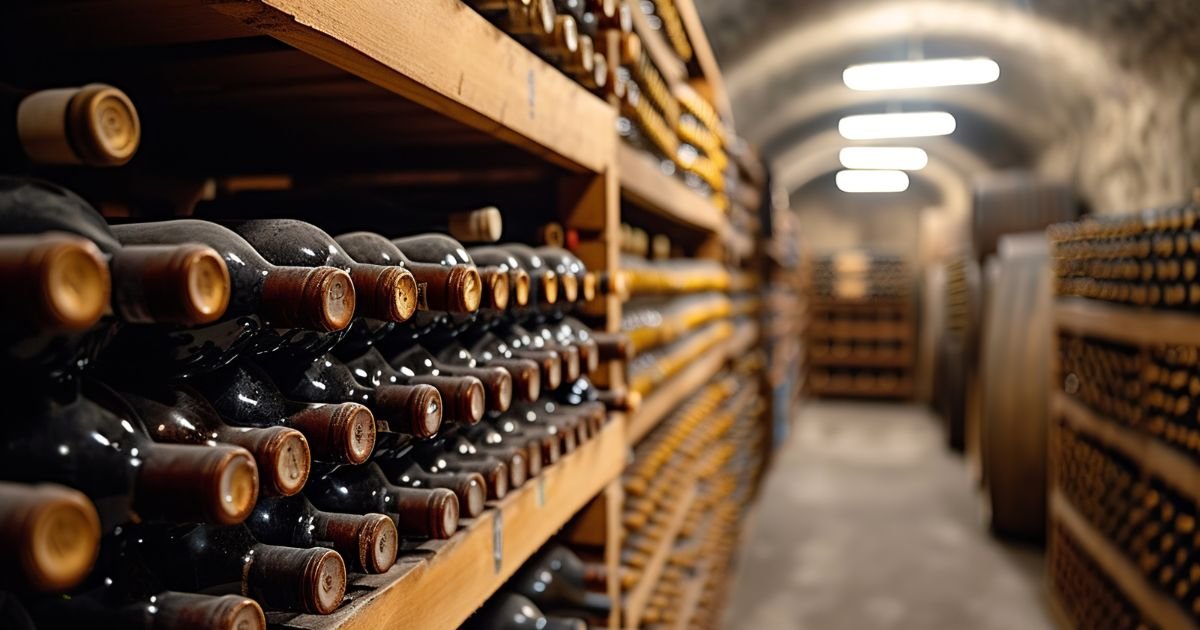
What really matters: a stable temperature of around 12 to 14 °C (stability is more important than the exact temperature), sufficient humidity to prevent the cork from drying out, darkness, and the absence of strong odors and significant vibrations. And store the bottle on its side so that the wine remains in contact with the cork (a screw cap, on the other hand, does not require this).
A useful point to note: it’s the storage space that preserves the wine, not the shelving unit itself. An underground cellar, a cool north-facing closet, or a stable basement will do the trick. Shelving, of any kind, does not regulate temperature or humidity. Its purpose is different: to keep the bottles lying down and stable, and to keep the labels legible so you don’t miss the peak of a bottle forgotten at the bottom of a box. That’s the idea behind wall-mounted wine racks: see your collection, so you can use it.
Frequently Asked Questions
How can you tell if a wine will age well?
Look at its structure: noticeable tannins, lively acidity, high sugar content for a sweet wine, and concentrated body. Consider the appellation, the vintage, and the price point. A wine that seems a bit austere and closed in its youth is often a good sign. As for the color, it won’t tell you anything.
Which wines age best?
Sweet wines and fortified wines, thanks to their sugar content and accompanying acidity. Then there are the full-bodied, tannic reds (Bordeaux, Northern Rhône, Madiran) and whites with high acidity (Riesling, Chenin, Burgundy Chardonnay).
Does an expensive wine necessarily age better?
No, but a very inexpensive wine rarely ages well. The price partly reflects yield, aging, and selection—three factors that influence a wine’s aging potential. It does not guarantee them.
Should you let all your wines age?
No. The vast majority of commercially available wines are meant to be drunk young and are at their best in their first few years. Keeping them for a long time robs them of their fruitiness without adding anything.
What is the ideal temperature for storing wine meant for aging?
Around 12 to 14 °C, with as little fluctuation as possible. A room that stays at a constant 16 °C is better than a cellar where the temperature fluctuates between 8 and 20 °C depending on the season.
How do you know when to open the bottle?
Buy several bottles of the same wine and taste one of them regularly. No chart can replace your own tasting experience.
A wine collection that grows at your own pace.
Modular wall-mounted shelves in raw or lacquered steel. Holds up to 22 bottles per module, 2-year warranty, free shipping on orders over €350.
Explore the collectionExcessive alcohol consumption is harmful to your health. Please drink responsibly.