Wine cooler for serving or aging: What are the differences, and how do you choose?
You’ve bought a wine cooler, and your cellaring wines go bad after two years. Or the opposite: you serve a red at 6°C because your unit won’t go any higher. The misunderstanding almost always stems from confusing two machines that serve different purposes. A serving cooler keeps your bottles ready to drink. An aging cooler lets them rest for the long term. Let’s see what really sets them apart, with a chart to help you decide quickly. Let’s start with the one that’s easiest to understand.
What is a wine dispenser?
A wine cooler has a single purpose: to bring your bottles to serving temperature and keep them there. You open it, take out the wine, and serve it. No waiting, no long-term aging. It’s a refrigerated unit designed for the short term—for the bottles you plan to drink in the coming weeks or months. So you store what you’ll be drinking: the red for the weekend, the white to open with friends, the bottle ready for the next meal.
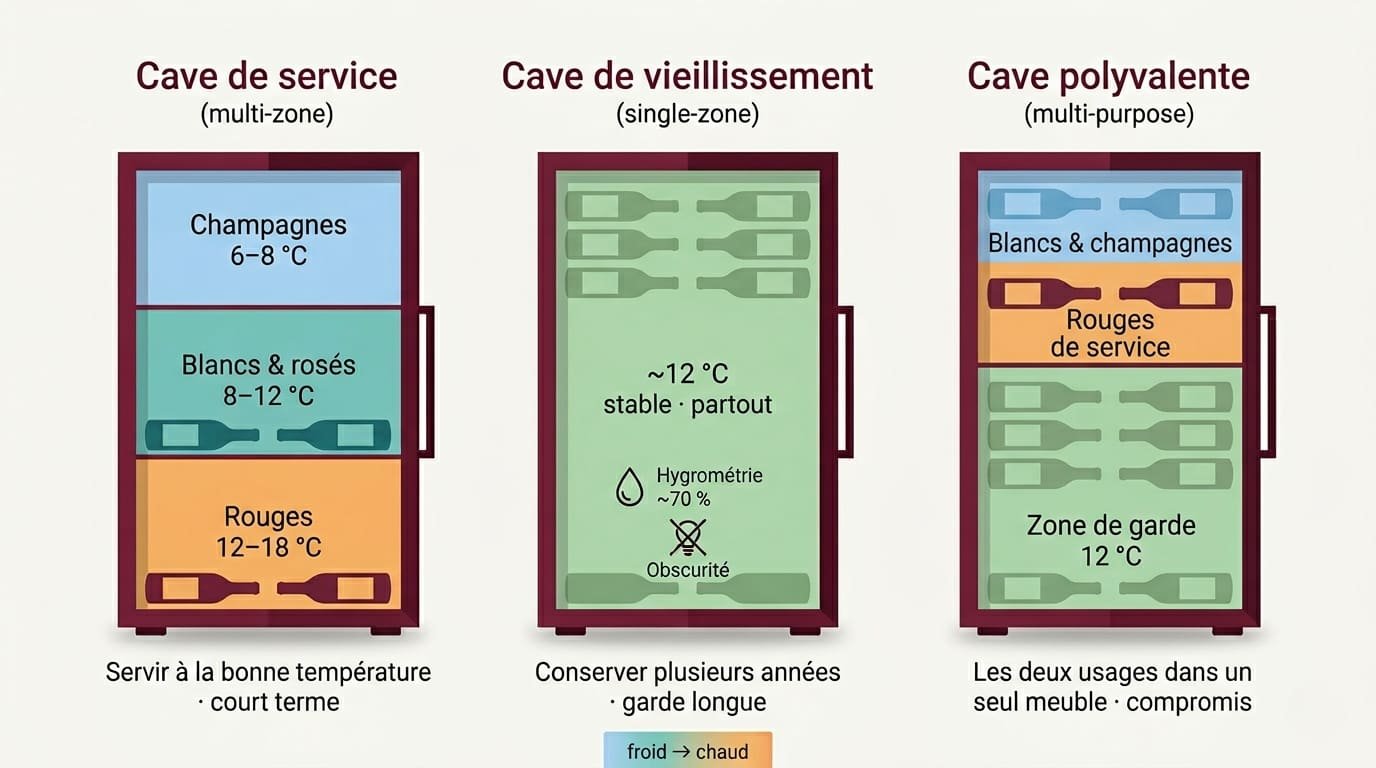
What sets it apart is the range of temperatures it offers. A wine is best enjoyed at different temperatures depending on its color—and even its style. A wine cooler, especially a multi-zone model, can maintain multiple temperature settings simultaneously to cover the entire spectrum, from chilled champagne to full-bodied reds.
Serving temperatures by wine type
- Full-bodied red wines (structured Bordeaux, Châteauneuf-du-Pape): 16 to 18 °C, never exceeding 18 °C
- Light red wines (Beaujolais, Pinot Noir): 12 to 15 °C
- Dry white and rosé wines: 8–12 °C
- Sweet white wines (Sauternes, sweet wines): 8 to 10 °C (slightly cooler for a young sweet wine, slightly warmer for a fine sweet wine—if served too cold, its aromas will fade)
- Champagne and sparkling wines: 6–8°C (preferably 8–10°C for a vintage champagne or a grand cru)
That’s where multi-zone cooling comes in. A wine cooler with two or three compartments keeps reds at 17°C on the bottom shelf, whites at 10°C in the middle, and champagne chilled on the top shelf. For those who entertain often, this is a real convenience. You can serve each wine at the perfect temperature without having to run back and forth between the fridge and the dining room.
What is a wine aging cellar?
Here, the process changes completely. An aging cellar, sometimes called a storage cellar, is used to store wine for years, allowing it to develop its aromas and gain complexity. This isn’t where you keep the bottles for Sunday night. It’s where you store the wines you want to let age—those that deserve to wait five, ten, or fifteen years before being opened.
To achieve this, it replicates the conditions of a traditional underground cellar. Stability is the top priority. Wine hates sudden changes, and that’s exactly why an aging cellar exists—to spare it from them.
The keys to healthy aging
- Stable temperature around 12 °C : regardless of the exact temperature between 10 and 14 °C, it’s the consistency that matters. Sudden fluctuations can stress the wine.
- Humidity around 70%: Air that is fairly humid (typically between 50% and 80%) keeps the cork pliable. If it’s too dry, the cork shrinks and lets air in. Note: This applies to natural cork, not screw caps.
- Darkness: Light can damage wine, whether it’s UV light or visible blue light. A solid door or a treated glass panel protects the bottles.
- No vibrations: Choosing a quiet, vibration-free compressor is a good precaution, especially for noise comfort if the unit is located in a living area.
- Ventilation: Fresh air helps prevent odors and trapped moisture.
Most wine cellars are single-zone. A single temperature is maintained throughout, at all times. This makes sense: aging requires consistency, not multiple settings. They are used to store both fine red wines meant for aging and certain white wines and champagnes with a long shelf life, all at the same mild temperature.
Comparison Chart: Wine Cooler or Wine Cellar
The quickest way to see the difference is to put everything side by side.
| Criterion | Wine cellar | Aging cellar |
|---|---|---|
| Objective | Bring the wine to serving temperature | Storing wine for the long term |
| Temperature | 6 to 18 °C, depending on the region | ~12 °C, stable and constant |
| Humidity | High school | Estimated at around 70% |
| Areas | Often multi-zone | Single-zone |
| Duration | Short term (weeks, months) | Several years |
| Types of wine | Ready-to-drink bottles | Aged wines, fine wines |
| Typical use | Entertaining, serving at the right temperature | Building and maturing a wine cellar |
In short: if you’re buying wine to drink right away, a wine cooler is all you need. If you’re building a collection to age, you’ll need a wine cellar. And if you want both, there’s a third option.
What about the multipurpose cellar?
A versatile wine cooler, or multi-purpose wine cooler, aims to combine both functions in a single unit. Specifically, it features several compartments: one kept at around 12°C for aging, and one or two serving zones at tasting temperature.
On paper, it’s appealing for those who are short on space or want a single piece of furniture. In reality, it involves compromises. The storage area of a multi-purpose unit doesn’t always match the stability of a true dedicated wine cellar, especially when it comes to humidity. For bottles meant to be stored for ten or fifteen years, a specialized single-zone unit remains the safer choice. For mixed and moderate use, the multi-purpose unit does the job very well. It all depends on your long-term storage goals.
How do you choose a wine cooler?
Three questions are all it takes to help you make the right choice.
Depending on your needs
Ask yourself what you do with your wine. Do you buy it to drink within the year? A wine cellar for everyday use. Do you buy en primeur wines and vintages meant for aging? A wine cellar for aging. A bit of both, without a large collection of wines meant for aging? A versatile wine cellar.
Depending on the space and capacity
Wine coolers range from small under-counter models that hold 20 bottles to cabinets that hold several hundred. Measure the space, consider ventilation around the unit, and above all, plan ahead. A wine cooler always fills up faster than you expect. It’s better to err on the side of being a little too big.
Depending on the budget
An entry-level wine cooler remains affordable. A high-quality aging wine cooler, with humidity control and an anti-vibration compressor, requires a larger budget—a cost justified by the value of the bottles it protects. The rule is simple: when it comes to long-term aging of fine wines, any savings on the unit will end up costing you more in the long run.
Practical Questions About Wine Coolers
Can wine be aged in a wine cooler?
No, not really, and that’s the most common mistake. A wine cooler maintains serving temperatures—sometimes quite high for reds—and doesn’t actively regulate humidity. For a few months, that’s fine. But over several years, the cork may dry out and the wine may lose its quality. For long-term storage, you need a wine cellar.
Where should you set up your wine cellar?
In a cool, stable room. Avoid placing it near heat sources (ovens, radiators, direct sunlight), areas that freeze in winter, very humid areas, and strong odors (paint, solvents) that can seep through the cap. Leave space around the device to allow for proper cooling. Do not store it in an uninsulated garage or an overheated sunroom.
Can you store red and white wines together in the same cellar?
Yes, no problem. In a single-zone aging wine cooler, all wines are stored at the same mild temperature, whether red or white. In a serving wine cooler, it’s the zones that make the difference: you place the whites in the cooler compartment and the reds in the warmer one. There’s no issue with mixing colors.
Does vibration damage wine?
This is a more nuanced issue than it seems. Strong, prolonged vibrations (from transportation or proximity to a railroad track) should be avoided, but the effect of the normal micro-vibrations from a device remains minor and is a matter of debate. Limiting vibrations is therefore more a matter of reasonable precaution than of a proven major risk. For long-term storage, an anti-vibration compressor remains worthwhile, if only for the quiet operation.
And where do we store the everyday bottles?
Not all of your bottles need to be kept in a refrigerator. Those you plan to drink in the coming weeks are best kept within easy reach and in plain sight, in a room that’s already at room temperature: a kitchen, a dining room, or a cool pantry.
That is exactly what a wall-mounted wine rack like Wine Line® is designed to do. Let’s get one thing straight right away: it is neither a serving cooler nor an aging cellar, and it is not a refrigerated unit. A steel wall-mounted rack does not regulate temperature or control humidity. It therefore can never replace a wine cellar for the long-term storage of your precious vintages.
Its purpose is different. It organizes and displays your current selection of bottles, keeping them within easy reach with the labels facing forward so you can easily see what you’re drinking. Made of steel and designed to be modular, it mounts on the wall in a living area. It’s a practical addition to your daily life alongside your wine cellar—not a replacement for it. To understand the concept in detail, check out the Wine Line® concept.
FAQ
What is the ideal temperature for a wine-serving cellar and a wine-aging cellar?
A serving cellar maintains a temperature range of 6 to 18 °C, depending on the region, to serve each wine at its ideal temperature. An aging cellar maintains a stable temperature of around 12 °C at all times.
How long can wine be stored in a wine cooler?
A few months is fine. Beyond that, the lack of controlled humidity and occasionally high temperatures will eventually take a toll on the wine. For storage lasting several years, move it to a dedicated aging cellar.
Can a wall-mounted wine rack replace a wine cellar?
No. A wall-mounted rack stores and displays bottles to be consumed soon in a room at room temperature. It does not regulate temperature or humidity, so it is not a substitute for a serving or aging cellar for long-term storage.
A wine collection that grows at your own pace.
Modular wall-mounted shelves in raw or lacquered steel. Holds up to 22 bottles per module, 2-year warranty, free shipping on orders over €350.
Explore the collectionExcessive alcohol consumption is harmful to your health. Please drink responsibly.