
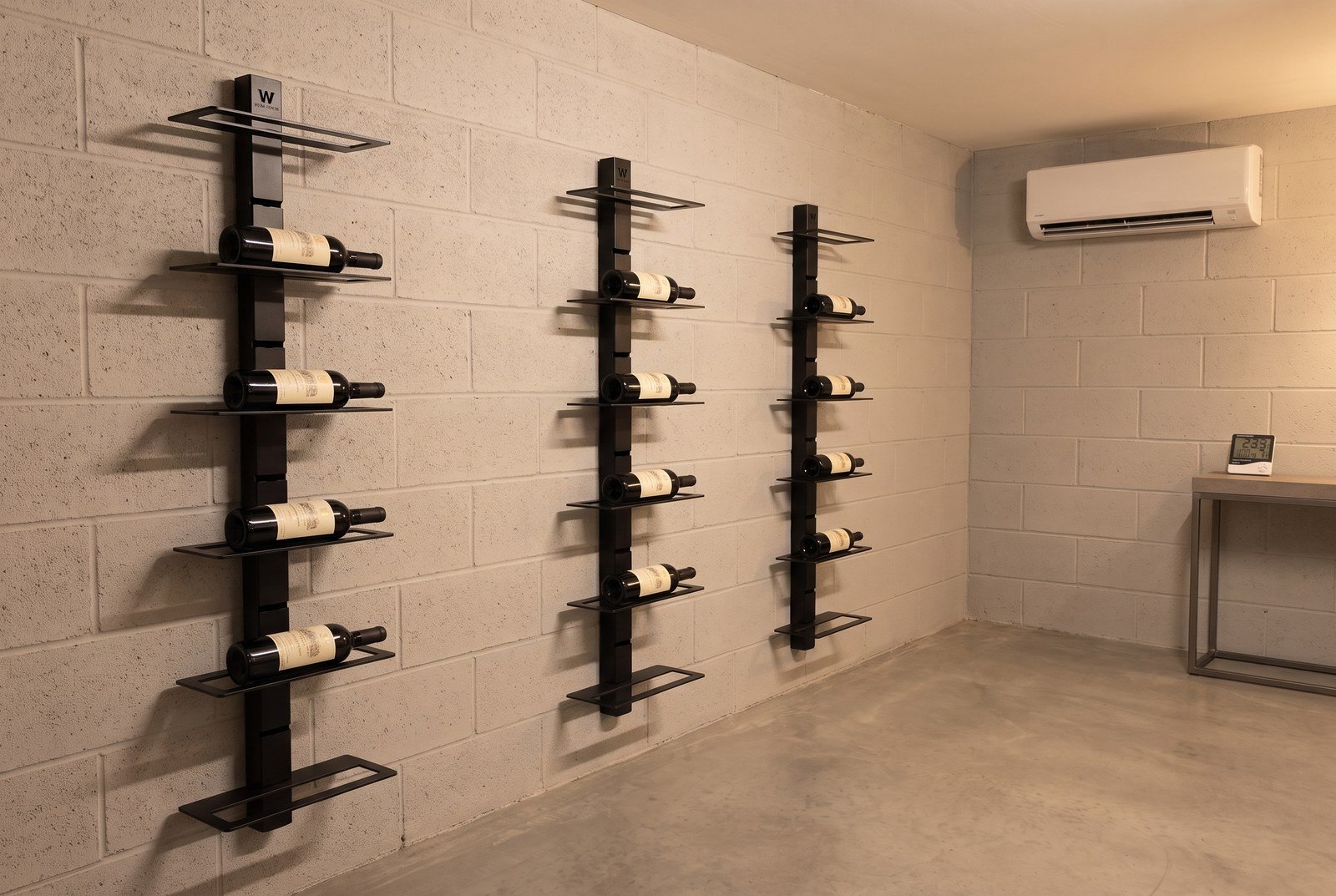
How to Climate-Control a Wine Cellar—and When You Can Do Without It
A well-insulated and properly ventilated underground cellar often maintains a stable storage temperature year-round without consuming a single watt. Many people buy an air conditioner to fix a problem that actually stems from the door, the ceiling, or a poorly placed vent. Before you start looking at prices for a unit, you need to determine whether you really need one—and, if so, which one to choose. Let’s start with a key question.

Does your wine cellar really need to be air-conditioned?
Note: Air conditioning corrects a flaw in the room; it does not replace it.
Set up a recording thermometer in the room and let it run for a full year. You'll know everything.
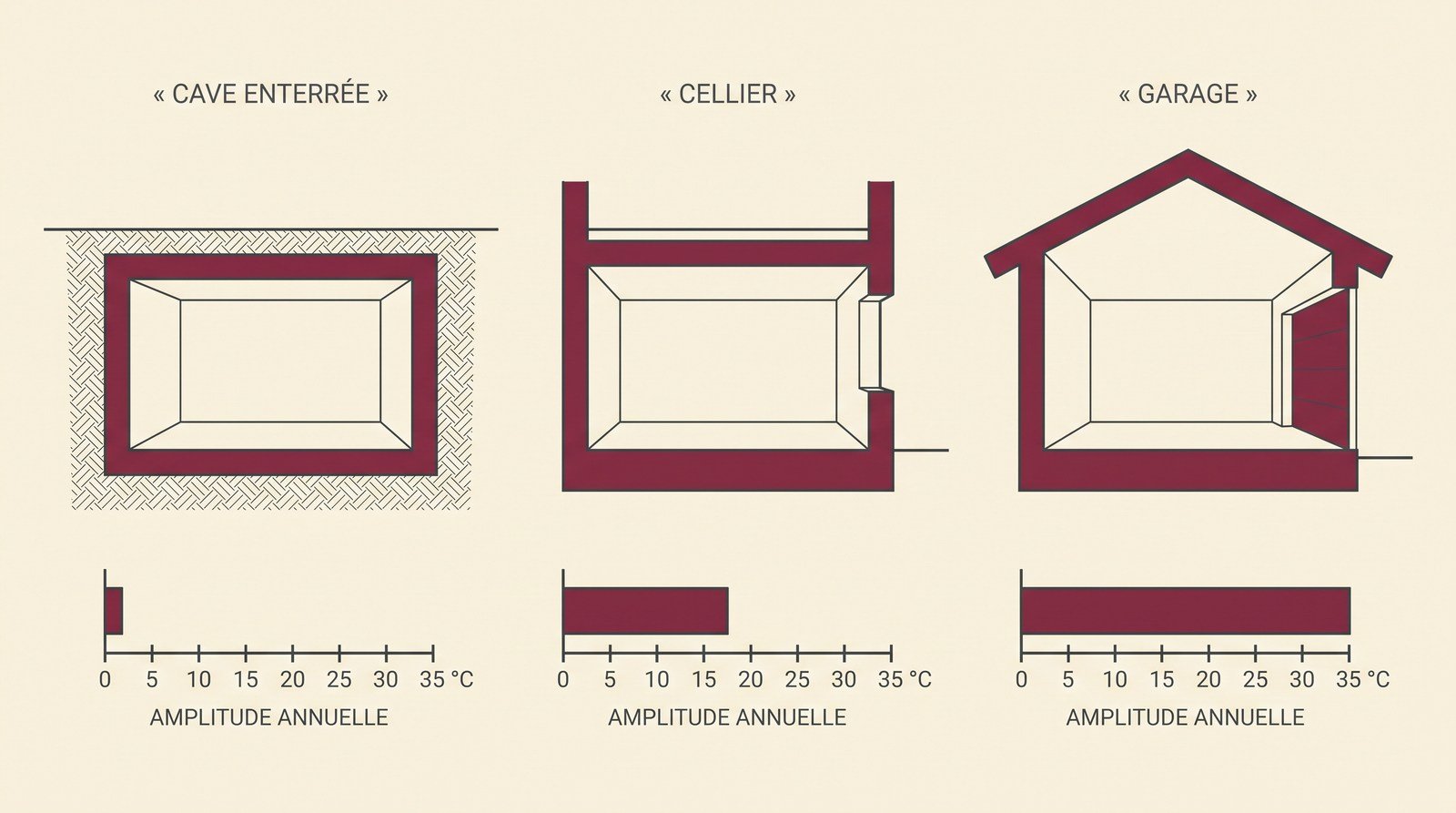
- Whether it’s a fully or partially underground cellar with thick walls and a clay floor, in most cases the thermal mass of the soil is sufficient—provided the ceiling is insulated if it’s located beneath a heated room, and the door closes properly. Also keep in mind that an underground cellar tends to maintain the average annual temperature of your region, which is closer to 15 °C in the south than to 12 °C.
- Pantry, laundry room, ground-floor room: temperature is fine in the winter but gets too hot in the summer. Start by adding insulation—a few centimeters of extra insulation on the exposed walls and an insulated door.
- Garages, attics, and rooms facing a south-facing wall: in these areas, the annual temperature range is too extreme. Insulation alone won’t be enough. Air conditioning becomes a real issue.
An air conditioner is only effective once the room has been insulated. In a room with drafts, it runs constantly, uses more energy, wears out faster, and makes noise—all for mediocre results. Insulate first, then use air conditioning if necessary.
What are the ideal temperature and humidity levels for a wine cellar?
Reliable sources indicate that the ideal storage temperature ranges from 10 to 14 °C, with 12 °C often cited as the benchmark. The important thing is not to aim for a specific temperature, but to maintain a stable temperature. A cellar that stays stable at 15 °C preserves wine better than one that fluctuates between 10 and 18, even if it causes the wine to age slightly faster than a cellar at 12 °C.
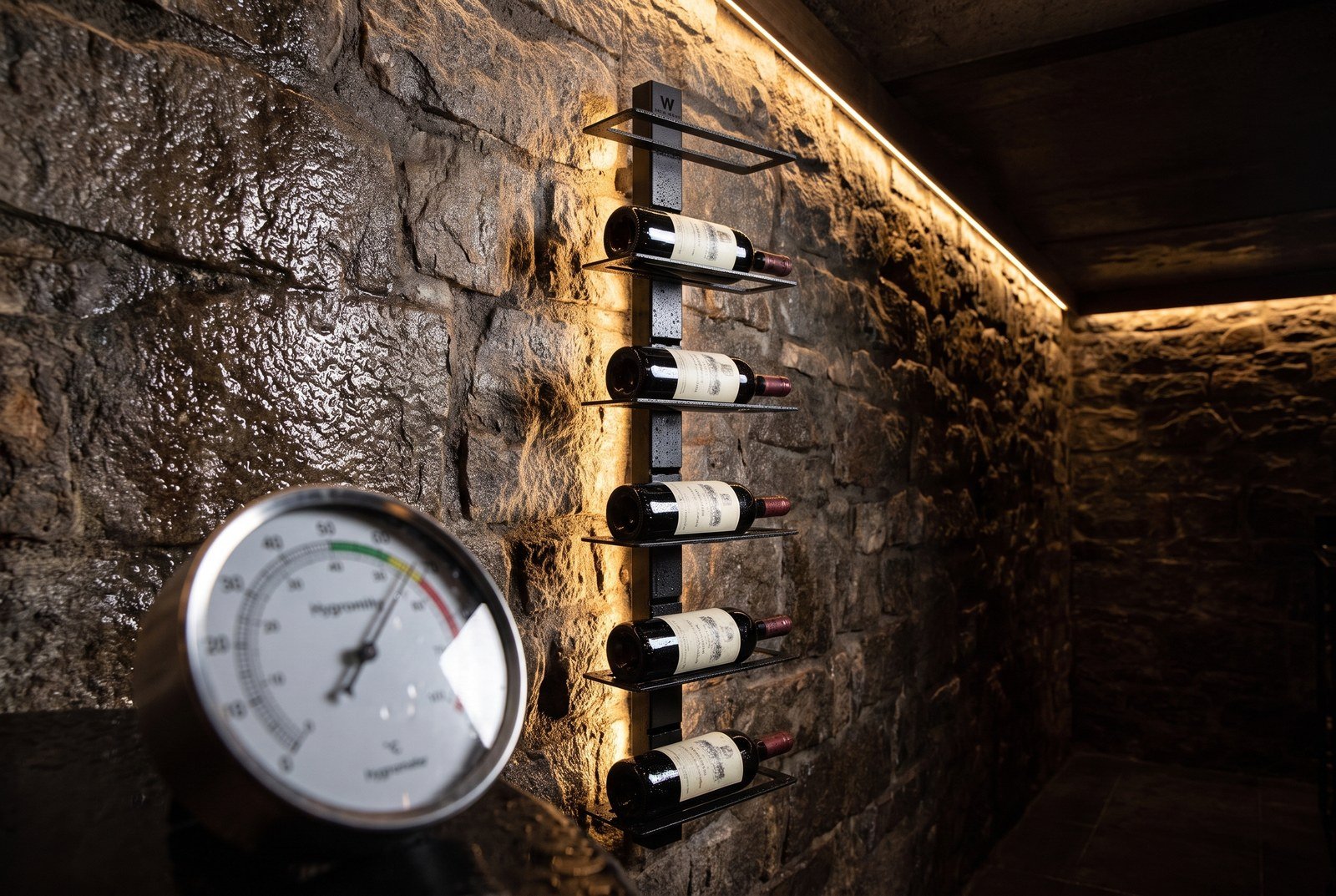
As for humidity, the acceptable range is broad—from 50 to 80 percent—with about 70 percent often cited as the optimal level. Aiming for 60 to 75 percent puts you comfortably in the middle: humid enough to keep the cork plump, but not so much that the labels peel off or the boxes get moldy.
Storage temperature: approximately 10 to 14 °C; the goal is stability rather than an exact value.
Humidity: safe range of 50 to 80%; the optimum level is often cited as around 70%.
Manufacturer-specified noise level: approximately 46 to 51 dB for a built-in monoblock unit, around 40 dB for the indoor unit of a split system.
Power: Manufacturers typically specify around 20 to 25 W per cubic meter of properly insulated cellar space.
Monobloc, split, or ducted: Which one is right for your basement?
| Type | Principle | Appropriate volume | Noise in the basement | Installation Requirements | Who is it for? |
|---|---|---|---|---|---|
| Built-in Monobloc | A single unit passing through the partition wall, with heat dissipated into the adjacent room | About 10 to 50 m³ | Moderate, 46 to 51 dB depending on the model | Cutting through a partition wall, with a well-ventilated waste room behind it | Standard-sized basement, reasonable budget, unoccupied adjoining room |
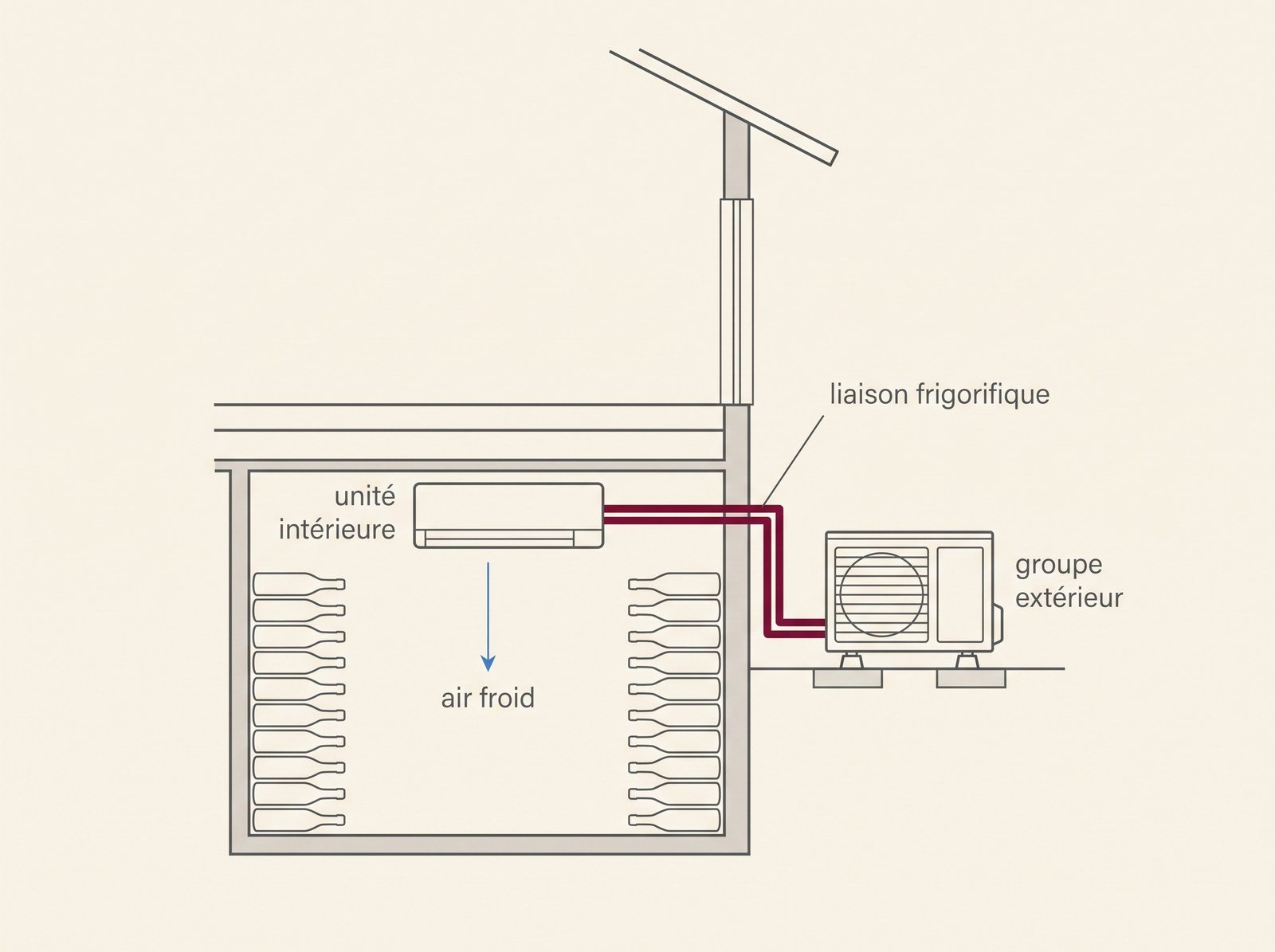
| Split | Indoor unit in the basement; outdoor unit located outside or in a ventilated room | Up to about 100 m³ | Quiet—about 40 dB; the compressor is located elsewhere | Refrigeration piping installed by a certified refrigeration technician (required) | Basement adjoining a living area; quiet environment required |
| Ducted | Remote production, with air supplied to the cellar through ducts | Medium and large volumes | Very quiet; nothing noisy in the basement | A ductwork system should be planned, ideally before construction begins | Large basement, new construction, or major renovation |
| Portable Air Conditioner | Appliance on casters, vented through the window | None, in practice | The highest one—the whole group is in the room | None, and that's the problem | No one |
Why should you avoid using a portable air conditioner in a wine cellar?
Its minimum setting is around 16 °C; you'll never be able to get it down to 12 °C. It dries out the air, it's not designed to run continuously all year round, and its duct creates negative pressure in the room, which draws in warm, humid outside air.
How do you determine the right capacity for an air conditioner in a wine cellar?
Calculate the actual volume of the cellar in m³. Manufacturers design their units to provide approximately 20 to 25 W of cooling capacity per m³ of properly insulated cellar: a 25 m³ cellar requires a unit with 550 to 600 W of cooling capacity, while a 10 m³ cellar requires a unit with approximately 250 W of cooling capacity.
This is just an order of magnitude. The actual calculation is a heat balance, which depends on the room’s insulation, the target temperature, the temperature difference with the adjacent room, and how often the door is opened. In a poorly insulated room, the heating requirement increases. Have the calculation verified before placing an order: an oversized unit will constantly start and stop, drying out the air and making noise for no reason.
How do you install an air conditioner in a wine cellar?
- Location. The unit blows cold air. Do not place it directly above the bottles or facing the labels.
- Condensate. Depending on the model, condensate is either drained through a pipe—using gravity to flow to a low point—or re-evaporated in the basement using a dedicated tray. The second option eliminates the need for a connection and retains moisture. Check how your unit works before drilling.
- Vibrations. Strong, prolonged vibrations have been shown to be harmful to wine; the effect of the microvibrations from a compressor, on the other hand, is minimal and poorly documented. Anti-vibration pads remain an inexpensive precaution, and many appliances already come equipped with silent blocks.
- Regulations. Installing a split-system air conditioner involves handling refrigerant. This is not just a safety precaution: Article R543-78 of the Environmental Code and the European F-Gas Regulation (EU 2024/573) require that the work be performed by a company holding a certificate of competence. Good news for everyone else: a hermetically sealed monobloc unit containing less than 2 kg of refrigerant is exempt from this requirement; putting it into service requires only an electrical connection.
How can you prevent the air conditioning from drying out the basement?
Generally, the evaporator in conventional room air conditioners operates below the dew point. Water vapor condenses there and is removed from the air.
A unit designed for a wine cellar does the opposite. It operates with an evaporation temperature maintained above 0 °C and often re-evaporates its condensate in the cellar to minimize drying. However, it does not humidify the air: if the humidity level remains low, this is achieved using a dedicated accessory, not the air conditioner itself.
A moisture meter that costs just a few euros will tell you how things are going. Keep the gravel soil slightly moist—use a small dish of water or a humidifier.
A wine cellar is therefore a space that is consistently kept in a humid environment, whether or not it is climate-controlled. If you install metal storage units on the walls, opt for a protective finish: this is what sets our versionof the wall-mounted wine rack made of lacquered steel apart—though keep in mind that no lacquer can replace proper care for the edges and drill holes.
Frequently Asked Questions
What is the ideal temperature for a wine cellar?
Between 10 and 14 °C. Above all, remember that stability is more important than the exact temperature.
What kind of air conditioner is best for a small wine cellar?
A built-in monoblock unit is suitable in most cases, provided two conditions are met: the space must be within the unit’s capacity range, and there must be an unoccupied, well-ventilated area behind the partition to accommodate the heat it emits.
Can you use a standard air conditioner in a basement?
No. It doesn't lower the setpoint enough, it dries out the air, and it isn't designed to operate at low temperatures year-round.
How much does installation cost?
Prices vary widely from one installer to another depending on the type of appliance, the size of the installation, and the difficulty of the job. Get two or three quotes rather than relying on a price listed online.
A wine collection that grows at your own pace.
Modular wall-mounted shelves in raw or lacquered steel. Holds up to 22 bottles per module, 2-year warranty, free shipping on orders over €350.
Explore the collectionExcessive alcohol consumption is harmful to your health. Please drink responsibly.