
How to Build a Wine Cellar Yourself: The Complete Guide
You’ve got bottles piling up in a corner of your living room, standing upright and exposed to light, and you know deep down that this isn’t right. Fine bottles meant for aging deserve better than an overheated closet. The good news is that setting up a wine storage space at home is still doable—even without a contractor and even without a vaulted room. This guide covers the conditions you need to meet, choosing the right room, insulation, and then the part that’s almost always overlooked: bottle storage. By the end, you’ll know whether your home is suitable for natural aging or if you need active temperature control, and how to set up a storage system that showcases your wines.
- Aim for a temperature of around 12 °C that remains fairly stable: sudden fluctuations are harder on the wine than a few extra degrees.
- Maintain a humidity level of 65 to 75% to keep the corks supple.
- Keep the bottles in a dark place, away from direct light and fluorescent lights.
- Avoid vibrations (washing machine, people walking by, nearby road).
- Ensure gentle ventilation without any odor-laden drafts.
- Lay the bottles on their sides and store them so that each label remains legible.
Why set up your own childcare space?
The first reason is financial. A turnkey wine cellar installed by a contractor can quickly become expensive. By handling the insulation and storage yourself, you can keep costs under control and tailor each aspect to your budget.
The second reason is more personal. Choosing the location, organizing your wines, watching the collection grow along a wall—that’s part of the fun. A wine lover who organizes his own collection knows his cellar by heart.
Finally, a well-designed storage space enhances the value of your purchases. A large bottle meant for aging, when stored properly, will live up to its promise when you open it. If stored improperly, it will quietly deteriorate.
Can be done in almost any location
People often imagine the ideal wine cellar as being underground, beneath an old house. That’s the ideal scenario, but it’s rare. Most projects are set up elsewhere: a basement, a pantry, a laundry room, a corner of the garage, or sometimes a closet under the stairs that’s thoroughly insulated.
Every space has its own challenges. A garage, for example, requires special attention when it comes to insulation and seasonal changes. If that’s the route you’re taking, this dedicated guide explains how to set up a wine cellar in a garage.
Natural aging or electric aging: Which option should you choose?
Before drilling into any wall, ask yourself the real question: Can your space maintain the right conditions on its own, or does it need a machine to help?
A natural or underground storage area
A buried or semi-buried cellar takes advantage of the soil’s thermal inertia. The earth moderates seasonal temperature fluctuations: it stays cool in the summer, mild in the winter, and the temperature changes slowly. It’s the ideal environment for long-term aging.
Some solutions go a step further, such as helical wells, which are installed beneath a slab by digging a cylindrical shaft. They’re effective, but they depend on the building structure and involve a major construction project.
If you're lucky enough to have a cool, damp basement, you're already off to a good start. The work then mainly involves stabilizing what's already there and organizing everything properly.
The electric wine cooler and the wine cellar air conditioner
Not all homes meet these conditions. A room on the top floor, or one that’s too dry or too hot—in those cases, active temperature control is needed.
There are two options.The electrical cabinet (the aging or serving cellar) controls both temperature and humidity on its own within an enclosed space, much like a large, dedicated refrigerator. To set up an entire room, however, you’d install a cellar air conditioner—a unit that cools the space and helps maintain the desired humidity level; in very dry conditions, a supplemental humidifier completes the climate control system.
Let’s be clear about one thing: a storage system—whether it consists of racks or shelves—doesn’t cool anything. It organizes and displays the bottles; it doesn’t replace a machine. If your room can’t maintain the proper conditions on its own, you should look into an electric wine cooler or a wine cellar air conditioner, not furniture. We’ll come back to this in the section on storage.
Storage conditions to be followed
It all starts here. Before the wall, before the shelf, there are four or five physical factors that determine the fate of your bottles. Here are the key points—and what you risk if you ignore them.
| Setting | Target Value | Risks if we deviate from it |
|---|---|---|
| Temperature | ~12 °C, mostly stable (10 to 14 °C) | Accelerated aging in warm conditions, stagnation in cold conditions, leaks if there are fluctuations |
| Humidity | 65 to 75% | Too dry: cork shrinks, oxidation. Too damp: mold, labels peeling off |
| Light | Almost total darkness | The “hue of light” (UV, but also visible blue light), especially on whites and bubbles |
| Vibrations | Minimum | Disturbed sediment and agitation disrupt aging |
| Ventilation | Light Air Exchange | Stale air and odors (paint, fuel oil) that seep through the cap |
Temperature, and especially its stability
Keep this number in mind: 12 °C. That’s the standard target temperature for wine storage. But the temperature range is more important than the exact value. A room that stays at a constant 15 °C provides better protection than one that fluctuates between 8 and 20 °C over the course of several months.
The pressure surges cause the liquid to expand and then contract, wear down the plug, and eventually allow air to escape. So keep anything that generates heat—such as a boiler, hot water tank, or pipes—away from it.
Moisture: The Enemy of Corks
A good moisture content—around 65 to 75%—keeps the cork supple and airtight. Below 50%, the cork dries out and shrinks, allowing oxygen to seep in. Conversely, above ~80%, the risk of mold and warped labels increases significantly; it’s therefore best to stay at the lower end of the range in a room that’s already humid.
A clay floor or a stone wall naturally provides this humidity. In a dry room, a container of water, damp sand, or a humidifier can help correct this.
Light, quiet, and smells
Darkness is your friend. It’s not just about UV light: the blue component of visible light (daylight, neon lights, certain cool-colored LEDs) also triggers the “taste of light,” especially in white and sparkling wines. Darkness, therefore, remains the best protection. An energy-efficient light bulb is sufficient for tastings; avoid direct and constant light.
To keep things quiet, keep the storage area away from sources of vibration: washing machines, busy stairways, and traffic lanes.
One last point that’s often overlooked: odors. The air should circulate gently, without carrying any lingering smells of fuel, fresh paint, or household cleaning products. While this risk is secondary to temperature concerns, a well-ventilated basement free of damp cardboard boxes easily eliminates it.
Choosing and Preparing the Space
Once you have the target values in mind, take a look at what your home actually offers. The goal: to find the coolest, most stable, and quietest spot, and then improve it.
Rate the song
Take a look at the different options. A north-facing basement with no windows is almost always the best choice. Check three things: the orientation (avoid south-facing basements and floor-to-ceiling windows), the type of walls (stone and concrete provide better stability than bare drywall), and the condition of the floor.
Set up a thermometer-hygrometer for a few weeks, ideally spanning two seasons. The readings will tell you whether the location is suitable as is or if it needs to be equipped.
Insulation, Vapor Barrier, and Ventilation
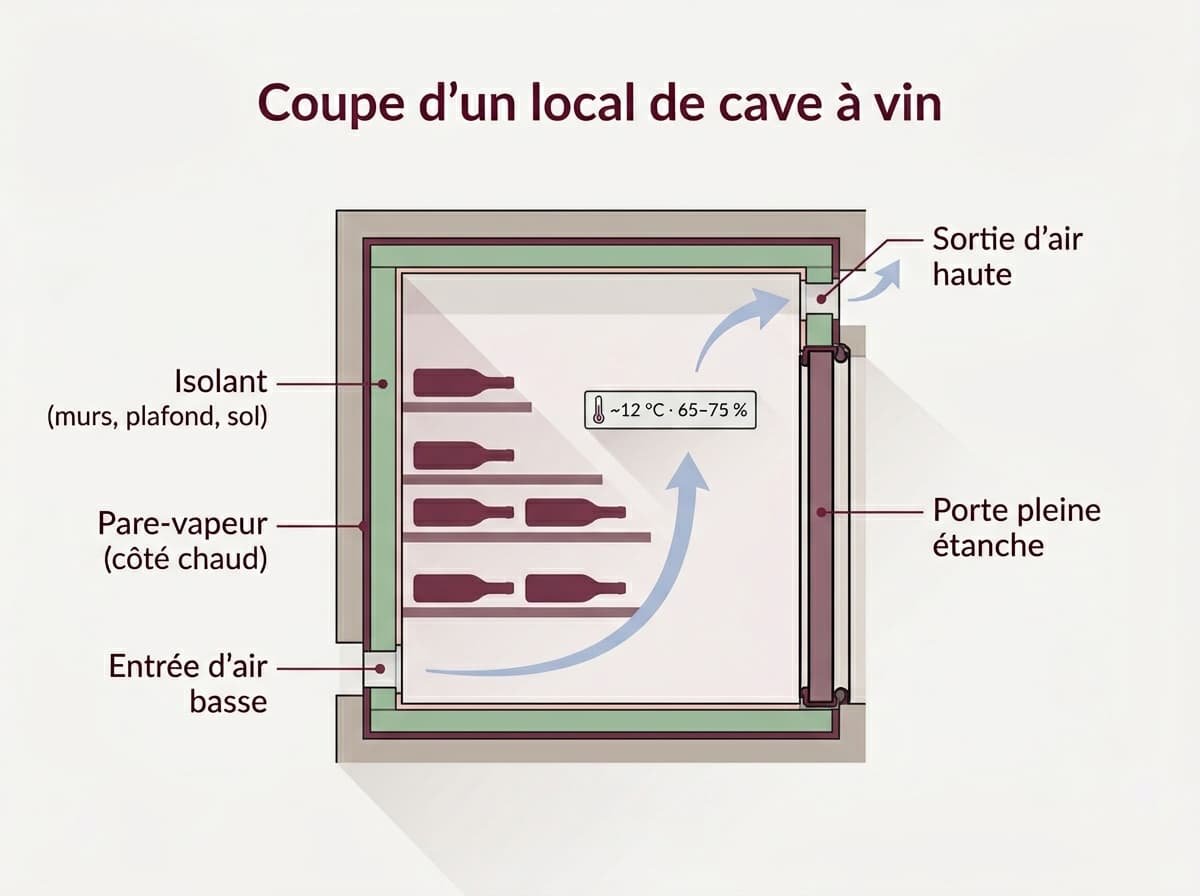
This is the technical aspect of the project. A well-insulated building envelope minimizes temperature fluctuations and reduces—or even eliminates—the need for active temperature control.
- Wall and ceiling insulation: polyurethane panels, expanded cork, or wool, depending on your budget. Cork has the advantage of effectively managing moisture.
- Vapor barrier: A membrane on the warm side prevents condensation from forming inside the insulation.
- Insulated door and seals: A solid, well-sealed door prevents cold air from escaping.
- Controlled ventilation: one or two vents or a low-flow mechanical ventilation system refresh the air without creating drafts or drying out the room.
Prepare the walls before installing anything. Once the shelves are in place, it becomes difficult to get back to the insulation.
Storing and Displaying Bottles
This is a topic that most guides gloss over in just a couple of lines. They’re wrong to do so. A good layout protects the bottles, saves space, and, incidentally, turns a bare wall into a beautiful display. It’s also key to ensuring quick access to and easy visibility of the collection.
Lay the bottles down, keep them accessible
General rule for long-term storage: store the bottle on its side. This is the widely recommended method, as it keeps the wine in contact with the cork. Two useful caveats: science now suggests that this isn’t absolutely necessary for still wines (in a humid cellar, the saturated air is enough to keep the cork supple), and in any case, it applies only to cork; a bottle sealed with a screw cap or synthetic stopper can be stored upright without any problem. In practice, however, storing bottles on their sides remains the best practice: it provides extra protection and saves space.
Also think about accessibility. You should be able to grab a bottle without moving ten others, and read the label without taking the bottle out of its box. A cluttered wine cellar, with bottles piled up in boxes, always ends up the same way: forgotten purchases buried at the bottom, and the wrong bottle opened at the wrong time.
Lockers, racks, or shelves: Which system should you choose?
Three major categories of materials make up the section. Each has its own rationale. The table below summarizes what truly sets them apart.
| Criterion | Wood | Metal / Steel | Stone or concrete |
|---|---|---|---|
| Moisture Resistance | Sensitive: May swell or develop mold in very humid conditions | Very good (excellent if the steel is painted) | Unfeeling |
| Modularity | Often fixed (fixed locker) | Elevated: elements that are added and repositioned | Virtually zero (heavy, sealed) |
| Highlighting the Label | Varies by model | Unobstructed front, visible label | Bottle often inserted into a compartment |
| Maintenance | Recommended antifungal treatment | Cloth or wax on raw steel | None |
| Do-It-Yourself Installation | Average | Single wall-mounted | Heavy, sometimes masonry |
No material is perfect in every way. Stone is timeless but makes the layout inflexible. Wood has charm, provided it’s treated to withstand ambient moisture. Steel checks many boxes when you’re looking for a DIY, adaptable setup that can withstand the damp air of a basement.
A wall-mounted solution: the modular steel shelf
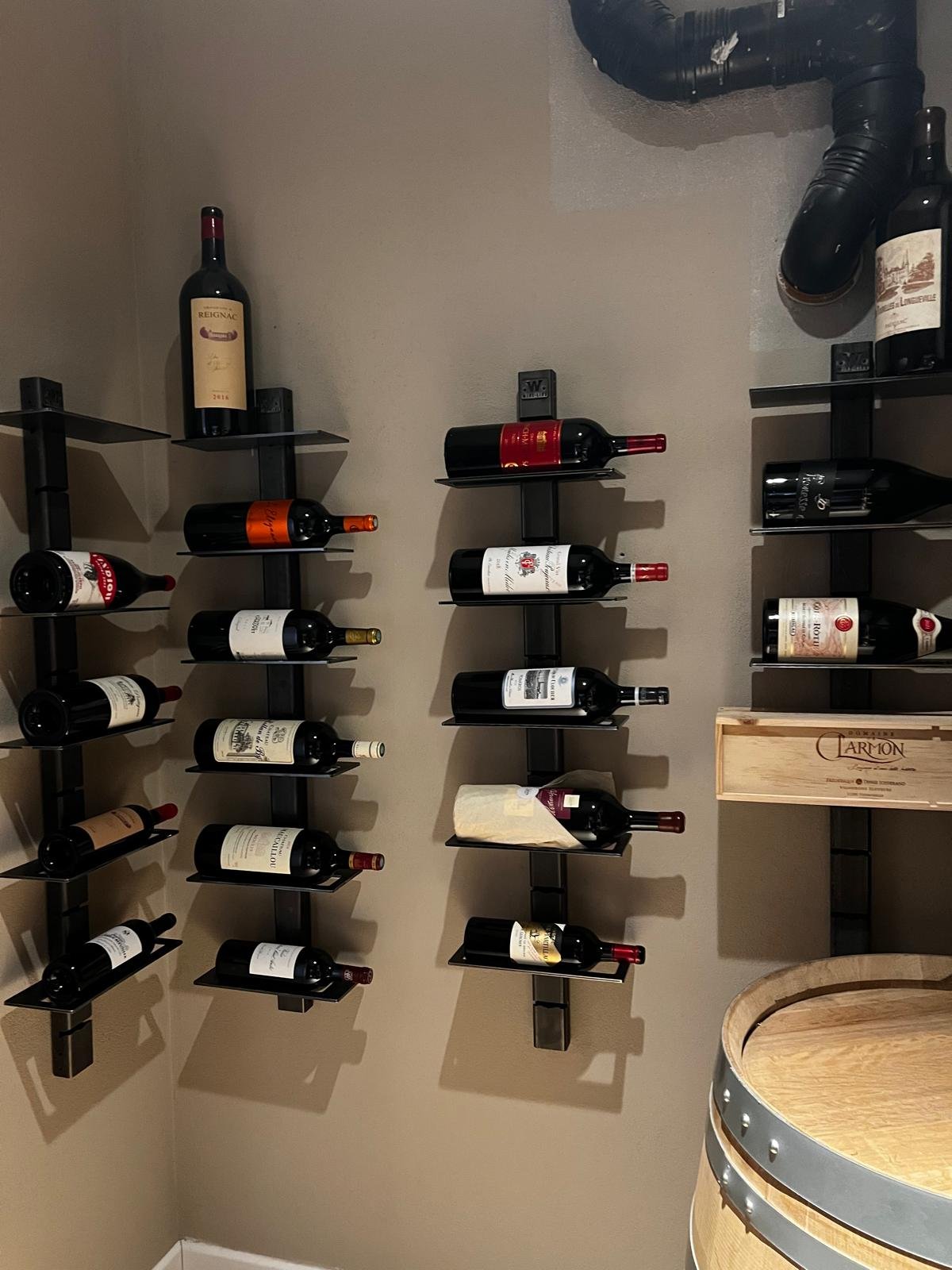
If you're setting up a wall display, Wine Line®'s modular steel wall shelving system is worth checking out. The concept: a vertical frame mounted on the wall, onto which shelves clip into place and can be repositioned without tools.
A few concrete points that speak to a homemade project:
- Space-saving wall-mounted design. A structure that is 118 cm high takes up only 30 cm in width and 14.8 cm in depth. You make use of vertical space rather than floor space.
- Modular, so it can be expanded. Start small, add shelves as your collection grows, and place multiple units side by side to create a full wall of bottles. Up to 11 bottles per module on single shelves, up to 22 on double shelves.
- Steel isn't affected by humidity the way wood is. It doesn't swell and doesn't transfer moisture to the bottles. The unfinished steel develops a patina over time (and requires a little wax if the humidity exceeds 70%); the lacquered finish is completely resistant to humidity, making it ideal for vaulted cellars.
- Front label. Bottles stored on their sides, with the cork in contact with the wine, display their labels on the front. You can identify a vintage at a glance—including magnums.
- Installation takes just a few minutes. One person is all it takes; a drilling template is included. It takes less than 5 minutes on wood or OSB, and about 10 minutes on concrete.
Just to be clear, following up on what we said earlier: this type of shelf is designed for storage and display; it does not regulate temperature. It is meant to complement a space that is already well-ventilated (or equipped with a cellar air conditioner), not to replace it.
To learn more: the Wine Line® concept, the complete kit, the shelf panels in raw steel or lacquered steel (depending on the humidity level in your room), and the installation guide so you can set it all up yourself.
Building and Selecting Your Wine Collection
The room is ready, and so is the storage space. Now we just need to fill it the right way.
How many bottles, and how are they distributed?
It all depends on your pace. To start with, about fifty bottles will give you plenty of leeway. Keep in mind there are two categories: wines for immediate enjoyment (to be drunk within the year, which you’ll replace) and wines for aging (which you’ll let mature for several years).
When it comes to colors, a common breakdown is roughly a majority of reds, one-third whites, and a portion of rosés and sparkling wines, depending on your tastes. Tailor this to what you actually drink, not to some theoretical guideline.
Organizing and Keeping Track of Your Collection
A classification system is extremely helpful. Whether by region, vintage, or peak drinking window—it doesn’t matter what logic you use, as long as it’s your own. Reserve the lower, cooler areas for wines with long aging potential.
Keep a wine log, either on paper or using an app. Note down the purchase date, the location, and the ideal opening date. No more forgotten bottles that pass their peak without you even noticing.
Frequently Asked Questions
How do you build a wine cellar yourself?
First, identify the coolest and most stable room in your home, measure its temperature and humidity over several weeks, and then insulate the walls, ceiling, and door with a vapor barrier. Add gentle ventilation, install suitable storage, and use active temperature control only if the room cannot maintain the proper conditions on its own.
What are the steps to building a wine cellar?
In summary: choose a location, assess the existing conditions, insulate and install a vapor barrier, manage ventilation, install shelves or racks, and then fill and organize the collection. Insulation should always be installed before storing items.
What materials should you use to build a cellar?
For the exterior: insulation (expanded cork, polyurethane, or wool), vapor barrier, and a solid, weatherproof door. For storage: moisture-resistant wood, steel (unfinished or painted), stone, or concrete, depending on aesthetics and available space. Wall-mounted steel has the advantage of being resistant to moisture and easy to install on your own.
How do you set up a wine cellar?
First, stabilize the environment (temperature, humidity, darkness, quiet, ventilation), then organize the space for easy access: store bottles on their sides, keep labels visible, and place wines meant for aging on the bottom shelves. A modular wall-mounted storage system frees up floor space and allows the wine cellar to grow along with your collection.
What are the best conditions for storing wine?
A temperature of around 12 °C that remains stable, humidity between 65% and 75%, darkness, minimal vibrations, and fresh, odor-free air. Stability is more important than the exact value.
What equipment do you need for a wine cellar?
A thermometer-hygrometer for monitoring, storage (cabinets, racks, or wall shelves), and, if necessary, climate control: an electrical cabinet for a small space, or a wine cellar air conditioner for an entire room. A humidifier or a simple container of water can correct a room that’s too dry.
How do I choose the right location for my wine cellar?
Choose a cool, dark, quiet place that is not subject to temperature fluctuations: a basement, pantry, insulated garage, or well-ventilated closet. Avoid south-facing areas, heat sources, and areas with vibrations. Measure the space before making a decision.
Doing things yourself doesn’t mean tinkering blindly. Stick to the target values, pay close attention to insulation, and the rest will fall into place. When it comes time to set up your storage, a modular wall-mounted system like Wine Line® will save you space and keep your labels in plain sight, ready to grow with your collection.
A wine collection that grows at your own pace.
Modular wall-mounted shelves in raw or lacquered steel. Holds up to 22 bottles per module, 2-year warranty, free shipping on orders over €350.
Explore the collectionExcessive alcohol consumption is harmful to your health. Please drink responsibly.