
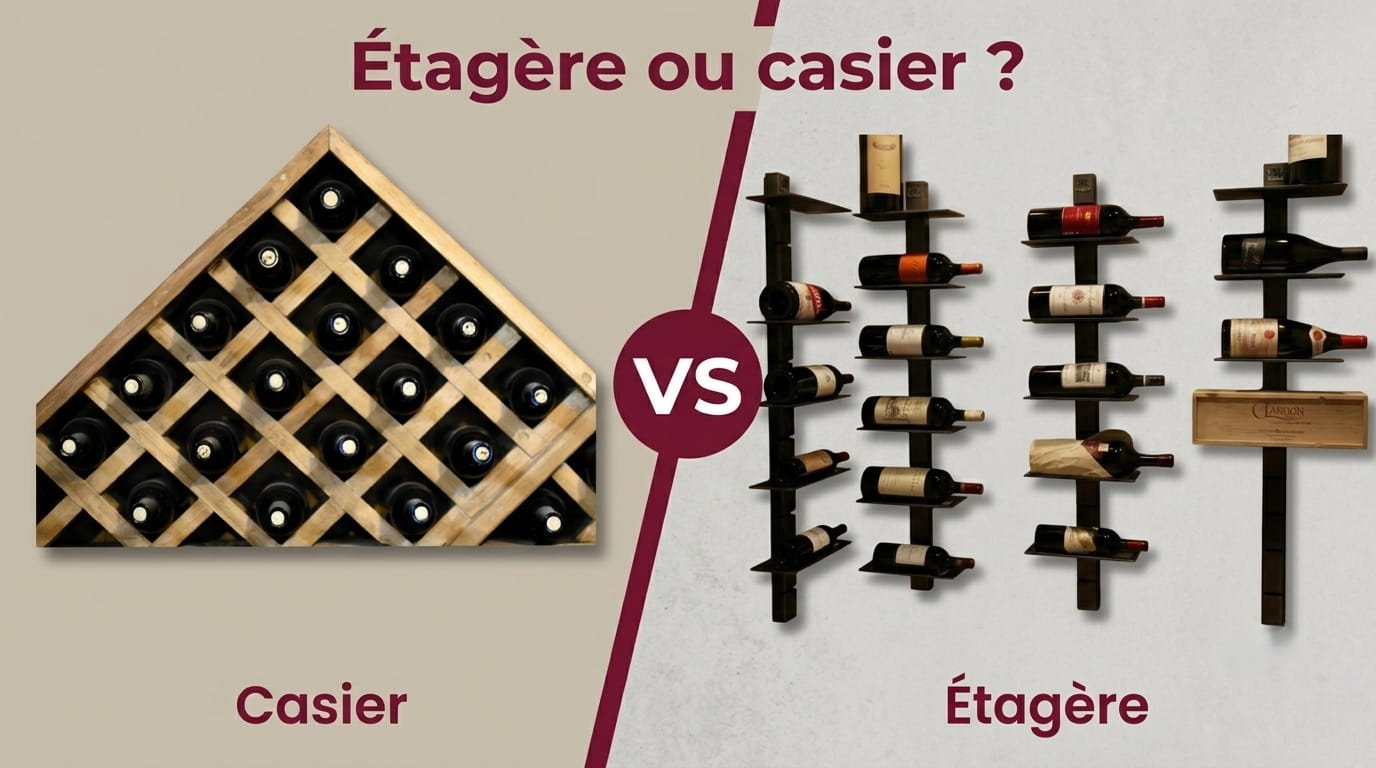
Wine rack or wine cabinet: What are the differences, and which one should you choose?
Search for “wine rack” on Google, then “wine shelf.” You’ll often come across the same products. Most retailers use the two terms interchangeably, even though they refer to two different items that aren’t placed in the same spot, aren’t filled the same way, and don’t age the same. Here’s what really sets them apart, feature by feature, and which one to choose based on your wine cellar, your wall space, and the number of bottles you plan to store.
The short answer: A wine rack is a freestanding, floor-mounted unit that can be stacked. A wine shelf is a linear, wall-mounted unit that can be extended. The former is more affordable and doesn’t require drilling. The latter saves space and is more scalable.
Wine Racks and Wine Cabinets: What Really Sets Them Apart
The wine rack: a freestanding, stackable container
A wine rack is a module enclosed on all sides, designed to hold bottles stored horizontally in compartments or between slats. It stands on its own. You set it up, fill it, and you're done.
Its design is based on volume: it occupies a cube of floor space and is filled to the top. Wood, steel, plastic, concrete, terracotta—all these materials are used. As the collection grows, a second unit is stacked on top of the first, or a third is placed next to it.
The wine rack: a fixed, linear, expandable storage solution
A wine rack, on the other hand, does not touch the floor. It is mounted on the wall and displays bottles on shelves or stacked rails. Its design is linear: you can increase storage capacity by stacking the racks vertically or by placing multiple units side by side along the length of the wall.
It isn't filled haphazardly. Each bottle has its own spot, with the label facing forward, and can be removed without moving the others. It's a storage solution that displays as much as it stores.
Why Are These Two Terms So Often Confused?
There are two reasons. The first has to do with marketing: many websites sell both items in a single category, with a title that says “rack” and a description that says “shelf.” The second has to do with usage: in everyday language, the term “rack” refers to any object designed to hold bottles lying on their sides, including wall-mounted models.
Remember the sorting rule—it's simple. Does it sit on the floor? It's a storage bin. Does it screw into the wall? It's a shelf.
The Comparison at a Glance
| Criterion | Wine rack | Wall-mounted wine rack |
|---|---|---|
| Footprint | Actual: the depth of the storage compartment + the clearance needed to access it | None: the ground remains clear beneath and in front |
| Capacity per linear meter | Depends on the stacking height | It depends on the height of the structure and the number of modules aligned |
| Scalability | By adding entire modules | By adding shelves, then structures |
| Installation | Place it against the wall; if necessary, prop it up or secure it to the wall | Drill, insert anchors, screw in |
| Required Support | A level and stable surface | A sound wall capable of bearing the load |
| Access to a bottle | Good, except on the lower or stacked rows | Available immediately, within easy reach on most tablets |
| Label Legibility | Often partial (bottle neck or base visible on the front) | Label visible depending on the model |
| Aged in a humid cellar | Depending on the material (see below) | Depending on the material and finish |
| Starting Budget | Market Low | Taller, including frame and fasteners |
| Rental / Wall—No Drilling Allowed | No restrictions | A deal-breaker without the landlord's consent |
Two rows in this table clearly show the winning combination: the initial budget and the absence of drilling. These are real selling points, not just consolation prizes. The rest of the article explains why the other rows tip the scales the other way.
Size and Capacity: Which One Holds the Most in the Least Amount of Space?
This is the most lopsided round, and it's also the one that's generally the least well explained.
A storage cabinet takes up two areas of floor space: its own, and the space needed to step back to open it and read the labels. In a small cellar measuring just a few square meters, this walkway can take up a significant portion of the room, depending on how you arrange the furniture.
A wall-mounted shelf takes up no floor space. Its only limitation is the depth it projects from the wall. As a reference, at Wine Line®, a unit is 30 cm wide, 118 cm high, and 14.8 cm deep. In its maximum configuration (11 shelves), it holds 11 bottles on single shelves and up to 22 on double shelves. A starter pack, which comes with fewer shelves, can be expanded later.
Do the math per meter of wall. Three units lined up along one linear meter, fully equipped with double shelves, can hold 66 bottles. This is on a wall-mounted section that is 118 cm high and less than 15 cm deep. The floor remains completely clear beneath the unit, leaving room for a delivery box or a tasting stool.
Verdict for this round: shelf, by a wide margin. The locker only has the edge in a room where the wall can’t support anything (unreinforced hollow partition, crumbly stone, or a false wall).
Storage: horizontal position, stability, light
In terms of the basics, both types do the same job, provided the bottle is stored lying down, as recommended by wine research institutes for cork stoppers (this isn’t an issue for screw caps). What sets them apart is what happens around them.
- Stability: A storage rack stacked two or three levels high becomes susceptible to impacts and tipping, especially if the basement floor isn't perfectly level. A properly secured shelf does not move; it is firmly attached to the wall.
- Handling: In a full rack, taking a bottle from the back causes the bottles next to it to shift. On a wall-mounted shelf, each bottle can be removed individually. First and foremost, this is a matter of convenience: taking out a bottle by hand every now and then doesn’t harm the wine, but not having to disturb an entire row makes all the difference.
- Light: Neither an open cabinet nor an open shelf provides protection from light. A shelf facing due south, behind a floor-to-ceiling window, is a poor choice regardless of the product. Reserve these exposed locations for bottles with a short rotation cycle.
- Temperature: Neither of these is an appliance. They are for storage; they do not regulate the temperature. A stable storage temperature of around 12 to 14 °C depends on the room, not the unit.
The Critical Point: Wood or Steel in a Damp Cellar
This is where the choice of material matters more than the choice of size. And there’s a paradox to be aware of: a wine cellar that stores wine well has a humidity level of around 70%, which is ideal for cork but challenging for bare stainless steel.
| Material | In a humid cellar | Maintenance | Note |
|---|---|---|---|
| Solid wood (oak, pine) | Absorbs moisture; may swell or warp over time | Treatment or wood stain, depending on the type of wood | Prone to mold if there is no air circulation |
| Engineered Wood / MDF | Not recommended for storage in a damp cellar | No maintenance required once inflated | Crumbles upon prolonged exposure to moisture |
| Raw Steel | Corrodes in a humid environment, and the higher the humidity, the faster it corrodes | Wax or light oil; reapply as needed | A raw finish that changes over time, prized for this quality in dry indoor environments |
| Powder-coated steel | Excellent resistance to moisture as long as the coating remains intact | Damp cloth | A deep scratch or impact can cause localized corrosion, which will require touch-up work |
| Plastic | Not affected by moisture | None | Utility registration, more limited mechanical maintenance |
Our recommendation: Whether in a vaulted or underground cellar, powder-coated steel remains the most low-maintenance option. Solid wood also works, provided you’re willing to accept that it will age over time and ensure proper ventilation. Raw steel, on the other hand, is best suited for dry interiors, where its evolving appearance becomes an asset rather than a maintenance concern.
Installation: Lay or Secure
What the record doesn't show
Nothing, or almost nothing. A flat surface, possibly a wedge, and for tall stacks, a safety anchor against the wall to prevent tipping. No tools are needed in most cases.
That’s the killer argument in favor of the storage unit, and it holds up. Whether you’re a renter, have walls in poor condition, or just want to rearrange everything in six months, a storage unit solves the problem.
What a wall shelf requires
A sound wall and fasteners rated for the load. At Wine Line®, the fasteners provided are 5 × 50 mm and include a drilling template; choose the appropriate anchors based on the type of wall. Always ensure that the load does not exceed the maximum load capacity indicated on the product sheet.
Concrete, solid brick, wood, 22 mm OSB: no problem. Hollow brick, hollow concrete blocks, and drywall: anchors suitable for the substrate are required, and preferably a 22 mm MDF or OSB backing behind the panel. Don’t cut corners here—this is the only place where a wine rack could go wrong.
In practice, installation is quick. One person is all it takes—it takes less than 5 minutes on wood or OSB and less than 10 minutes on concrete.
Verdict for this round: the locker. No drilling, no questions about the wall. If you can't drill, the debate ends here.
Scalability: As the Collection Grows
A 30-bottle wine collection rarely stays a 30-bottle collection forever. This is the factor people tend to underestimate at the time of purchase—and the one they come to regret two years later.
The storage unit expands in blocks. You purchase an entire module, then stack or line them up. It works, but the increment is too large: you can’t add just five spaces; you have to add a whole unit, with all the floor space it takes up.
The modular shelving system offers finer adjustments. On a Wine Line® frame, the shelves clip into place and can be repositioned without tools: you can switch from single to double shelves to maximize storage density, move up a level when you buy magnums, or add another frame when wall space allows. Your initial purchase is never wasted.
The fact that the system is 100% modular makes a real difference in the cost of scaling up from 50 to 100 bottles: you buy shelves, not a new unit. If you want to see how the structures and compatible shelf sets are put together, everything can be combined using the same base.
Verdict for this round: a shelf, provided it’s truly modular. A fixed wine rack, sold as a single unit, offers no advantage over a rack from this perspective.
Aesthetics and Presentation of Bottles
The rack displays the bottoms of the bottles, and sometimes the necks. It’s simple, often made of warm-looking wood, but it says nothing: you don’t know what you have until you take the bottles out one by one.
When designed for this purpose, a wine rack displays the labels on the front. You can take in your entire wine collection at a glance. This is a real asset behind a bar or in a winery’s showroom: the selection becomes a visible selling point, and service is faster.
When it comes to the overall look, it all depends on the style of the room. The wooden rack evokes a traditional feel—think vaulted cellars and stacked wine crates. The steel shelf, on the other hand, has a more contemporary vibe—a graphic wall of bottles, clean lines, and drop shadows. Neither is inherently better than the other. But in a living room or open kitchen, a wall-mounted display works better than a freestanding unit.
Which format is best for which profile?
You have neither floor space to spare nor a dedicated room. The issue of space is the deciding factor.
Verdict: wall shelf. One or two units in a hallway, entryway, or kitchen, and the floor stays clear.
The constraint is administrative or structural, not aesthetic.
Verdict: storage cabinet. No serious alternatives. You'll need to get a shelf for your next place.
Your collection is going to grow, and you'll want to be able to find your bottles without having to move everything around.
Verdict: modular shelving unit. You can add shelves to match the collection without having to buy a new piece of furniture for each level.
The lineup must be visible, accessible during service, and able to keep up with the pace.
Verdict: a wall-mounted shelf, running along the back of the bar. The storage bins are reserved for aging wine and partially opened cases.
What if the correct answer were both?
This is the setup we see most often among our customers who keep a lot of bottles, and it makes sense.
The crates remain on the floor in the cellar for bottles meant for aging that won’t be touched for several years. Minimal handling, plenty of storage space, and controlled costs.
The shelf takes center stage in the living room or at the front of the wine cellar, for bottles you’re rotating through and those you want to display. Legible labels, immediate access, and an eye-catching display.
In other words: the cabinet is for storage, the shelf is for display. This arrangement avoids the main drawback of open-shelf wine cellars—the forgotten bottle hidden behind a case, which you don’t find until three years later.
If you'd like to explore options beyond these two types (underground wine cellar, wine cabinet, bar cabinet), our guide to choosing wine storage covers all the options.
Wine Line® systems are wall-mounted structures made of 2 mm steel (H 118 × W 30 × D 14.8 cm) with clip-on shelves: up to 22 bottles per module in the maximum configuration, or up to 6 magnums; installs on wood in less than 5 minutes. Complete kits starting at €149, 2-year warranty, free shipping on orders of €350 or more (including tax).
View the entire line of wall-mounted wine racksFrequently Asked Questions
What is the difference between a wine rack and a wine cabinet?
A storage bin is a freestanding container that sits on the floor and can be stacked. A shelf is a unit mounted on the wall that extends both vertically and horizontally. The storage bin requires no drilling, while the shelf keeps the floor completely clear and makes the labels visible.
How do you choose a wine rack?
First, consider the material in light of the room’s humidity (MDF should be avoided in a damp basement), then its stability when stacked, the capacity per module, and the available depth. Also make sure the compartments accommodate your bottle sizes: a Bordeaux bottle is about 7.5 cm in diameter, a Burgundy bottle is 8.5 to 9 cm, and a magnum ranges from 10 cm (Bordeaux) to nearly 11 cm (Burgundy). These dimensions are not standardized—only the volume is—so measure your bottles if in doubt.
What materials should you use for a wine rack?
Solid wood for a traditional look, steel for strength and sleek lines, and plastic for a tight budget. With steel, the raw finish offers a look that changes over time but corrodes in humid conditions and requires maintenance with wax or oil, whereas powder-coated steel withstands humidity very well as long as the coating remains intact and can be cleaned with a damp cloth.
How do you store wine bottles properly?
Stored on their sides, as recommended by wine research institutes for cork-sealed bottles. Protected from direct light and prolonged vibrations. In a room with as stable a temperature as possible. And arranged so that you can read the labels without having to move everything around—otherwise, half the cellar ends up forgotten.
What are the benefits of a wine rack?
A low initial cost, no mounting hardware required, full compatibility with rental properties, and the ability to be installed on walls that can’t support any weight. It’s also the simplest solution for storing large quantities of bottles meant for long-term aging that won’t be moved.
Are wine racks modular?
Some are designed this way, by stacking or placing identical modules side by side. The modularity remains coarse: the increment is an entire compartment, with the corresponding footprint. A shelving unit with clip-on shelves allows for finer adjustments, shelf by shelf.
What's the best choice for my collection?
For fewer than 40 bottles and when there’s no need to drill holes, a wall-mounted rack is sufficient and frees up space in the room. For more than 100 bottles, a combination of both is often the most practical solution: wine racks in the cellar for aging, and a rack for bottles currently in use. If drilling isn’t an option, there’s no question about it—go with a wine rack.
A wine collection that grows at your own pace.
Modular wall-mounted shelves in raw or lacquered steel. Holds up to 22 bottles per module, 2-year warranty, free shipping on orders over €350.
Explore the collectionExcessive alcohol consumption is harmful to your health. Please drink responsibly.