
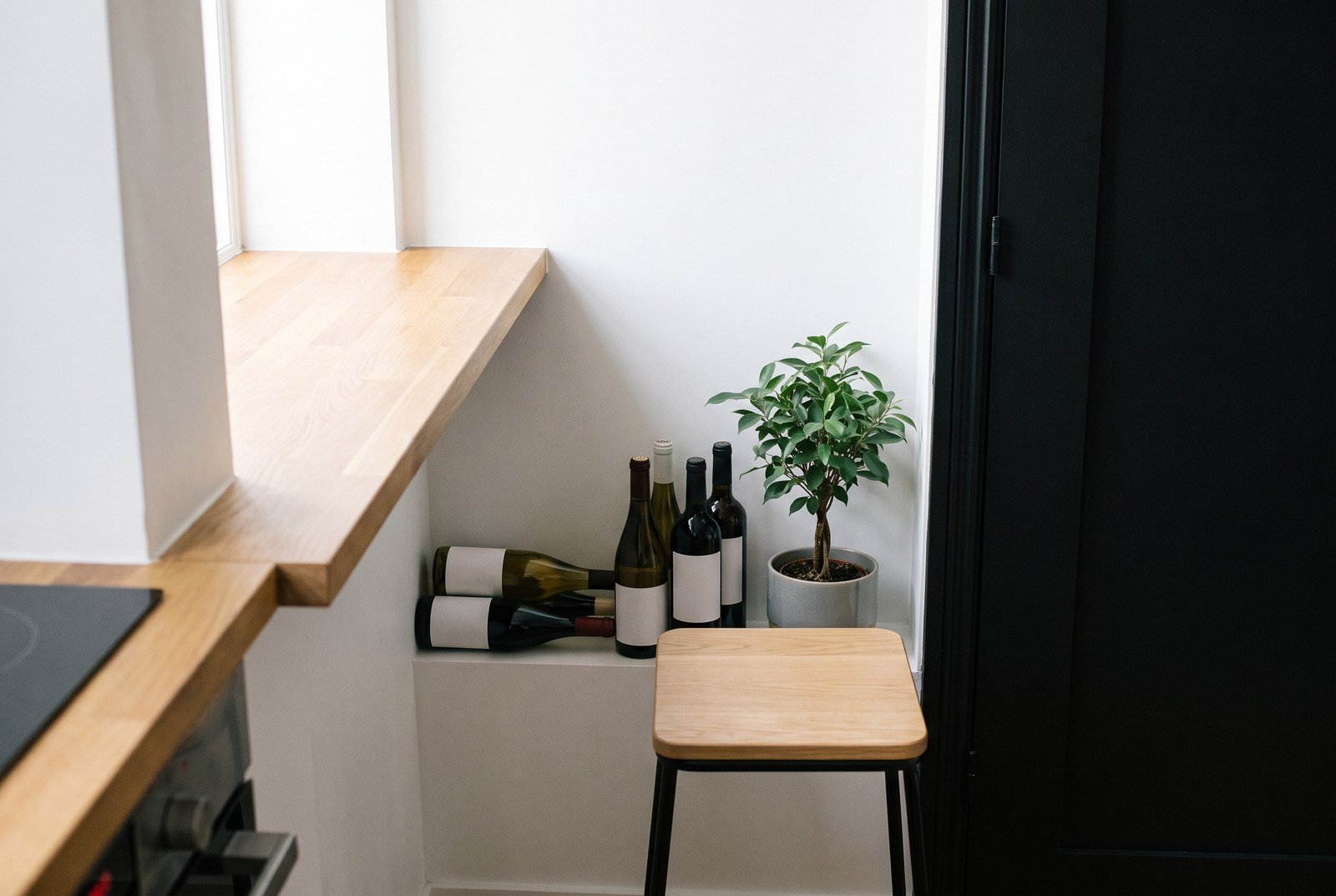
Wine Storage in Small Spaces: Make Room for More Bottles Without Sacrificing Square Meters
Your 24-bottle rack takes up half a square meter of kitchen space, including the clearance needed to access it. You pay for that half square meter every month along with the rest of your rent, and it’s used for nothing more than storing bottles on the floor. Six strips of wall space in a small apartment can hold the same bottles without taking up a single centimeter of living space, and the following figures break down the storage capacity for each family to the nearest square meter. Let’s start with the numbers.
That cabinet in the kitchen costs you nearly €150 in rent per year
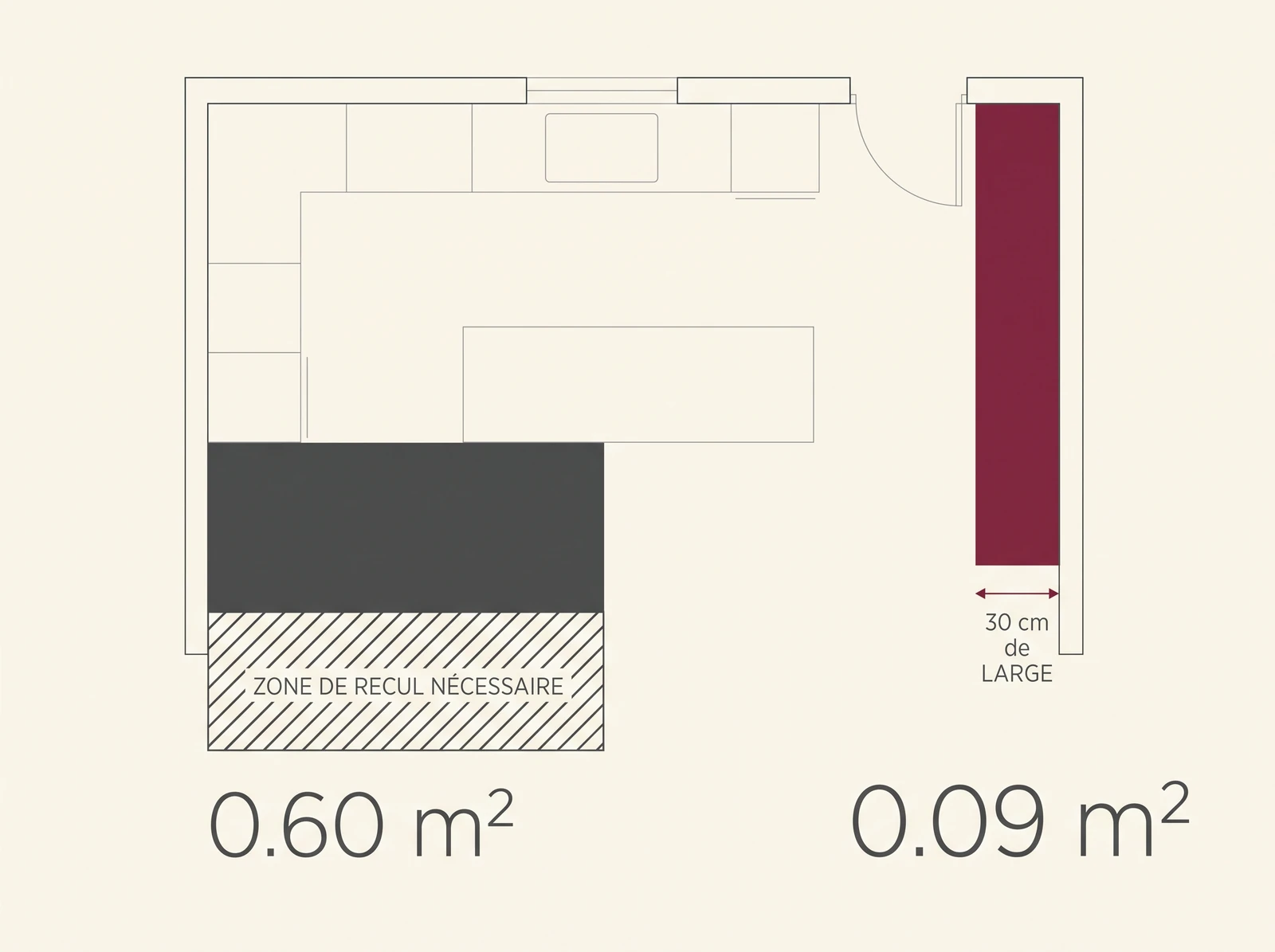
Take a 24-bottle case, the standard size on the market. On the floor, it takes up between 0.2 and 0.3 square meters. Add the space you need to crouch down and grab a bottle from the bottom without moving everything else, and you end up with half a square meter that’s effectively taken up.
In a studio apartment, the rent per square meter is much higher than the national average: approximately €24.60 per month, including utilities, according to the LocService 2025 Observatory (€565 for 23 m² in studio and one-bedroom apartments that are actually rented).
So that half-square meter costs you nearly €150 a year—just for storage. Over ten years, the cost of the piece of furniture pales in comparison to the cost of the floor space it occupies.
The figure seems theoretical as long as the living space is large. It ceases to be so when the space is less than 50 m², because the area is no longer interchangeable: the half-square meter taken up by the bottles is exactly what’s missing to fit a dishwasher or place a chair. Storing wine in a small space is therefore determined by square meters, just like every other item in the room.
Stackable storage unit, bar cabinet, wine rack: how much floor space each family takes up
Before looking for square meters elsewhere, it’s worth checking out what’s available on the market and how much each unit costs.
- The modular stackable rack. Sold in sets of 6, 12, and 24 bottles, made of plastic or metal, in the form of modules that stack on top of each other. It’s an impulse buy—a straightforward and inexpensive option—with two limitations. Manufacturers of large modules generally advise against stacking more than three high without wall mounting, whereas flatter racks can be stacked much higher: read the instructions before buying. Most importantly, the floor space required remains the same whether you’re storing 6 or 24 bottles. You’re gaining height above space that’s already been taken up.
- The bar cabinet and the bar cupboard. A staple of home decor and design sections. It stores bottles and glasses, which is a real selling point. But factor in a depth of 40 cm, plus the door opening: the actual footprint often exceeds 0.7 m². My honest opinion: in a space under 40 m², a bar cabinet is the worst possible choice.
- The rolling cabinet and the countertop bottle rack. The former can be pushed, so it always ends up in the same spot. The latter takes up the most coveted space in the kitchen—the one where you cook. Six to twelve bottles maximum in both cases.
- The wine cooler. We’re ruling that out here. It takes up floor space, uses electricity, heats up the back of the room, and makes noise in a living area. When you don’t already have a cellar, the first question is where to store the bottles—not at what temperature.
None of these solutions stems from the same trade-off: they are all competing for the same ground.
Places in a small apartment where no one thinks to store their wine
Let's try a different approach. Instead of looking for a piece of furniture, let's look for an available surface. In a 35 m² apartment, there are almost always six unused strips of wall—often narrow ones—that neither furniture nor decor takes up.
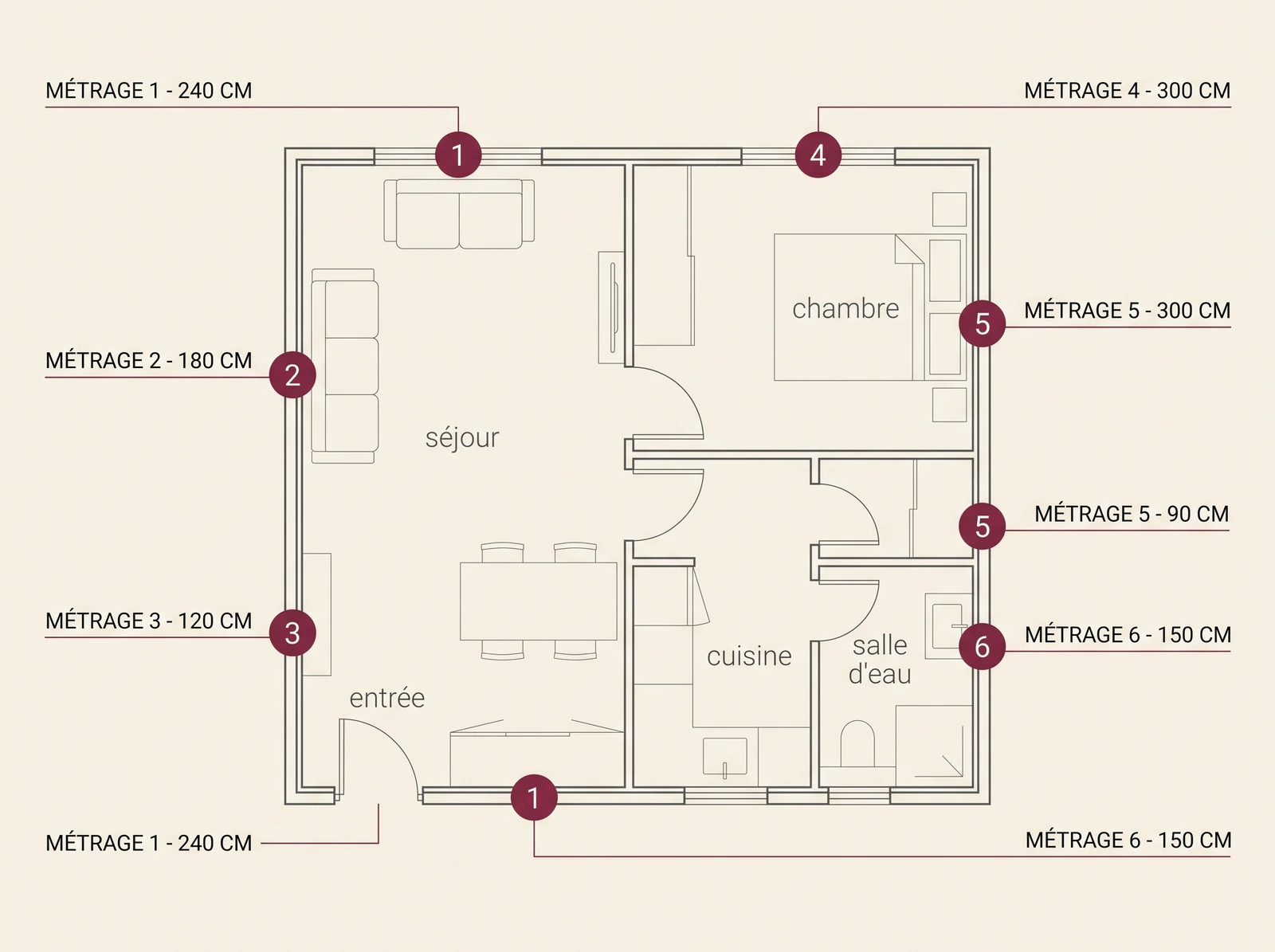
- The space above the door. This strip—often 30 to 45 cm wide, between the door frame and the corner of the wall—is never used for anything: too narrow for a piece of furniture, too wide to be ignored. It’s the most consistently available space in a small apartment. Measure yours; it depends on the floor plan.
- The kitchen corner, at the end of the countertop. The vertical section of wall that extends the line of the cabinets, between the last cabinet and the corner. It is often 30 to 60 cm wide and completely unobstructed from floor to ceiling.
- The section of wall next to the window. The sill often has a clear height of 90 or 100 cm, which is not enough for a structure that is 118 cm tall. The mullion—the solid section of wall that separates the window opening from the corner—rises all the way to the ceiling and remains empty. Be mindful of the exposure; we’ll come back to this later.
- The return section of the couloir. The stretch of wall at the change in direction—the one everyone walks past without even looking at it. The depth there is critical: just a few centimeters too much overhang, and the couloir becomes difficult.
- The entryway wall. Between the entry door and the beginning of the living area. A buffer zone, rarely furnished, often the longest of the six.
- The height lost above 1.80 m. Throughout the entire house. We don’t store anything there because it’s not easily accessible, which makes it free space for bottles we’ll open soon. Keep the lower shelves of your wine racks for bottles meant for aging: the air in a room warms up by 1 to 1.5 °C per meter of height, and the top of the wall is the warmest spot.
That leaves the issue of stemware, the Achilles’ heel of a small space: it takes up more room than bottles, it breaks, and no one seems to know where to put it. The answer fits in a single line. Hung by their stems under a tall kitchen cabinet or beneath a shelf, they free up an entire cabinet shelf. The same space-saving logic applies to the rest of the house: our tips for organizing bottles room by room round out the following.
How many bottles can you store in each section?
The table below compares the performance of floating and fixed systems at comparable capacities. The capacity ranges are based on market standards.
| Solution or area | Floor space occupied | Depth | Realistic capacity |
|---|---|---|---|
| Stackable bin, 1 module | 0.12 to 0.15 m² | ~30 cm | 6 bottles |
| Stackable storage unit, 3 stacked modules | 0.12 to 0.15 m² | ~30 cm | 18 bottles |
| Large-format shelf unit | 0.2 to 0.3 m² | ~35 cm | 24 bottles |
| Bar cabinet or bar cabinet | 0.5 to 0.8 m² with the door open | ~40 cm | 12 to 30 bottles |
| Cabinet on casters | 0.2 m² | ~35 cm | 6 to 12 bottles |
| Door jamb (30 cm from the wall) | 0 m² | 14.8 cm | 11 to 22 bottles |
| End of countertop (60 cm from the wall) | 0 m² | 14.8 cm | 22 to 44 bottles |
| Hallway or entryway turn (90 cm) | 0 m² | 14.8 cm | 33 to 66 bottles |
Methodological note: The solutions presented here are calculated for the object alone, without accounting for the access setback from the initial calculation. Wall areas do not occupy floor space; they are accounted for in depth.
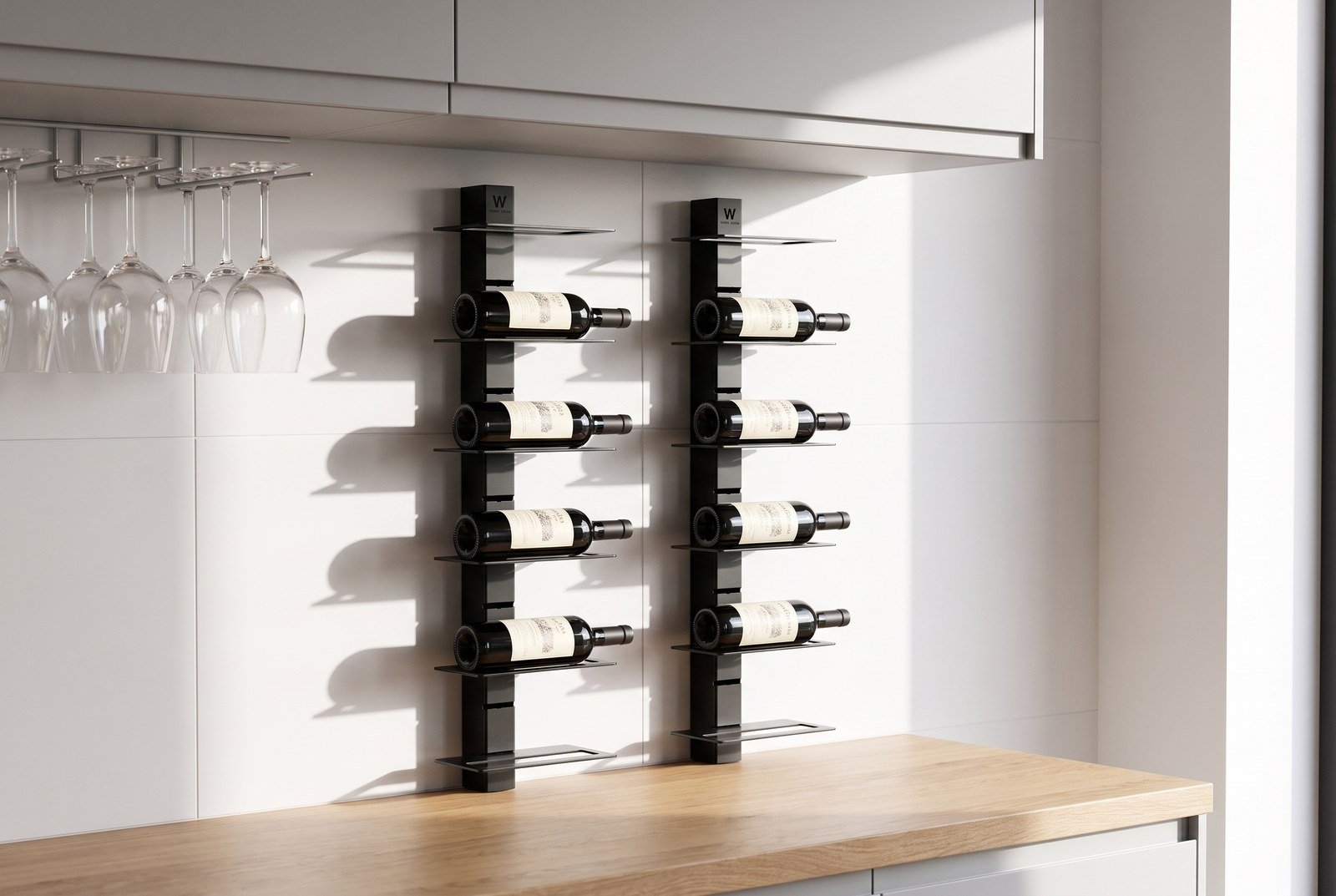
Wall-mounted units consist of one, two, or three Wine Line® modules placed side by side, depending on whether you equip them with single or double shelves. Each unit is 118 cm high and 30 cm wide.
The wall is the only square meter you've already paid for
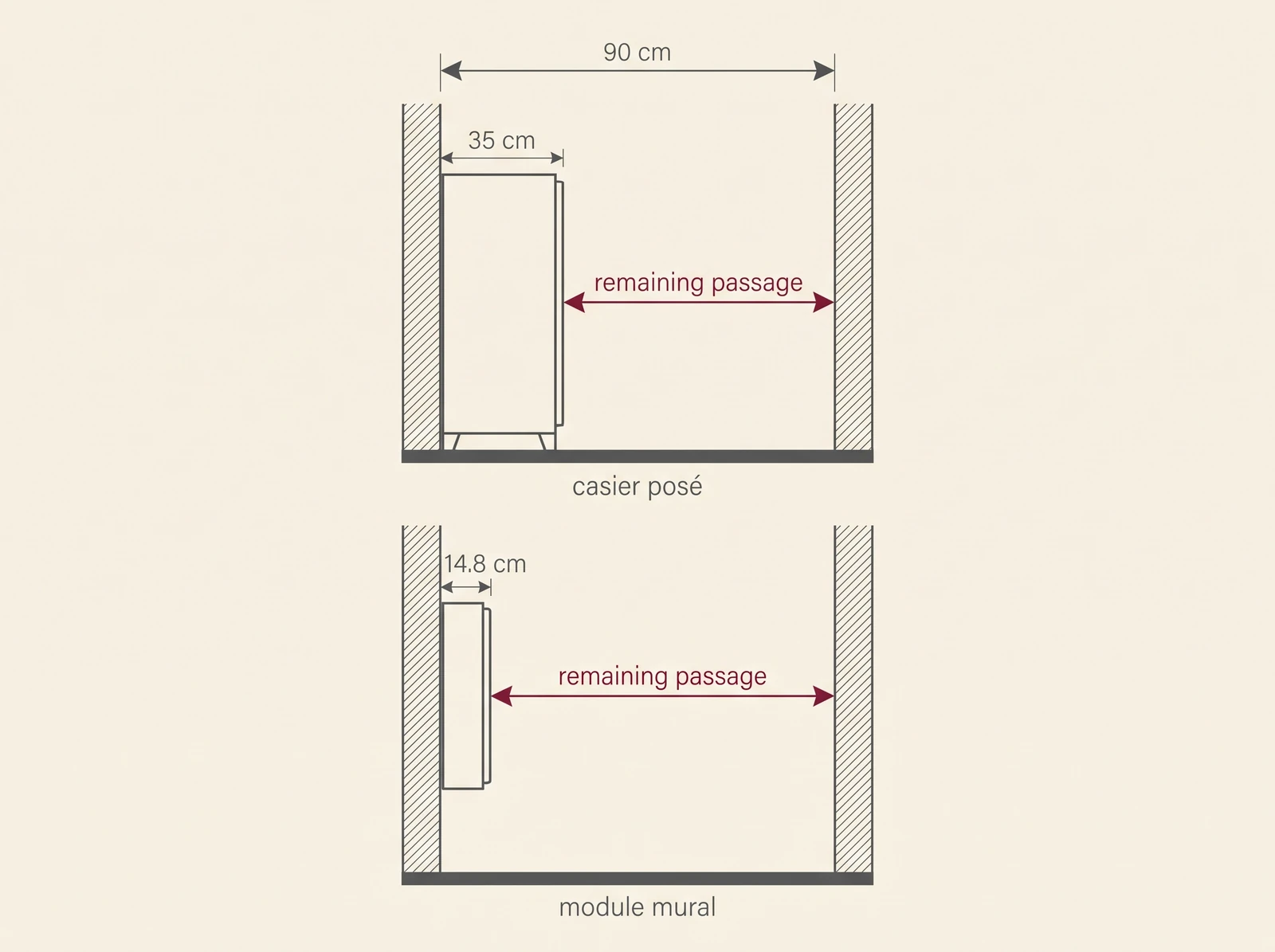
A wall-mounted shelf doesn’t take up floor space. It takes up depth, and depth is everything in small living spaces. A freestanding cabinet protrudes 30 to 35 cm into the room. A wall-mounted Wine Line® unit protrudes 14.8 cm. In a 90-cm-wide hallway, the difference between these two measurements determines whether you can walk normally or have to turn sideways.
The bottle remains lying on its side, with the cork moist and the label facing forward. You can see exactly what you have, which, incidentally, solves the problem of bottles forgotten at the back of a low cabinet—invisible until the day they’re gone. A well-designed wall-mounted storage system remains discreet behind the items it holds.
The choice between the two types depends mainly on the size of your space and the condition of your wall, and our detailed comparison of floor-standing and wall-mounted options outlines the situations in which a floor-standing model is preferable. Such situations do exist; they’re just rare in spaces smaller than 50 m².
Wood, metal, plastic: what each material takes from you on a deep level
Material comparisons focus on style and ambiance. In a small space, the practical question is different: How many centimeters of this material does it take to support a bottle at an overhang?
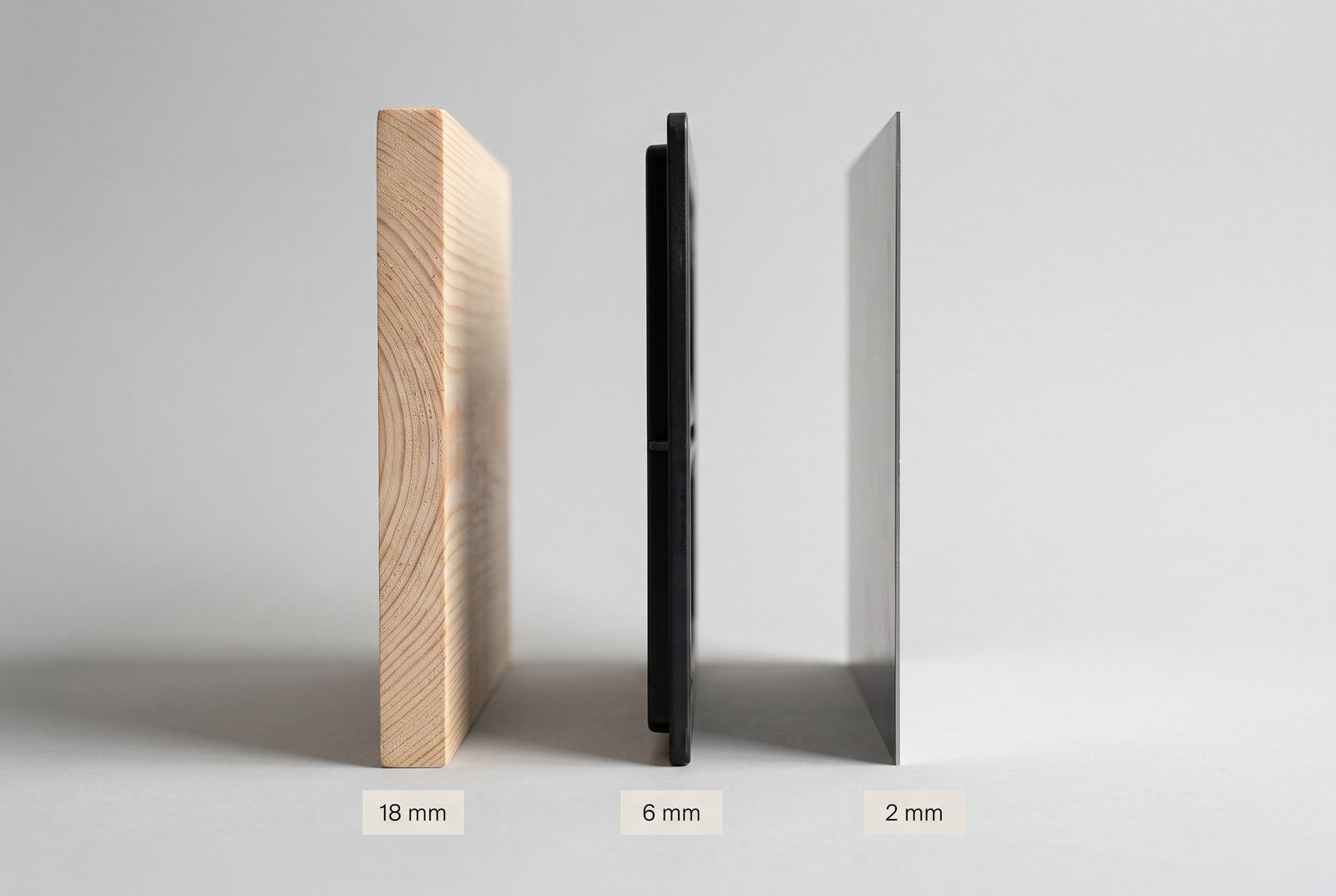
Wood requires a certain cross-sectional area. To support a full bottle without bending, a pine or oak rack side must be thick, and that thickness increases with each level. Oak offers greater strength than pine for the same cross-sectional area, but the logic remains the same: solid wood comes at the cost of centimeters. In a hallway, those centimeters are the ones you need to walk through.
Plastic is lightweight and cost-effective, which explains its dominance in the stackable bin market. Under a constant load, the material yields—that is, it slowly deforms—so these modules are designed to be placed and stacked rather than mounted in a cantilevered configuration.
Metal eliminates this limitation. For the same cross-sectional area, steel is about twenty times stiffer than wood. To put it simply: 2 mm of bent steel does the job of a 15- to 20-mm-thick wooden shelf side, and those millimeters are saved in your installation space. That’s where the 14.8 cm of a Wine Line® module comes from. Metal is also what makes mounting possible, thereby freeing up floor space.
In terms of durability, there are two finishes and two care requirements. Raw steel develops a vibrant, dark gray patina with a slight bluish tint; a light application of wax or oil from time to time is sufficient, and it does not do well in damp areas. Lacquered steel, with a matte powder-coated finish, is moisture-resistant and can be cleaned with a damp cloth. Both come with a 2-year warranty.
Arrange the pieces according to the length of wall you have available
Measure the available wall space, then divide by 30. That gives you the number of modules. Each unit is 30 cm wide; the units fit side by side as far as the wall allows, and the shelves clip into place without tools and can be repositioned whenever you want.
In practical terms: 30 cm of wall space for a door frame, 60 cm at the end of a countertop, and 90 cm along a hallway wall. You start with whatever space is available, add double shelves as your collection grows, and the structure stays the same. Magnums fit, as long as the bottle is securely wedged in the opening.
A practical feature that matters when renting: Installation can be done by one person in less than 5 minutes on a wood or OSB wall, using the included drilling template. Six holes—no construction work required.
A 30-cm-wide module holds up to 22 bottles on double shelves—including magnums—and can be assembled in less than 5 minutes. Prices start at €149 for the raw steel pack, €199 for the lacquered or mixed-finish versions, with interest-free payment in three installments and free shipping on orders of €350 or more (including tax).
View the complete wall-mounted sets or, if you’re designing a custom setup, the central structures alone.
The Four Costly Mistakes to Avoid When Working with a Small Space
A small apartment is less forgiving than a house. There are four mistakes that come up time and time again.
Too low. If they’re less than 60 cm off the floor, the bottles become invisible and get knocked over by the vacuum cleaner or doors. The usable height starts at hip level and goes all the way up to the ceiling.
Facing an opening. A 30-centimeter protrusion into a narrow hallway may seem acceptable on the first day but becomes unbearable after a month. Measure the remaining clearance before drilling, not after. If the clearance is less than 90 centimeters—the standard width for a residential hallway—choose a different wall.
Above a heat source. Radiator, stovetop, oven, refrigerator: hot air rises and pools against the wall. In a studio apartment, these heat sources are concentrated within a few linear meters, so it’s easy to make this mistake. Move the unit sideways rather than higher up, allowing for at least one meter—the standard measurement used in kitchen design.
In direct sunlight. A south-facing window in a small home means the entire room is flooded with light. The tinted glass of a wine bottle protects some of the wine, but never enough to withstand daily direct exposure. Choose the wall perpendicular to the window instead.
These four points relate to both wine storage and organization. Without a wine cellar, your home serves as the storage space, with its fluctuations in temperature and humidity. Our tips for storing wine when you don’t have a wine cellar cover this topic in detail, including radiators and open-concept kitchens.
Frequently Asked Questions
How do you store wine in a studio apartment?
Vertically, on a wall that isn’t taken up by anything else. The doorframe and the entryway wall are the two most reliable spots in a studio apartment, because no furniture takes up space there. A 30-centimeter-wide strip of wall can hold up to 22 bottles without touching the floor. Avoid the kitchen area if your stovetop and refrigerator are concentrated there.
I live with roommates, so I can't drill holes just anywhere. What's the solution?
Drill sparingly but thoroughly. A shelf like this is secured with six screws and can be completely removed when you move out, leaving six holes to fill. These six screws are considered part of the interior fit-out, not a structural alteration: the landlord cannot object to them (Law of July 6, 1989). A written agreement remains the best way to avoid a dispute during the move-out inspection.
Where should you store your bottles in a kitchen that opens onto the living room?
On the section of wall that extends from the kitchen into the living room, away from the cooking area. The bottles serve as a decorative element there, with their labels visible, and the room doesn’t lose any space in the process. Make sure to leave at least one meter of space between them and the stovetop and oven.
Can you install a wine rack above a radiator?
No. Warm air rises along the wall and comes into direct contact with the bottles, causing daily temperature fluctuations throughout the heating season. Move the bottles slightly to the side along the same wall, or choose a different wall in the room. A one-meter gap usually solves the problem, depending on the heater’s output and the room’s volume.
How many bottles do you need before a dedicated storage solution becomes useful?
Around twelve, in practice. Below that, a cardboard box will do, even if it’s ugly. Above that, you start losing track of bottles, opening the wrong one, and stacking them in odd places. That’s the point at which visible storage saves you time and money.
A wine collection that grows at your own pace.
Modular wall-mounted shelves in raw or lacquered steel. Holds up to 22 bottles per module, 2-year warranty, free shipping on orders over €350.
Explore the collectionExcessive alcohol consumption is harmful to your health. Please drink responsibly.