
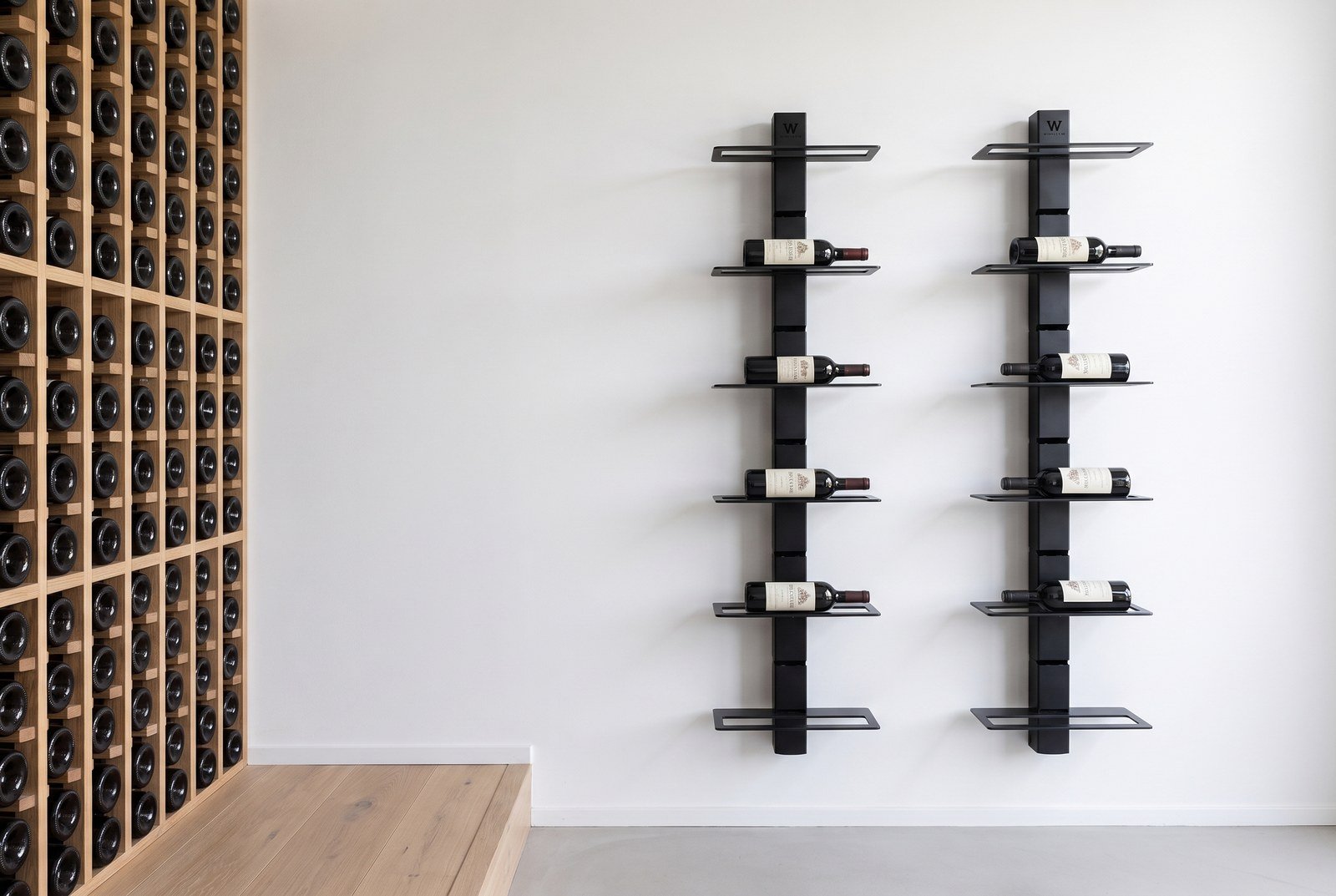
Wall-mounted wine rack or freestanding storage: How should you choose the right option for your bottles?
You have thirty bottles stacked in a cardboard box, a free wall in the hallway, and no idea how much weight that wall can actually support. That’s when the question arises: should you mount it or set it down? This comparison addresses three physical constraints (what the wall can support, how much each square meter of floor space costs you, and what your lease allows you to drill into), with two decision charts, a discussion of load capacity, and a verdict for each scenario. By the end, you’ll know what to measure before ordering anything.

Still unsure about the storage solution itself (rack, cabinet, cellar, shelf)? Start with our guide to storing wine bottles. This article assumes you’ve already decided on the storage solution and addresses the following question: where to set it up.
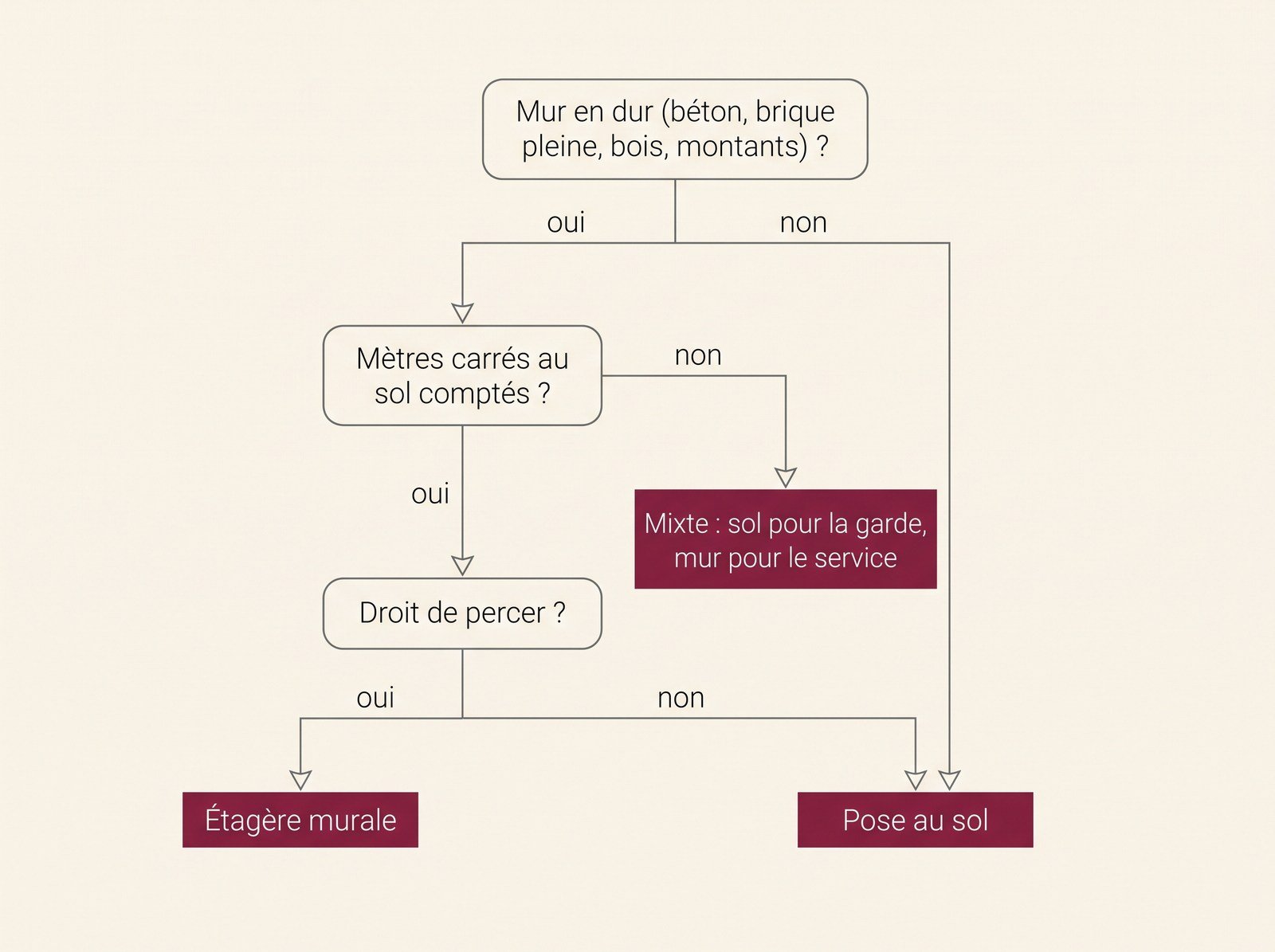
The Answer in 30 Seconds
If your wall is made of concrete, solid brick, wood, or OSB, and you’re short on square meters, mount your items on the wall. If you’re renting a place where even the smallest hole requires permission, if your wall is made of standard, unreinforced drywall, or if your collection extends far beyond the confines of a single living room, place your items on the floor.
3 to decide:
- What’s behind the paint? Knock on it. A dull, solid sound means it’s solid. A hollow sound, on the other hand, doesn’t necessarily mean “partition wall”—it could be a glued-on lining, meaning a sheet of drywall and insulation glued to concrete or cinder block. So the right question isn’t “hollow or solid,” but how deep I have to go before I hit the hard surface. A test hole, a mark on the drill bit—thirty seconds.
- Is floor space at a premium in your home? In a 30 m² apartment, a freestanding shelf that takes up 0.5 m² at the foot of a wall really adds up.
- Do you have the right to drill holes? If you’re a homeowner, the question doesn’t even come up when it comes to an interior wall. If you’re a renter, the question does arise, but the answer is more favorable than you might think (see below).
Wall-mounted or freestanding: a head-to-head comparison
| Criterion | Wall shelf | Floor-standing storage unit |
|---|---|---|
| Footprint | None. Verticality does the work for you | Actual, and often underestimated (the cabinet plus the space needed to open it) |
| Support constraint | Strong. It all depends on the type of wall. | Low, but not zero: even a floor has a load-bearing capacity |
| Drilling | Required | None, except for an anti-tip device on a tall piece of furniture |
| Maximum capacity | Limited by the available wall space and the load capacity | Very spacious. You can stack, line up, and fill an entire basement |
| Access to Bottles | Front-facing, visible label, ready to use right away | Varies. The lower rows require you to bend down, and the bottles at the back are out of sight. |
| Cellar Reading | Immediate. You see what you have. | Often mediocre beyond the second row |
| Scalability | Module by module, we're extending the wall | By adding units, if there's room |
| Direction | Strong. The wall becomes part of the room | Low to moderate, depending on the piece of furniture |
| Moving | You have to reinstall it, fill in the hole, and drill a new hole elsewhere | Pick it up and take it away |
| Reversibility (Lease) | Holes to Fill | Total |
| Compatible Parts | Open kitchen, living room, hallway, office, basement | Cellar, basement, garage, pantry, large room |
Two factors carry more weight than the others—structural load and footprint—and they pull in opposite directions. The rest is a matter of negotiation.
What Floor Storage Does Best
- It's not a matter of the anchor. The weight is transferred to the floor. No anchors to size, no worries about what's hidden behind the drywall.
- No drilling required to support the load. Just set it up and put it away. For rentals, that’s a decisive selling point.
- It works with any type of wall. Whether it’s a hollow partition, drywall, or an old, crumbling wall—this freestanding piece of furniture doesn’t care.
- Storage capacity. A dedicated wine cellar with stacked racks can hold hundreds of bottles. There are no living room walls in this space.
- It's portable. If you want to use it in a different room, just move the piece of furniture. If you're moving, just take it with you.
- Long-term aging in an underground cellar. As long as the cellar is cool, dark, and stable, the wine is right at home there.
2 shades:
The floor is not without load-bearing capacity. On a concrete slab or in a basement, the issue is settled. On a wooden floor—whether upstairs or in an older building—the question arises again: a residential floor is designed to handle an operational load of around 150 kg/m². However, 300 full bottles weigh nearly 400 kg—and even more if they’re made of thick glass. When concentrated within a square meter of stacked racks, the load far exceeds the standard. Distribute the load across several units, position the racks against a load-bearing wall, and if in doubt, have a professional inspect the floor.
There are limits to the “no-drilling” approach. A tall, heavy piece of furniture that’s loaded with items at the top must be secured with straps or braced against the wall to prevent it from tipping over—just like any bookcase. This is essential if there are children in the home. With a low cabinet, this isn’t an issue. But once the loaded height exceeds one meter, it becomes a real concern.
One last point—less glamorous but true: the initial cost of a basic floor-standing locker is often low. You can find stackable lockers for next to nothing. They’re worth what they cost, but they do the job.
If you're comparing the items themselves rather than their placement, our comparison of wine racks and wine cabinets approaches the topic from a different angle.
What the wall does best
The wall collects everything the ground takes from you. And it makes it visible.
- Square meters. A wall shelf takes up no floor space. In an apartment where every meter counts, that’s the key selling point.
- An organized wine cellar. Bottles stored on their sides, labels facing forward, wine in contact with the cork. You can see what you have, so you don’t forget about it. Everyone knows what it’s like to have a bottle forgotten at the back of a lower shelf.
- Verticality. A wall goes up. The floor does not. A Wine Line® structure that is 118 cm high and 30 cm wide offers up to 11 slots for single shelves and up to 22 for double shelves, each 14.8 cm deep. Note: The number of slots does not indicate load capacity. The module’s maximum load capacity determines the actual load it can hold, and this is calculated below.
- Modularity. With a good system, you can add a module as your collection grows, without changing anything about the existing setup. The shelves snap into place and can be repositioned without tools.
- The Setting. Behind a bar, in an open kitchen, on a living room wall: storage becomes part of the room’s design. The wineries that have furnished their tasting rooms with our units didn’t do so to save space.
The wall's load-bearing capacity: the real deciding factor
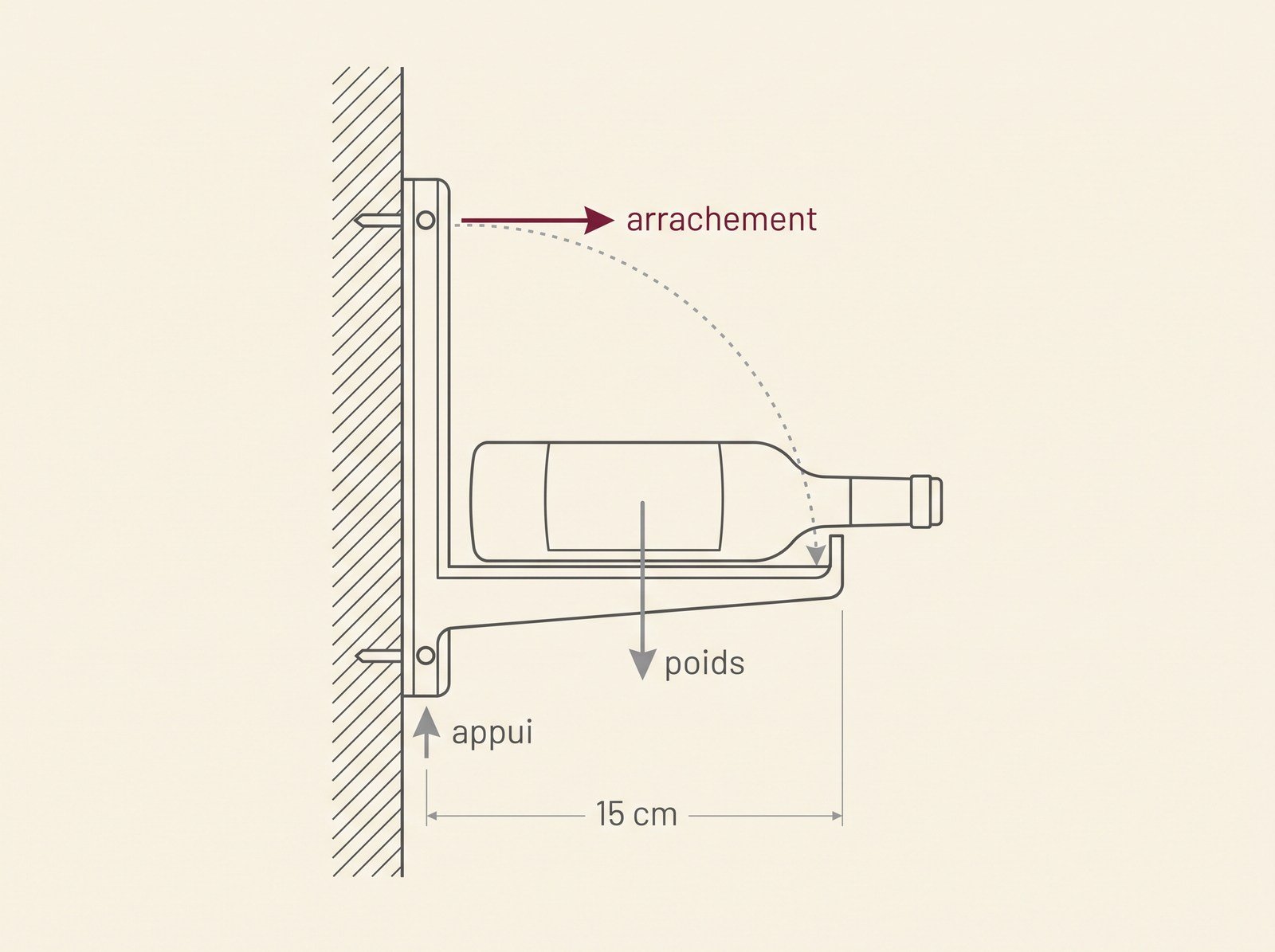
This is where the decision stands or falls. The weight of a bottle is always vertical. But on a wall-mounted shelf, it acts forward from the wall—14.8 cm from the shelf bracket in our case. This offset creates a lever arm: the structure tends to pivot forward. As a result, the bottom of the mounting plate presses against the wall while the top fasteners are pulled outward. That’s what we call “tear-out.” The farther the bottle is from the wall, the greater the tear-out becomes.
Keep this key point in mind—it’s crucial: many anchors handle pure vertical load (shear) very well but handle pull-out forces much less effectively. The top anchor is the critical point. That’s the one you must never skimp on.
Calculate the actual weight, not the perceived weight
The method can be summed up in one line: weight of the full bottles + weight of the system = load to be supported.
The weight of a full 75 cl bottle varies more than you might think, because the glass varies: about 1.2 kg for lightweight glass, up to 1.5 or 1.6 kg for thick glass (heavy Bordeaux bottles, Champagne bottles). When calculating load, never use the average: count on 1.5 kg per bottle. A full magnum, on the other hand, weighs 3 to 3.5 kg—more than double that.
It is this load, and this alone, that determines the capacity. The maximum load specified by the manufacturer is the determining factor, regardless of the number of slots in the module. Take the value listed in the manual, divide it by 1.5 kg, and subtract the weight of the structure: this will give you the actual number of standard bottles you can store in it. With a 25-kg limit, for example, you’ll get around 16 full standard bottles and only 7 to 8 magnums. A module isn’t filled just because there’s space left; it’s filled up to its maximum load capacity, then you add another module elsewhere and distribute the load across other mounting points.
Keep this principle in mind: the load should never rest on a single point, and especially not on a point that isn't anchored to anything solid.
The Wall, Panel by Panel
| Type of wall | What to Aim For | Wall Verdict |
|---|---|---|
| Concrete, cast-in-place concrete, stone, solid brick | Expansion or hammer-in anchor suitable for solid material | Yes, without reservation |
| Aerated concrete (Siporex, Ytong) | Anchors specifically designed for aerated concrete (with long fins) or chemical anchors. Drill using rotation only; never use hammer action. | Yes, with the right ankle, but with limited capacity: do not overload it |
| Hollow brick, hollow concrete block | Anchor for hollow materials, or chemical anchor with a screen for a full load. Drilling with rotation only: the wall is only 10 to 15 mm thick and breaks when struck. | Yes, with the right anchor, the load-bearing capacity is lower than that of solid material |
| Wood-frame construction, solid wood, OSB | Screw into the studs (using wood screws of sufficient length). OSB alone, between two studs, is not sufficient for a cantilevered structure. | Yes, the simplest case is when we know the amounts |
| Drywall on Metal Studs | Drill into the studs, or install a 22-mm MDF/OSB reinforcement panel screwed into the studs, then attach the material to it | Yes, but only if reinforced or anchored to the studs |
| Gypsum board installed as a second layer and glued to masonry | A long anchor that passes through the insulation to anchor into the masonry, or a chemical anchor. The Molly alone spins freely. | Yes, as long as you can reach the hard part at the back |
| Standard drywall, hollow partition without accessible studs | Mandatory reinforcement | Not as it stands |
| Plaster tile | Chemical anchoring (percussion-free drilling, dust removal, curing time) or a specialized plaster anchor | Possible, but capacity is limited: distribute the points evenly; do not overload |
| An old, crumbling wall; plaster on laths | Nothing is reliable without a preliminary survey | No, stay on the ground |
A word about drywall, because this is the most common scenario—and the one most often handled incorrectly. Molly-type metal expansion anchors are often touted as the universal solution. They aren’t bad products: within their intended range of use, they hold up well. But they perform much better under shear stress than under pull-out stress (around 25 to 30 kg versus 8 to 10 kg for an Ø8 model on BA13), and pull-out stress is precisely the load a cantilevered shelf will experience. They are therefore insufficient for a loaded wine rack. The toggle anchor performs better under tensile load, but for a load of this magnitude, our recommendation remains the same: use a 22 mm MDF or OSB reinforcement plate, screwed into the studs of the partition wall, and then secure the structure to this reinforcement. A metal upright is made of 0.6 mm sheet metal: use self-tapping metal screws; a regular wood screw won’t hold. It takes an extra half hour. It prevents your collection from ending up on the floor.
The actual safe load limits depend on the anchor/bracket combination and the manufacturer's specifications for the fastener. Don't rely on a random number you find on a forum; read the packaging.
The Hidden Cost of Square Meters of Floor Space
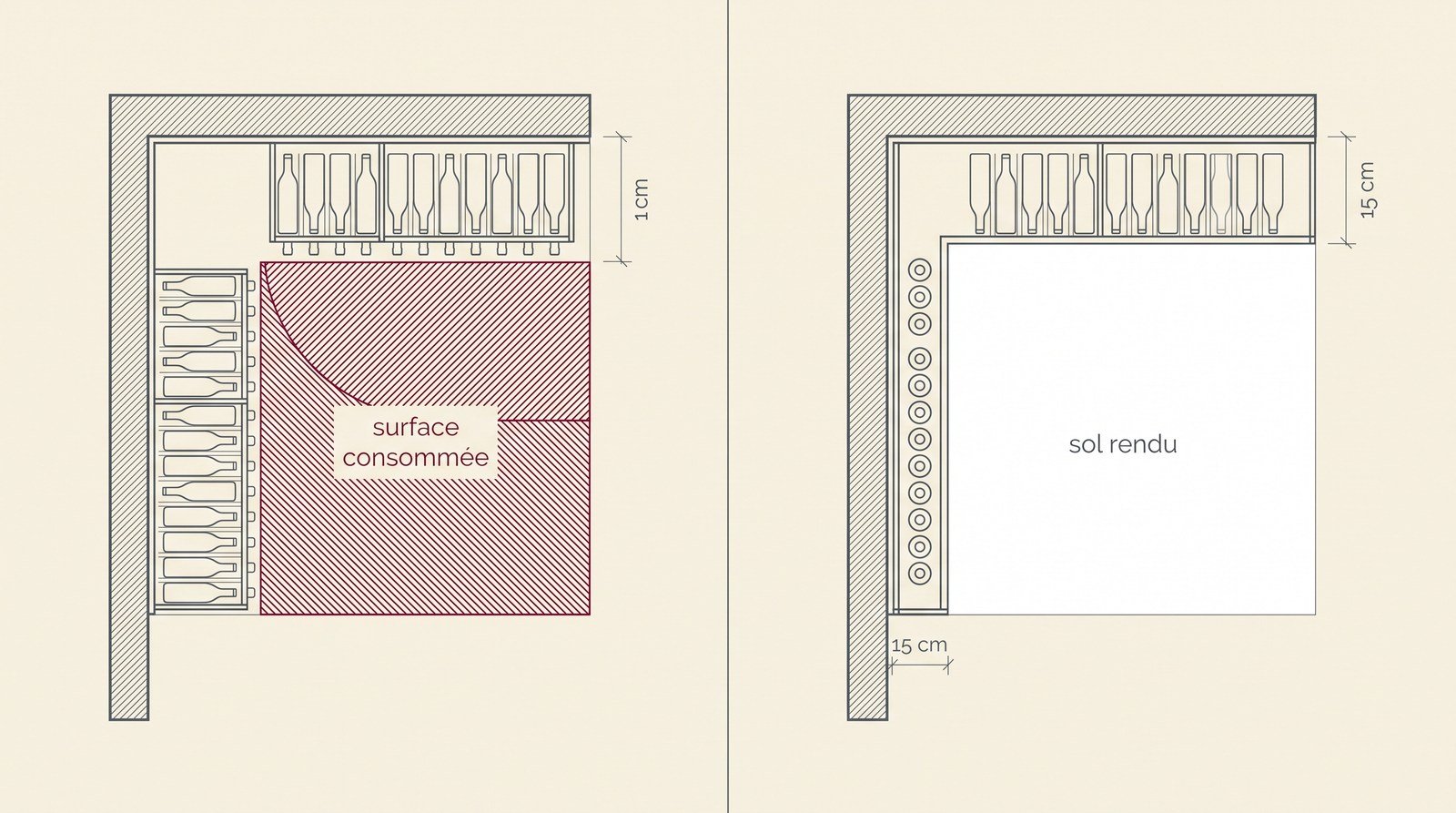
A freestanding piece of storage doesn’t just take up its own footprint—it also requires the space needed to access it, and it renders the wall behind it unusable. A shelf placed along a partition—plus the space needed to walk in front of it, plus the wall that’s rendered unusable—means the actual space it takes up is much greater than the surface area of the piece itself.
Try this exercise at home. Measure the depth of the piece of furniture you’re considering, add the clearance you need to open it or reach for a short bottle, and multiply that by its width. Compare that number to the price per square meter in your city. The result is often surprising.
A wall-mounted unit, on the other hand, is 14.8 cm deep and leaves the entire floor open. You can still walk in front of it, place an armchair there, or open a door. The space is still there, and it remains usable.
The logic is reversed in a dedicated wine cellar. There, square meters aren’t worth much anymore: the space is used for nothing else. You might as well fill it to capacity.
Installation: What the Mural Requires
Many people decide against building a wall because they imagine it will be a major construction project. Here's what it's really like.
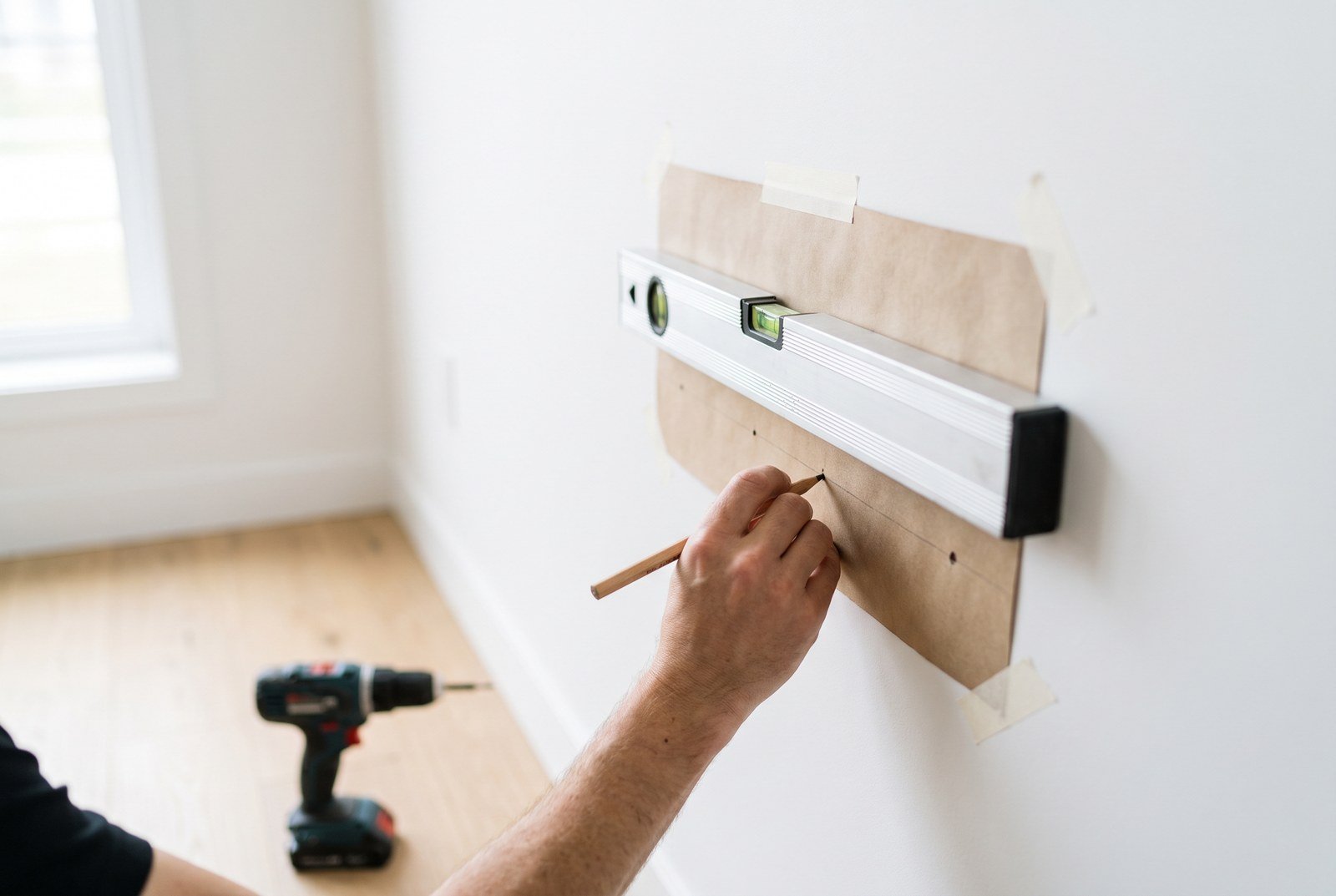
Tools: a drill, a level, a pencil, a tape measure, and a stud finder for drywall. Nothing out of the ordinary. The hammer drill should be used on concrete, solid brick, and stone, but never on aerated concrete, plasterboard, or hollow brick: it destroys the material instead of drilling through it, and the anchor becomes useless.
Time: Allow a few minutes per structure on wood or OSB; a little longer on concrete. Adding MDF reinforcement to drywall obviously takes more time, but it’s still something you can do in a leisurely afternoon of DIY—not a whole weekend.
Alone or as a pair: one person is enough for our setups. As a pair, it’s easier to maintain the level while scoring points.
Common mistakes: drilling without checking what’s behind the wall (cables, pipes), not ensuring the structure is level (a crooked structure is immediately obvious when the bottles are laid flat), loading the structure before it’s fully secured, and using an anchor that’s too small for the wall.
When to call a pro: a wall you’re unsure about, an old wall, a large section that needs to be fitted, or simply the desire to sleep soundly. A professional can install it in a single visit.
Which option is right for your situation?
Studio or apartment for rent. The wall—if the surface allows it and if you fill in the hole neatly when you move out. Your square meters are too valuable to be taken up by a piece of furniture. If the landlord still refuses and you want to avoid conflict: a compact freestanding storage unit—and nothing more.
Open kitchen or living room. The wall, without a doubt. The countertop stays clear, the labels are easy to read, and the storage blends into the room instead of cluttering it. It’s the wall’s natural playground.
A dedicated wine cellar or basement. The floor is for the bulk of your collection—in terms of volume—ideally on a concrete slab. The wall is for the service area, where you select the bottles of the month. Combining the two is less expensive than mounting everything on the wall, and it’s more practical.
A collection of more than two or three hundred bottles. The floor is the only option for storage—period. No living room wall can support that much weight. Consider the floor: at this level, we’re talking about several hundred kilograms, so the weight needs to be distributed, and the ground floor or basement is the best choice. The wall then becomes a display case, not a storage system.
Wall Shelves or Floor Storage? Why Combine the Two?
Yet this is the most logical arrangement: the floor for maintaining volume, the wall for rotation and staging.
In practical terms: the crates and racks are down below, in the cool room, along with the bottles that need to age for several years. And on the wall of the living room are the bottles from the current year—the ones we open, show off, and let guests choose from. Labels facing forward, bottles lying on their sides, ready to pick up right away.
The wall becomes your pantry. The floor can become your wine cellar.
A Wine Line® structure made of 2 mm steel, 118 cm high, and only 14.8 cm deep. Clip-on shelves that can be repositioned without tools; drilling template included; quick installation on wood. Always fill the rack within the weight limit specified in the instructions: that limit is what matters, not the number of slots. Packs starting at €149.
View our selection of modular wall-mounted wine racksFrequently Asked Questions
Can you mount a wine rack on drywall?
Yes, but not just any old way. Drywall alone cannot properly withstand the pull-out force from a loaded cantilevered shelf, and Molly-type expansion anchors—which are often recommended—perform much better under shear than under tensile stress. Two reliable solutions: anchor directly into the studs of the partition, or screw a 22-mm MDF or OSB reinforcement panel onto these studs (using self-tapping metal screws if the studs are metal), then secure the structure to the reinforcement. Be aware of the special case of glued-on wall lining: the panel sounds hollow but there is masonry behind it, and you need a plug long enough to anchor into the masonry; otherwise, the Molly plug will spin freely.
How much does a full wine rack weigh?
Allow 1.5 kg per full 75-cl bottle (1.2 kg for thin glass, up to 1.6 kg for thick glass, and 3 to 3.5 kg for a magnum), add the weight of the system, and compare the total to the maximum load specified by the manufacturer. It is this load—not the number of available slots—that sets the limit. If the load exceeds this limit, add a module and new mounting points rather than overloading the system.
Can you install a wall-mounted wine rack in a rental property?
In the vast majority of cases, yes: installing a shelf is a fixture, not an alteration, and the law of July 6, 1989, prohibits landlords from objecting to fixtures. A lease clause prohibiting any drilling is, in fact, legally very tenuous. However, you must restore the wall to good condition; you are responsible for filling in the holes if their number, size, and location make it a repair. In practice: fill in the holes, sand the surface, and touch up the paint before the move-out inspection, and request the landlord’s written consent if the lease is strict.
How much floor space is needed to store a collection?
It depends on the piece of furniture, but don’t forget to factor in the clearance needed for access in addition to the footprint of the furniture itself. The actual space taken up is always greater than what’s listed on the product page. And keep weight in mind: a few hundred bottles weigh several hundred kilograms, which needs to be distributed evenly if you have a wooden floor. Wall-mounted storage, on the other hand, leaves the entire floor free: our units protrude only 14.8 cm from the wall.
Do you need a professional to install a wall-mounted wine rack?
Not in standard cases. All you need is one person, a drill, a level, and the included drilling template—and it’s done in a few minutes on wood, a little longer on concrete. Call in a professional if the wall is in questionable condition, is old, consists of a glued-on wall lining whose thickness you don’t know, or if you need to install reinforcement and are concerned about screwing into the studs.
Is a floor-standing storage unit more stable than a wall-mounted shelf?
More forgiving, yes: it doesn’t rely on any legs. But it isn’t invulnerable. A tall, heavily loaded piece of furniture has a high center of gravity and must be secured to the wall with a strap or an anti-tip bracket, especially if there are children around. A wall shelf that’s properly secured to a suitable wall, on the other hand, is perfectly stable. The stability of a wall-mounted unit depends entirely on how it’s installed. The stability of a freestanding unit depends on the levelness of the floor, the piece’s center of gravity, and its anti-tip mechanism.
A wine collection that grows at your own pace.
Modular wall-mounted shelves in raw or lacquered steel. Holds up to 22 bottles per module, 2-year warranty, free shipping on orders over €350.
Explore the collectionExcessive alcohol consumption is harmful to your health. Please drink responsibly.