
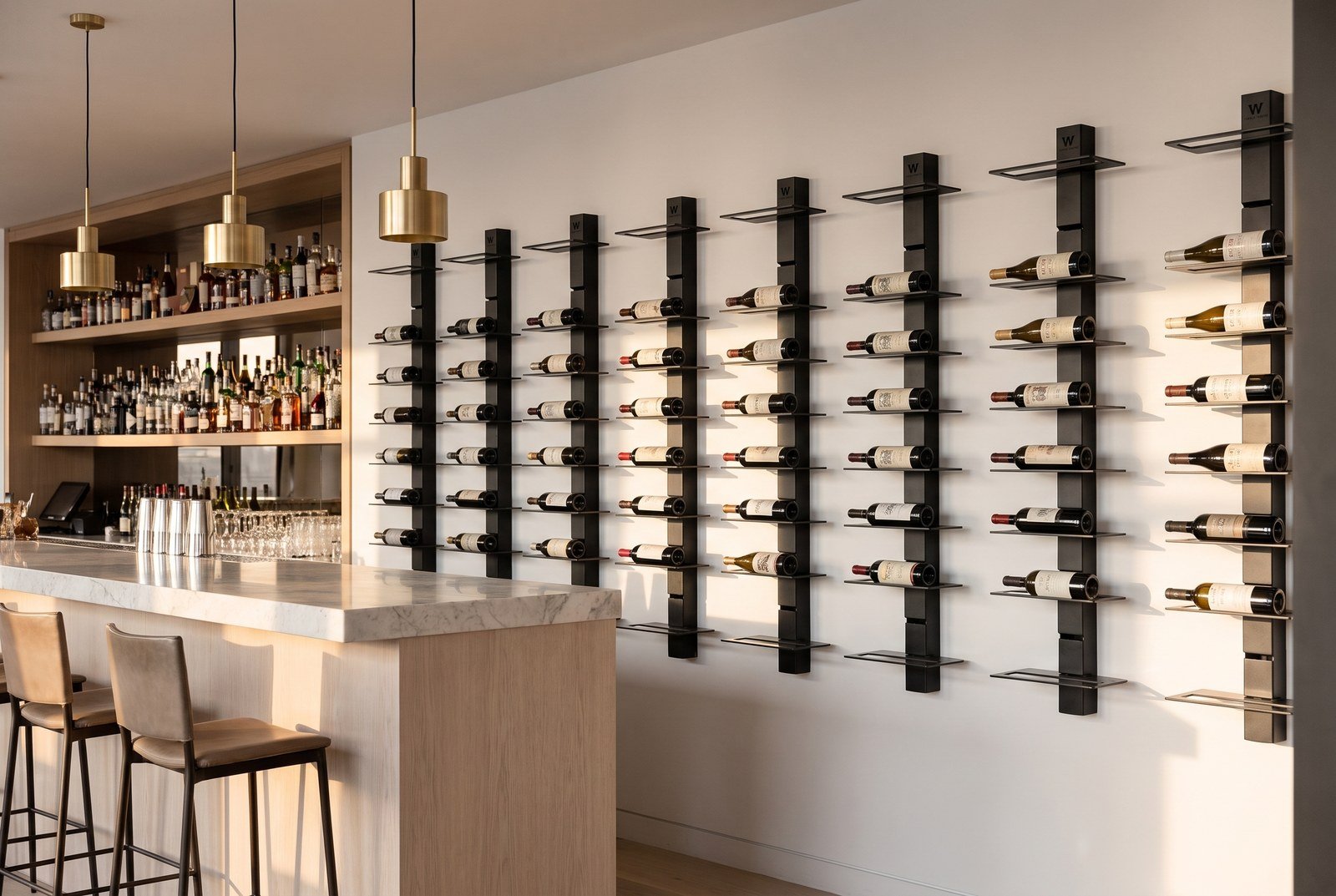
Wine displays for restaurants, wine bars, and wine shops: How they differ from those for home use
Friday evening, 8:40 p.m., forty guests in a packed restaurant. A server has to grab the red wine being served by the glass that night. It takes three seconds if it’s on the wall, within arm’s reach. A trip to the cellar and back if it’s still down there—and a table is waiting. On Tuesday morning, at a wine shop, the problem is reversed: the new shipment comes in through the back room, and a section of the wall needs to be cleared before the store opens.
A professional wine display is judged by these actions, repeated dozens of times a week. The furniture found on online marketplaces addresses a different need—that of the individual who places a few bottles in their living room.
What Changes When Storage Becomes a Service
In a private home, a wine rack is evaluated once, on the day it is installed. In a store, the same rack is evaluated every day.
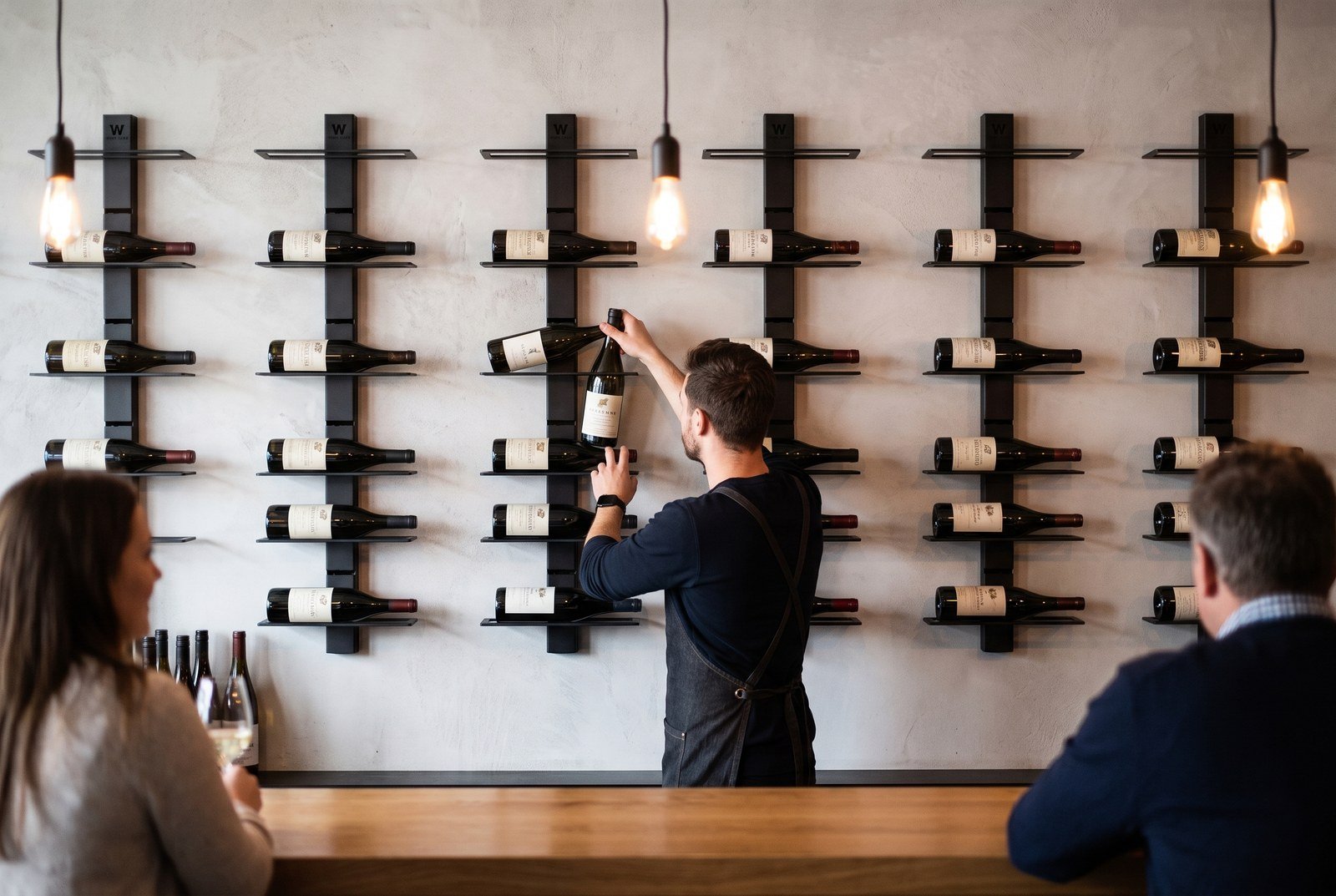
Access time takes precedence over everything else: a bottle that’s hard to find costs in terms of service, and a bottle placed too high up requires a step ladder. Next comes readability, since both staff and customers need to be able to identify an item from a distance. Then there’s the speed at which the wall space is reorganized when the menu changes.
One last point, which is often misunderstood when making a purchase: Wine on the wall is meant to be consumed within a day or a week. Wine meant for aging, on the other hand, stays in the cellar. A wall display is designed for use in a room at room temperature, and a bottle meant to age has no business being there. Understanding this distinction prevents you from buying a display cabinet thinking you’re equipping a wine cellar.
At a restaurant, show as little as possible and serve quickly
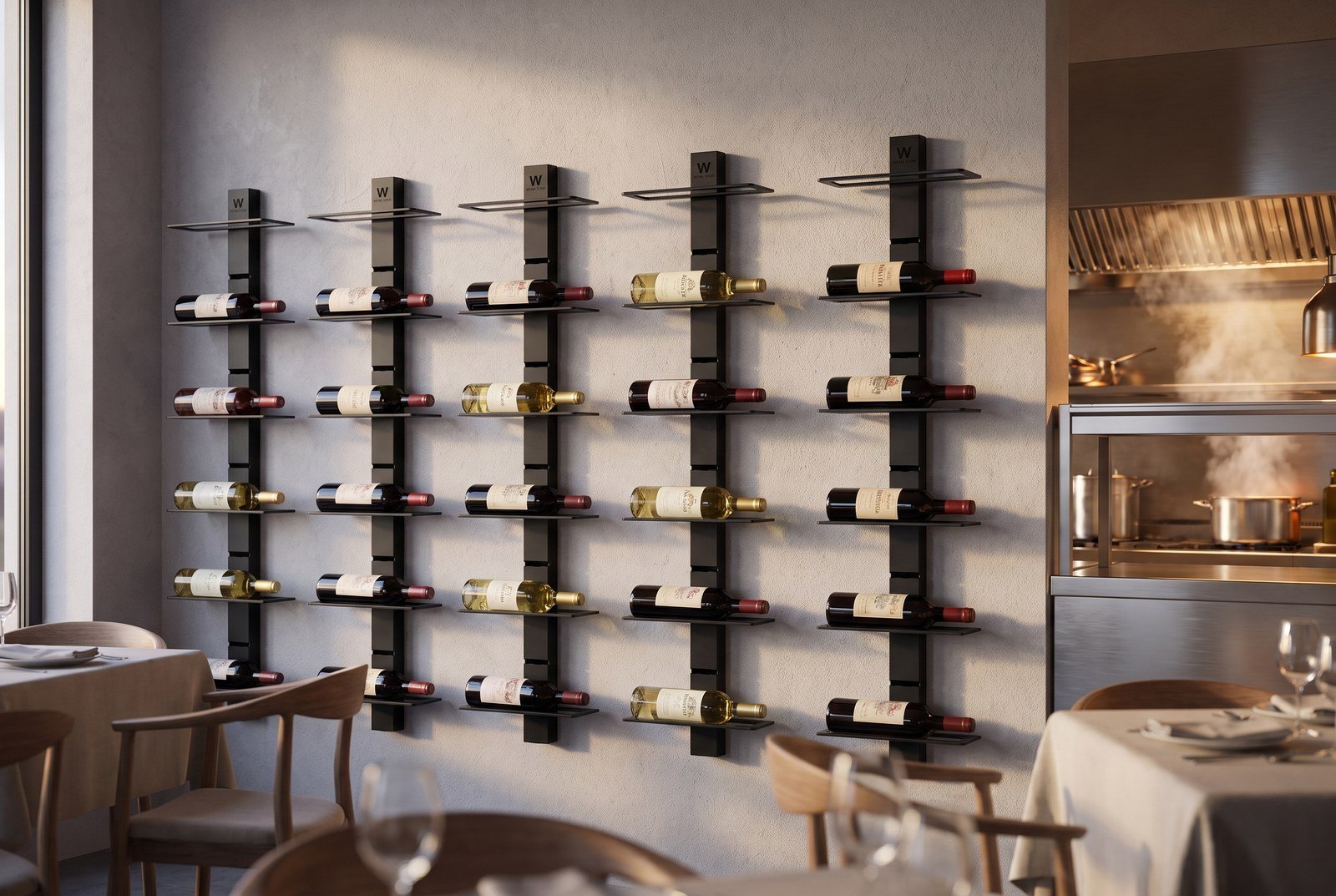
The wine list rotates. The wall space available in the dining room is limited—often squeezed between the pass and a bench—and service takes place during peak hours. This wall isn’t meant to hold the entire inventory: it displays the current selection and the reds served by the glass. The whites, rosés, and sparkling wines are kept chilled, either in a refrigerated cabinet or in an ice bucket, while the bulk of the inventory waits in the cellar.
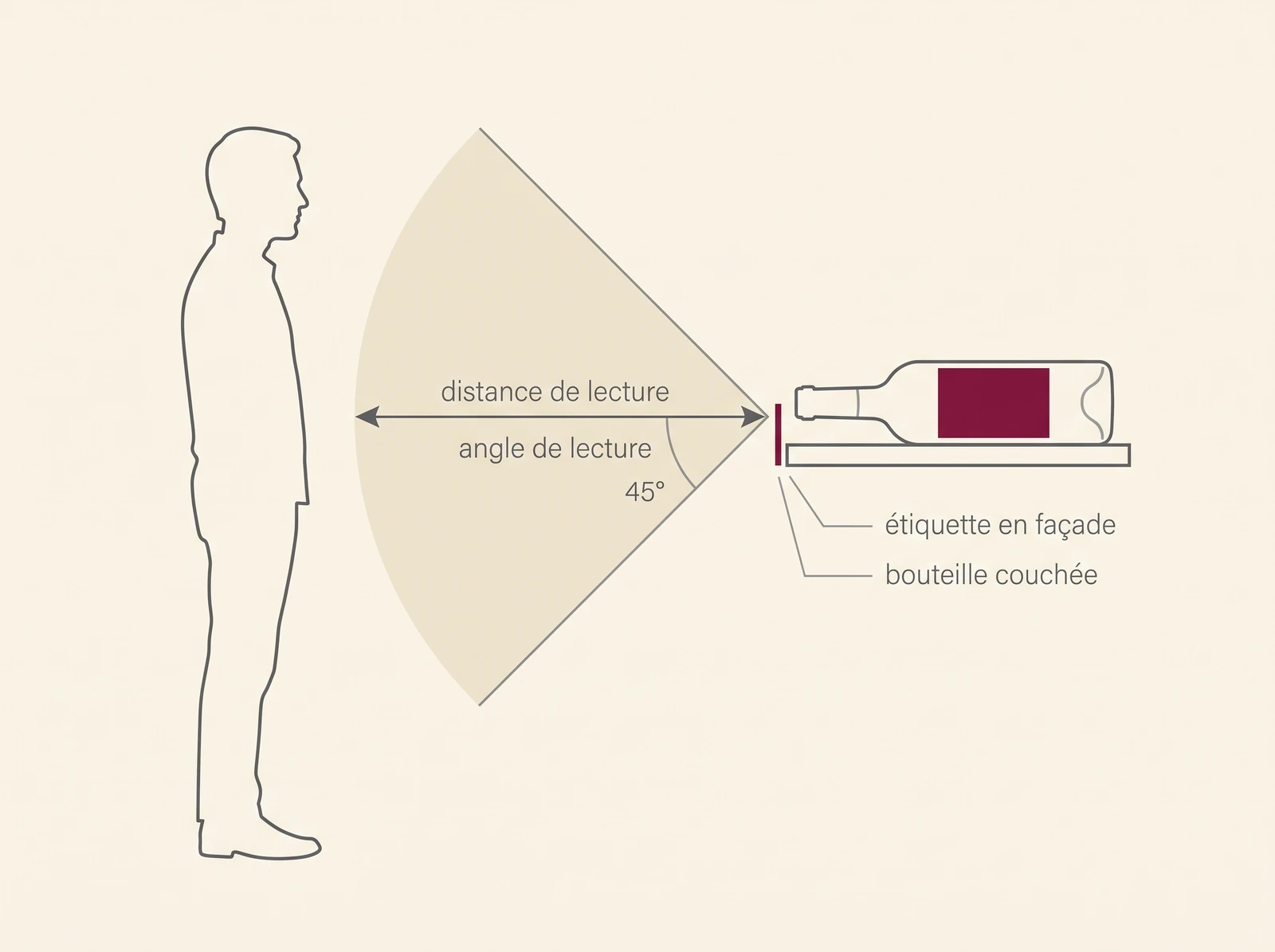
The layout is just as important as the furniture itself. At a comfortable reaching height, near the serving counter or at the far end of the room, so that the server can grab items without raising their arms or stepping out of their path. Bottles are stored on their sides, with the label facing forward and displaying the vintage: the wine can be identified from three meters away, without having to read it again. When the wine list changes, the clip-on shelves can be repositioned without tools.
There are two common mistakes. Turning the wall into storage space, which makes it hard to find items and slows everyone down. Putting things too high up is another: no one is going to pull out a step ladder in the middle of a shift—no one does that twice.
Behind the counter at a wine bar, the wall serves as the menu
In many wine bars, customers choose by eye, standing up in dim lighting. What they see determines what they order, and the selection changes monthly—sometimes weekly.
The layout is designed vertically, utilizing all the available space between the countertop and the ceiling. Alternating between single and double shelves creates rhythm and prevents the wall from looking monotonous. One principle governs vertical storage: at the top, items that are rarely displayed or handled; at hand level, items that are taken out during service. A full bottle of champagne weighs more than a still wine, and champagne served by the glass has no place on the bottom shelf. Spirits, on the other hand, should be stored upright: high-proof alcohol attacks the cork as soon as the bottle is laid on its side.
Low-angle lighting highlights the texture of the steel and makes the labels stand out. One caveat, however: sparkling wines and white wines in clear glass develop a “light-induced” taste when exposed to UV and blue light—sometimes within just a few hours. Use LEDs with a low blue component, avoid shining a beam continuously on the bottles, and rotate the items on display frequently.
Two pitfalls. Overcrowding the wall: past a certain point, the eye loses focus and the display no longer serves its purpose. And the fixed furniture, which locks the menu in place for five years. Frankly, in a business that depends on its menu, fixed furniture is a bad move.
Our guide to designing a wine bar provides guidelines for the layout between the counter and the back bar; for information on choosing materials for the dining area, see our notes on industrial-style bars.
At a wine shop, everything needs to be able to move between shipments
From several hundred to several thousand items, depending on the size of the store; frequent relabeling; and prices that change with each new shipment. The wine shop features a sales wall, a central display in the middle of the store, and a street-facing display window. On the rotating section of the shelf, the layout lasts no more than a few weeks.
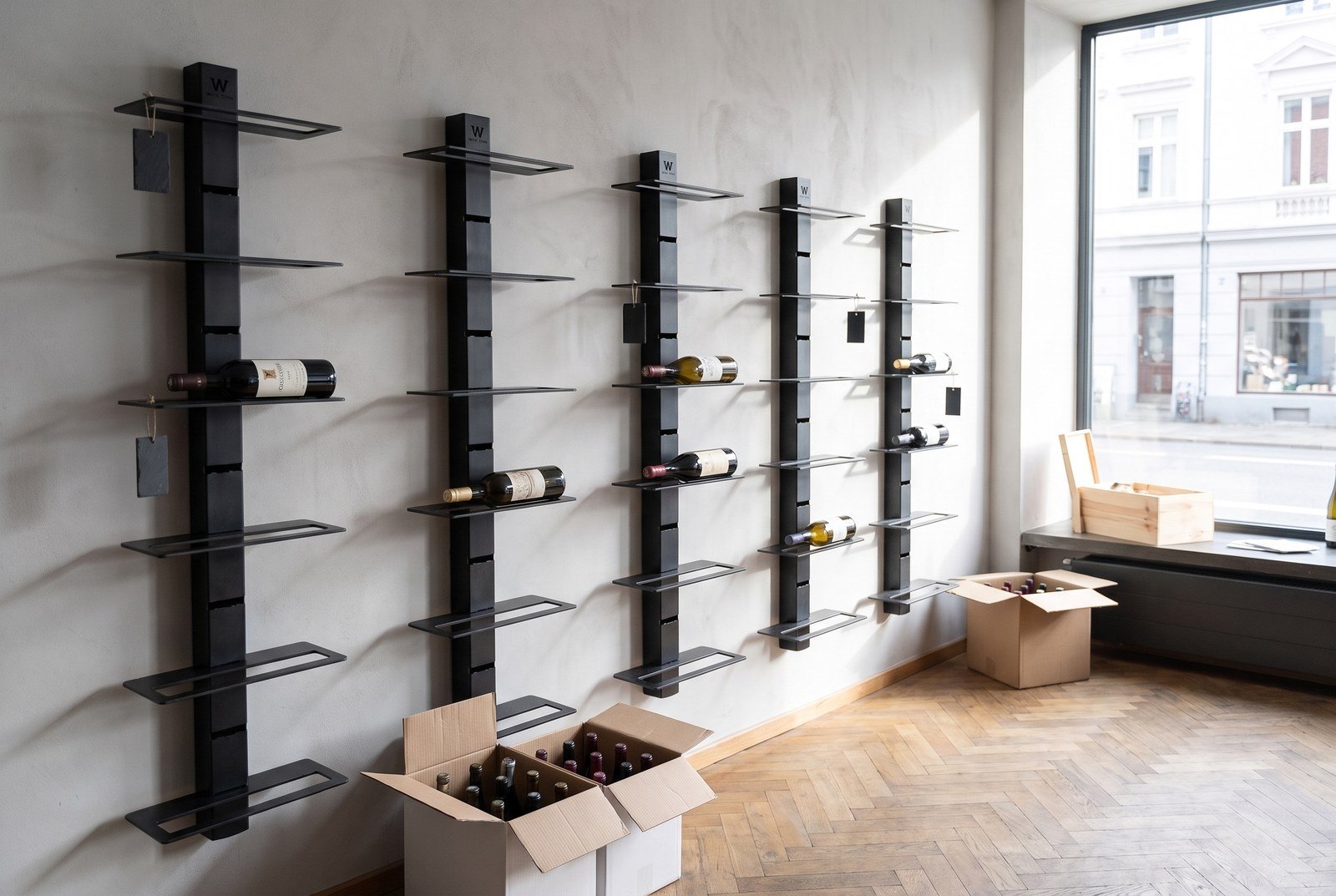
What this requires from the furniture: clip-on shelves that can be reconfigured without dismantling the structure, so that a section of the wall can be reorganized in the middle of the day without emptying the shelf. The slim 2-mm steel profile also changes the way space is utilized: compared to a solid wooden rack, where the dividers take up space between each bottle, it allows for more items to be displayed given the same wall width. Magnums and champagne fit into the same system without needing a different unit; spirits also have their place there, stored upright.
Common mistakes: shelving designed for 75 cl bottles, which forces larger sizes to be placed on the floor; fixed shelves that require everything to be taken down each time the shelves are restocked.
Our article on showcasing wine bottles provides guidelines for prioritizing displays that can be applied in a store.
What Each Profession Needs from Its Wall, at a Glance
A Wine Line® module measures 118 cm high × 30 cm wide × 14.8 cm deep: this is the basic unit of the display system. A wall consists of modules placed side by side, each 30 centimeters wide. The right-hand column determines the display capacity per module, depending on the chosen shelf configuration.
| Occupation | Service Constraint | Consequences if the furniture isn't delivered | Reply to the post | Breakdown by module |
|---|---|---|---|---|
| Restaurant | Access in just a few seconds during service | A bottle to be found, a table waiting | At hand height near the pass-through, label on the front | Up to 11 bottles on single shelves, 30 cm wide |
| Wine Bar | Selecting by eye, standing, in low light | Selection cannot be read from the counter | Vertical composition, alternating single and double elements, low-angle lighting | Up to 22 bottles on double shelves, 118 cm high |
| Wine Merchant | Relabeling and Ongoing Stock Arrivals | The entire shelf must be lowered again after each change | Tool-free clip-on shelves; accommodates magnum bottles and champagne | Depth: 14.8 cm; modules can be placed side by side across the entire width |
Why steel, and why does it move?
Wood remains the go-to choice when it comes to wine storage furniture, and much of a wine shop’s layout still relies on wooden crates, even though metal racks and display units have long been a standard feature in stores. Wood holds its own. However, it does come with two practical limitations that become apparent with use.
First, maintenance. An open steel rack can be cleaned with a quick wipe of a cloth. A full solid-wood rack requires you to remove the bottles to reach the bottom. Next, durability: wood expands and contracts with changes in the room’s humidity, whereas a steel structure remains dimensionally stable, and its slim profile leaves more space for the bottles rather than the uprights. That said, steel is not entirely immune to a humid environment, and that’s where the finish makes all the difference.
Two finishes, two uses. The raw steel retains its rolling marks and develops a patina that changes over time; the wax or light oil coating needs to be reapplied depending on how often the item is handled—and in everyday use, that frequency is high. The powder-coated steel features a moisture-resistant matte finish: clean with a damp cloth and a neutral detergent if needed, avoiding abrasives or acidic or alkaline products, which dull the finish. The matte finish shows fingerprints slightly. In matte black behind a counter, it blends in behind the labels.
The rest is a matter of design. The shelves snap into place and can be repositioned without tools. The central frames, single shelves, and double shelves are sold separately: you assemble the unit module by module, then expand it later without having to replace anything. A modular system like this makes the quote useful. You determine the dimensions of a wall, and the unit is designed to fit.
How a Modular Wall Can Make a Difference in a Hotel-Restaurant
A hotel-restaurant almost never furnishes just a single room. The bar and the dining room do not have the same wall width or the same service rhythm, and the layout is recalculated for each space.
The way the modular system changes things here is simple. When the selection changes, the shelves can be repositioned without dismantling the structure or drilling new holes in the wall, and both the label and the vintage remain visible from the table.

Review your project
Every establishment has its own wall width, ceiling height, and turnover rate. Send us the dimensions and a photo of the wall, and we’ll get back to you with a module-by-module design and a detailed quote tailored to your business—whether it’s a restaurant, wine bar, or retail store.
Request a project studyFrequently Asked Questions for Professionals
What capacity should be planned for, and how should the wall be sized?
One module measures 30 cm wide by 118 cm high. With single shelves, it holds up to 11 bottles; with double shelves, up to 22, with each shelf holding two bottles. The wall is made up of modules placed side by side: divide the available width by 30 cm. Magnums and champagne fit into the same system without any additional furniture. Spirits are also compatible, with the exception that they must be stored upright and never on their sides.
Quotes, Invoicing, and Lead Times: How Does a Business Order Work?
We start with the wall dimensions and the items to be displayed, then provide a quote for the structures and shelves. Preparation takes 24 to 48 hours; delivery takes 2 to 5 business days and is free for orders of €350 or more (including tax). Allow 2 to 3 weeks for powder-coated steel, which is custom-finished. Pay in 1, 2, or 3 installments with no fees; 2-year manufacturer’s warranty.
On which wall should it be mounted, and what is the load capacity per module?
Concrete, brick, wood, 22 mm OSB: Secure using 5 × 50 mm screws and the included drilling template. For single-layer drywall, use a 22 mm MDF or OSB backing board, or Moly screws. One person is sufficient for installation. The maximum load capacity is 25 kg per module. All other details, including the type of substrate, are determined at the time of the estimate, based on the wall plan.
Raw steel or painted steel for indoor use?
Raw steel changes over time: it develops rolling marks and a patina that forms with age; it should be treated with wax or a light oil, depending on how often it is handled. Powder-coated steel has a matte finish that resists moisture; it can be cleaned with a damp cloth and a neutral detergent, but never with abrasive, acidic, or alkaline products. Behind the bar, where glasses are rinsed throughout the shift, this is the easiest finish to maintain, and it’s also the one we recommend for any damp or high-traffic area.
A wine collection that grows at your own pace.
Modular wall-mounted shelves in raw or lacquered steel. Holds up to 22 bottles per module, 2-year warranty, free shipping on orders over €350.
Explore the collectionExcessive alcohol consumption is harmful to your health. Please drink responsibly.