
What wine should you serve with a Christmas meal?
On December 24 at 7 p.m., six bottles are waiting on the counter, and no one knows which one to start with. The champagne is finished during the aperitif, a full-bodied red is opened to accompany the scallops, and the rich, creamy foie gras follows. The evening goes well. As for the wines, they canceled each other out.
Here is the meal in order, from the aperitif to the dessert log, with two suggestions for each course: an affordable option, available at any wine shop, and a more ambitious one if your budget allows. Wine Line® does not sell wine. That gives us the freedom to point out where price ceases to be a factor.
The order of the glasses is just as important as the contents of the bottles
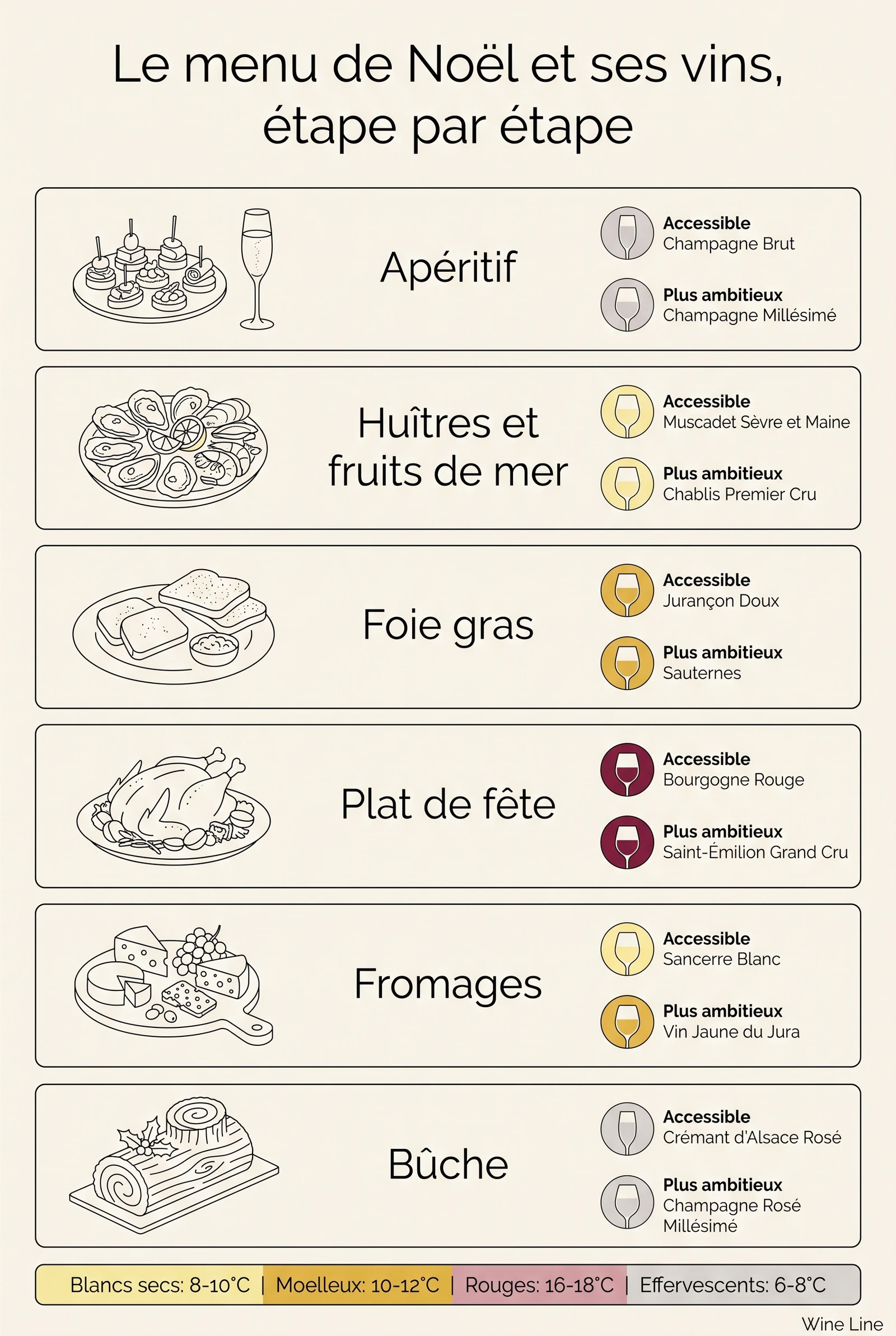
The most common mistake on New Year’s Eve occurs even before choosing the wine. It has to do with the sequence of wines. A full-bodied wine served too early overpowers the wines that follow, and the next glass seems thin when in fact it is simply more delicate.
Three key points are all it takes to make the evening a success:
- From the lightest to the most full-bodied. Sparkling wines and crisp whites set the tone, while structured reds take center stage.
- From the driest to the sweetest. A dry wine served after a sweet wine seems tart and short on the palate.
- From the youngest to the oldest. The oldest vintage is served last, when everyone at the table is paying close attention.
There is, however, one exception that defies the second rule: foie gras, which is often served as an appetizer with a sweet wine, even though the main course calls for a dry red wine. There are two options, depending on your restaurant. You can serve the foie gras at the very end of the meal, in place of cheese, and the progression remains intact. Or you can pair it with a full-bodied dry white wine, which resolves the issue of sweetness.
For an aperitif, serve some bubbly and save the best for later
The cocktail hour lasts an hour and a half; the guests chat, but no one really tastes the drinks. There’s no need to waste your best bottle on it.
The affordable option: a crémant. Those from the Loire, Alsace, and Burgundy offer a value for money that entry-level champagne no longer matches. A brut crémant from the Loire, made from Chenin, holds its own in a blind tasting. A brut Vouvray serves the same purpose, with more acidity.
The more ambitious choice: a blanc de blancs champagne. Almost always made entirely from Chardonnay, it’s lively and chalky, and pairs well with gougères and puff pastries without being overshadowed. Serve it in white wine glasses—the aromas need room to breathe.
One bottle for six people is enough at this stage; otherwise, the meal will already be halfway gone by the time it starts.
If you're coming as a guest with a bottle to give as a gift, the approach changes: you choose something for the person receiving it, and our gift ideas for wine lovers have you covered.
Oysters, smoked salmon, and scallops all go well with a white wine
Seafood appetizers are the most technically challenging part of the meal—and the easiest to get wrong. There’s one rule to keep in mind: red wine and shellfish don’t go well together.
Oysters call for a crisp, very dry white wine
The culprit is the iron naturally present in red wine. It catalyzes the oxidation of the fatty acids in the scallops, and this reaction produces aldehydes with a metallic taste, similar to that of a coin. A 2009 Japanese study, conducted on 64 wines tasted with scallops, confirmed this. Tannins, on the other hand, play a different role: they dry out the palate. Few guides take the time to explain this, and an explanation is better than a list.
Among a dozen fine white wines, a Muscadet Sèvre-et-Maine aged on its lees does the trick for just a handful of euros. At a higher price point, a Chablis, whose briny intensity complements the iodine notes.
Smoked salmon can handle a higher fat content
The smokiness and richness of the fish call for a wine that is neither too light nor too sweet. A dry Alsatian Riesling cuts through the smoky flesh. For something a bit more sophisticated, try a Jura Chardonnay aged under a veil of yeast and not topped up with wine, whose oxidative notes pair remarkably well with the smokiness.
Scallops call for a delicate touch
A lightly seared scallop is a delicate dish that can easily be overcooked. A Mâcon-Villages or a white Bourgogne de Village is always a safe bet. For a more ambitious pairing, a white Bordeaux from Pessac-Léognan—with its blend of Sauvignon Blanc—pairs just as well with scallops as it does with lobster or langoustines.
Foie gras is the only real dilemma on New Year's Eve
Two schools face off every year on this course, and tradition isn't always right.
The affordable option: a semi-dry Vouvray. With between 8 and 18 g/l of residual sugar, the sweetness remains well-balanced; the Chenin’s acidity cuts through the richness, and the bottle costs one-third the price of a renowned sweet wine. A sweet Jurançon, made from Manseng grapes, has significantly more sugar (at least 40 g/l), yet its very high acidity still maintains the balance.
The more ambitious choice: a Sauternes. This classic pairing works well, especially when the foie gras is served on its own, at the end of the meal, with nothing else to follow.
My personal preference, after several New Year’s Eve dinners spent watching the half-full glasses at the end of the table: with a foie gras appetizer followed by a main course, I serve a full-bodied dry white wine rather than a sweet one. An Alsatian Riesling from a good vintage or a Marsanne-based white Rhône wine complements the texture without overwhelming the palate, and the rest of the meal remains enjoyable. A sweet wine, on the other hand, leaves a sugary aftertaste for an hour and makes it difficult to enjoy the red wine that follows. If family tradition calls for Sauternes, serve it in small quantities and very chilled.
When cooking capon and turkey, prioritize tenderness over flavor
Festive poultry is a delicate white meat, often stuffed with chestnuts or dried fruit. It calls for a smooth red wine with a mellow body. A stuffed turkey served with a wine that’s too tannic loses all its tenderness.
An affordable option: a Pinot Noir or a Cabernet Franc from the Loire Valley. A village-level red Burgundy or a Chinon offers the red fruit and freshness that reawaken the appetite after foie gras.
The more ambitious choice: a 10-year-old red Bordeaux. A Saint-Julien or a Médoc cru bourgeois, with tannins that have mellowed, coats the stuffed turkey without drying it out. With a roasted capon, a Saint-Julien remains the safest pairing of the evening.
For restaurants serving game, duck, or truffle-stuffed poultry, the focus shifts to full-bodied wines. A Côtes du Rhône Villages pairs effortlessly with duck. At a higher level, a Châteauneuf-du-Pape or a Côte-Rôtie from the northern Rhône pairs well with venison and duck breast. For truffle dishes, choose a mature wine: a young, fruity wine competes with the aroma, while a ten-year-old wine complements it perfectly.
A cheese platter deserves better than the dregs of red wine
The instinct is to finish the bottle that came with the dish on the platter. This works well with a smooth red wine and Comté cheese, but much less so with blue cheese or a washed-rind cheese: the compounds in the mold and the sharpness of the cheese clash with the tannins, which come across as bitter and metallic.
Two simple solutions. Save a little dry white wine from your previous dish—it’s a fantastic pairing with goat cheese and hard cheeses. Or plan ahead and have a glass of natural sweet wine, such as Banyuls, to pair with blue cheeses: the sweet-and-salty combination is spectacular.
And a long-aged cheese, or a Vin Jaune from the Jura, if you have any.
When it comes to mulled wine, naturally sweet wine takes the cake
Dessert rounds out the meal and is paired with the wrong wine more often than any other course. A brut champagne served after a sweet Yule log tastes harsh and flat: the sugar in the dessert washes away the fruity notes and leaves only the acidity on the palate.
The accessible choice: a Rivesaltes “tuilé” or a Muscat. Paired with a chocolate Yule log, the “tuilé”—which contains some Grenache Noir—develops notes of cocoa and coffee that complement the dessert. With a red berry or vanilla Yule log, a Muscat de Beaumes-de-Venise is a better match, or a Coteaux du Layon if you want to step it up a notch.
The more ambitious choice: an aged Banyuls. The coffee and nutty notes of a 10-year-old Banyuls paired with rich dark chocolate are one of the great pairings in French cuisine. The glass is small; a 75-cl bottle is enough for about ten guests. Be mindful of the bottle size: many natural sweet wines are sold in 50-cl bottles.
If you want to enjoy the bubbles right to the end, go for a demi-sec champagne. The higher dosage makes it more of a dessert wine.
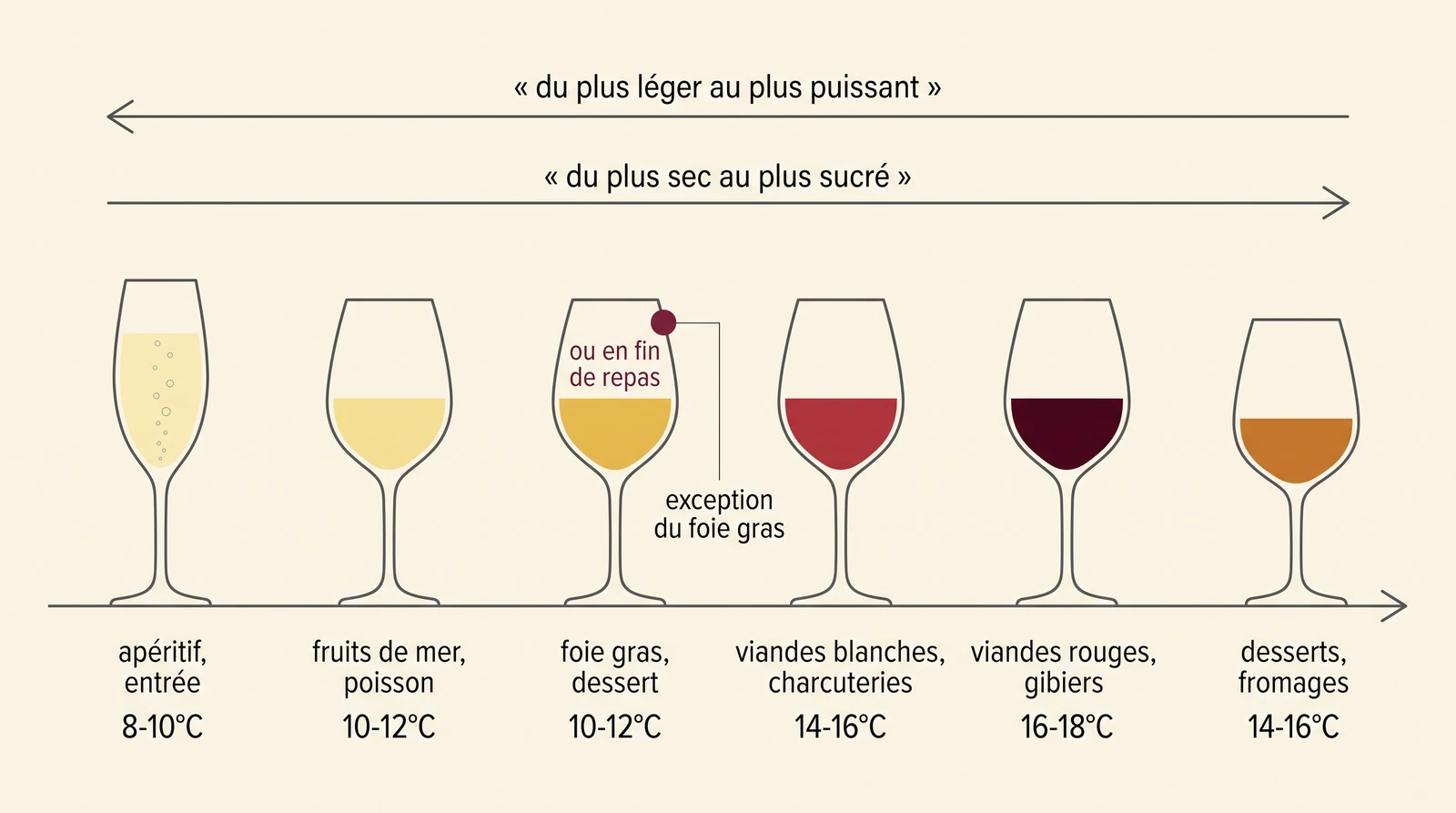
The Complete Step-by-Step Guide
The middle column is all you need to put together a well-rounded festive meal. The right-hand column is meant to be used sparingly, in one or two steps.
| Course of the meal | Accessible option | A more ambitious option |
|---|---|---|
| Appetizer | Crémant de Loire Brut, Vouvray Brut | Blanc de Blancs Champagne |
| Oysters and Seafood | Muscadet Sèvre-et-Maine aged on the lees | Chablis |
| Smoked salmon | Dry Alsace Riesling | Jura White (Chardonnay, not topped up) |
| Scallops, lobster | Mâcon-Villages | White Pessac-Léognan |
| Foie gras | Vouvray demi-sec | A dry white wine suitable for aging, or Sauternes served on its own |
| Capon, turkey, poultry | Pinot Noir, Chinon | Saint-Julien, a 10-year-old Médoc |
| Game, duck, truffles | Côtes du Rhône Villages | Châteauneuf-du-Pape, Côte-Rôtie |
| Cheeses | Dry white wine from the previous course | Yellow wine from the Jura, Banyuls sur les Bleus |
| Chocolate Yule Log | Rivesaltes (red) | Aged Banyuls |
| Fruit Log | Muscat from Beaumes-de-Venise | Coteaux du Layon |
How many bottles should we plan for, and at what temperature should we serve them?
A 75-cl bottle fills six 12.5-cl glasses. This is the only useful way to calculate it, because at Christmas, no one drinks a full glass of each wine.
Serving size guidelines for a group of adults:
- Appetizer: one bottle for six people.
- Seafood appetizers: one bottle for six.
- Foie gras: one bottle for ten people—that’s not much per person.
- Main course: one bottle for five people—that takes the longest to serve.
- Dessert: one bottle for twelve people.
For ten adults, these guidelines amount to about seven bottles—a good third of which are dry white wines—in addition to the sparkling wine for the aperitif. That works out to a little more than four glasses per person, keeping in mind that no one is expected to finish their glass at every course. Plan to have a few extra bottles of each type, but no more than that: panic-buying on December 23 always ends up costing twice as much.
Operating temperatures, along with their counterexamples
- Sparkling wines: 8 to 10 °C. If a champagne is placed in the freezer and then served ice-cold, it won’t reveal its full character until it has warmed up again.
- Dry white wines: 10 to 12 °C. The refrigerator cools them to between 4 and 6 °C, depending on the region—too cold for a Chablis.
- Sweet and rich: 8 to 10 °C, so that the freshness balances out the sweetness.
- Natural sweet wines: 12 to 14 °C for a Tuilé or a Banyuls, 9 to 11 °C for a Muscat.
- Light reds (Pinot Noir, Cabernet Franc): 14 to 15 °C. Chilling them for half an hour works well.
- Full-bodied reds: 16 to 17 °C. “Bringing the wine up to room temperature” meant taking the bottle from the cellar to an unheated room, where the temperature rarely exceeded 18 °C—a far cry from the 21 °C living room on December 25.
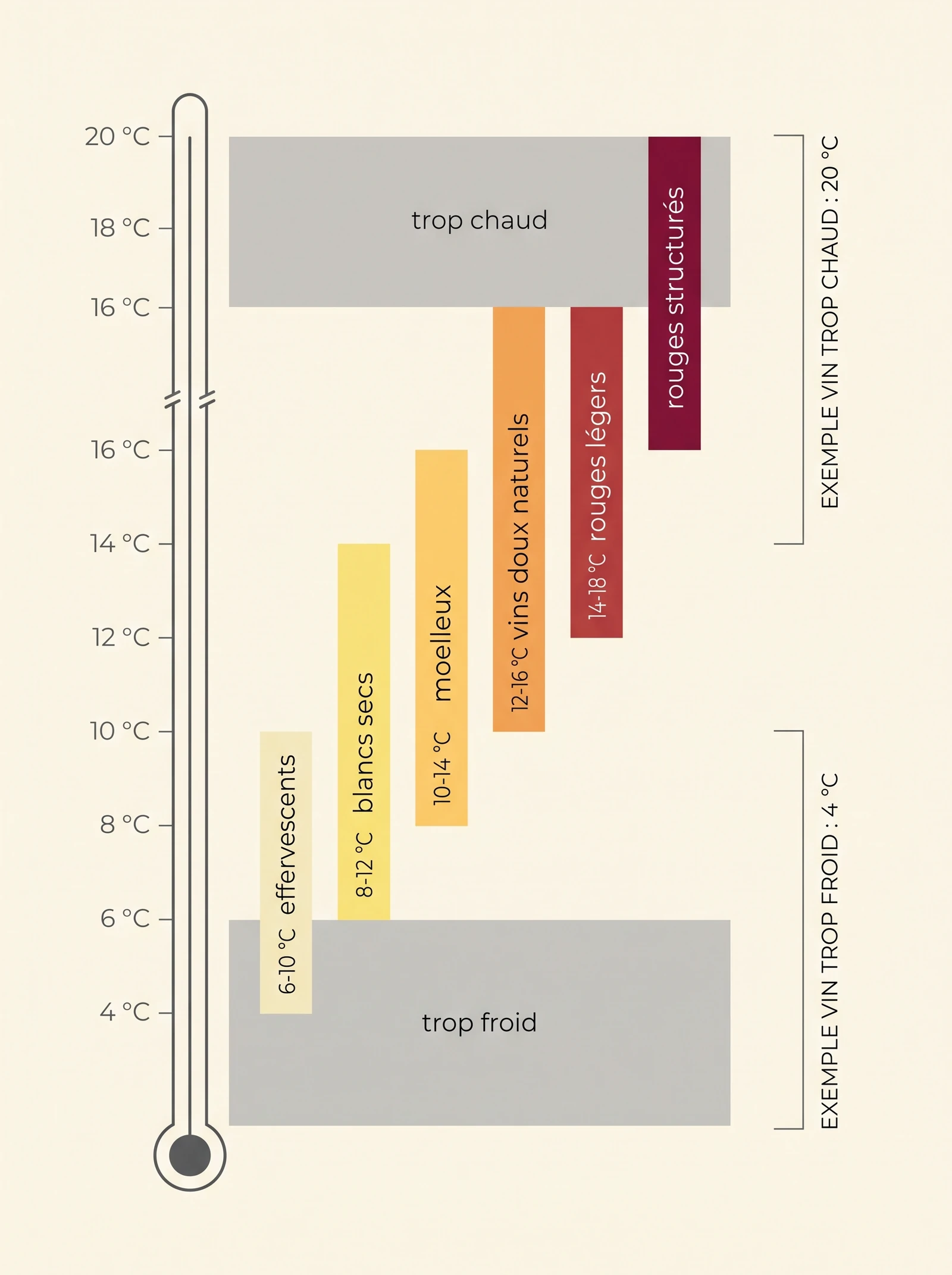
Then there’s the question of what happens after the 25th. We buy twelve bottles, open eight, and four end up standing upright in their box—often in the hottest room in the house—until spring. At 20°C, wine ages about three times faster than at 12°C, and the damage can’t be undone. Store them horizontally, keep them away from heat, and adjust your purchases next year: our guide to calculating the number of bottles of wine per person provides the ratios based on the type of meal.
Frequently Asked Questions About Christmas Wines
Can we serve just one wine for the entire meal?
Yes, with a full-bodied, structured dry white wine: a white Pessac-Léognan or an Alsatian Riesling work well as an aperitif with cheese. They fall short during two courses: foie gras and dessert. A second bottle of sweet wine covers those two courses. Two well-chosen wines are better than six mediocre ones.
Can champagne be served throughout the entire meal?
With seafood appetizers and roast poultry, a champagne holds its own with ease. The problem arises with dessert: the sweetness of the Yule log masks the fruit flavors and leaves only the acidity on the palate, making the wine seem harsh. A semi-dry wine is the perfect choice for the final course. As for the prestige wines, serve them with the main course, while the guests are still attentive.
Can we save the wine we drank with the meal for the cheese?
With Comté or Tomme, yes, without a doubt. With blue cheese or Époisses, the tannic red wine brings out a bitter, metallic taste. Keep a little dry white wine on hand, or serve a small glass of natural sweet wine with blue-veined cheeses.
Should we charge more just because it's Christmas?
In practice, between 8 and 18 euros a bottle, the quality improves very quickly. Above 35 euros, you’re mainly paying for rarity and aging potential—two qualities that are hardly noticeable at a table of twelve where people are talking loudly. Spend your money on the wine that pairs with the main course, and keep it reasonable for the others. Four wines at 15 euros each make for a better meal than a single one at 60.
What should you serve to people who don't drink alcohol?
Non-alcoholic sparkling wines have come a long way and are, quite frankly, a worthy substitute for crémant as an aperitif. Non-alcoholic red wines, however, remain disappointing when paired with a meal. A varietal grape juice or a sparkling apple juice—which is a carbonated juice with 0% alcohol by volume—work better when served in the same glass as the other guests.
A wine collection that grows at your own pace.
Modular wall-mounted shelves in raw or lacquered steel. Holds up to 22 bottles per module, 2-year warranty, free shipping on orders over €350.
Explore the collectionExcessive alcohol consumption is harmful to your health. Please drink responsibly.