
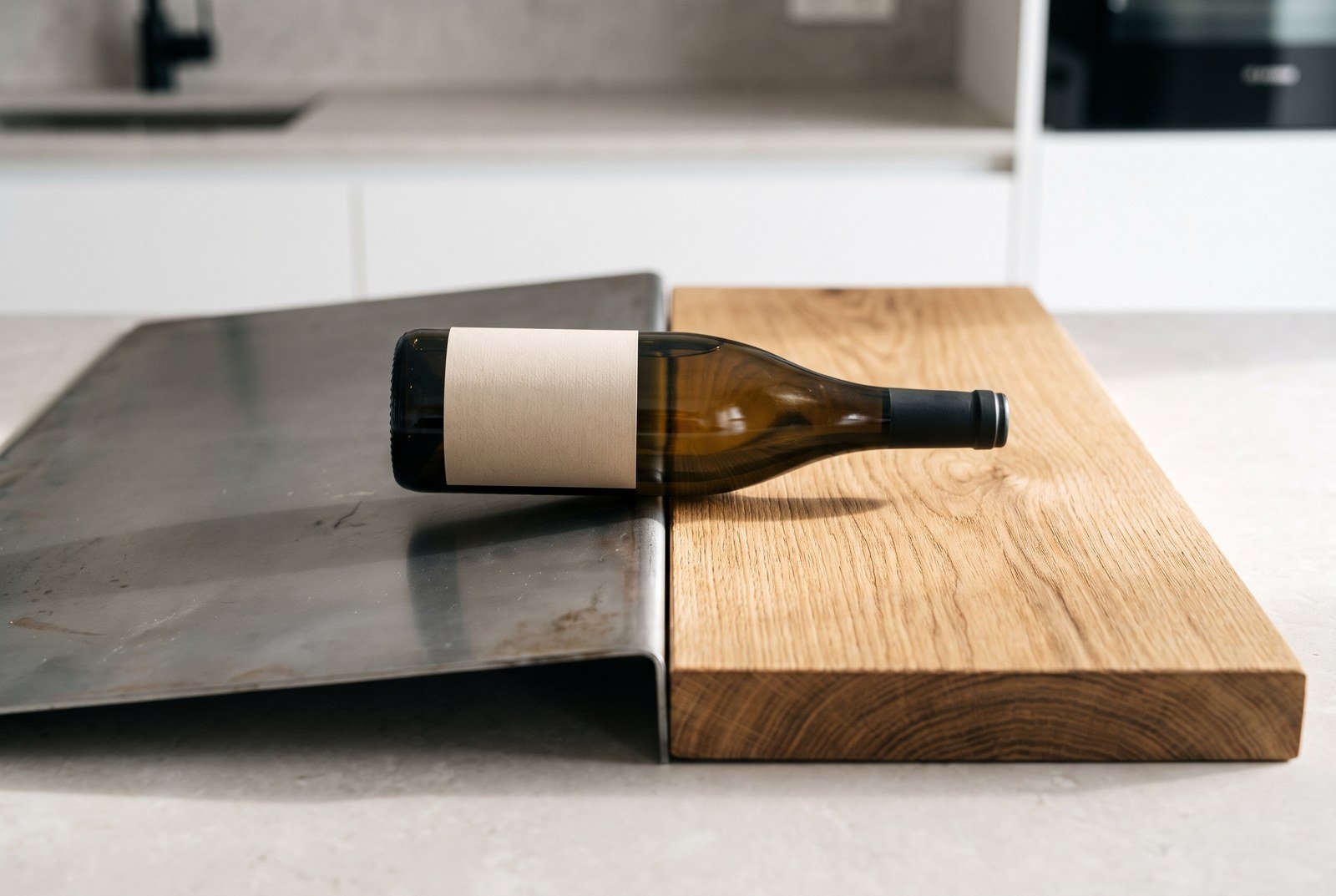
Metal or Wood Wine Racks: What Really Sets Them Apart
The question often comes up in the same form: metal, brick, or wooden wine racks. In stores, it boils down to two options—sometimes just one—the one shown in the catalog you’re looking at. Before deciding between a metal or wooden wine rack, one point deserves to be clarified: a stackable wine rack and a freestanding bottle rack don’t have the same requirements as a wall-mounted rack secured with screws. If this point remains unclear, it’s worth reading about the differences between a wine rack and a wine cabinet first. Moving forward, each criterion will have its own winner.
Metal outperforms on five criteria; wood, on two
In a dry living space—such as a living room, kitchen, or office—both materials get the job done. Wood adds warmth to the wall and is less expensive up front. Steel has the edge in every other respect: a 2-mm-thick folded sheet derives its rigidity from the fold, it takes up less space for the same capacity, its shape remains stable, and the shelves can be repositioned without tools in the case of a modular shelving unit.
In a room that is frankly damp—and a wine cellar is, by design, such a space—the trade-offs take on a different character. Wood struggles in these conditions. So does raw steel. That leaves powder-coated steel.
What criteria distinguish metal from wood?
Seven criteria for choosing a wine rack; one winner selected for each category; no ties. The numerical values for steel racks are those of the Wine Line® systems.
| Criterion | Wood | Metal | Winner |
|---|---|---|---|
| Durability and Long-Lasting Performance | The rigidity comes from the solid thickness; the shelf warps and sags over the years | 2-mm folded sheet metal: the rigidity comes from the bend, resulting in a very slim profile | Metal |
| Capacity and Dimensions | Stackable units; each additional unit takes up floor space, with significant depth against the wall | Up to 11 bottles per module on single shelves, 22 on double shelves; 14.8 cm deep | Metal |
| Moisture Resistance | Swells, works, may mold depending on the type of wood | Raw steel leaves marks; lacquered surfaces can withstand impacts as long as the coating remains intact | Lacquered Steel |
| Maintenance | Oil or varnish that needs to be reapplied regularly | Occasionally apply wax or light oil to the unfinished wood; use a damp cloth on the lacquered surface | Lacquered Steel |
| Visual warmth and impact in the room | Mass, color, an immediate rustic feel | Fine lines, graphic and contemporary design | Wood |
| Entry Cost | Top prizes in the very low pine category | Raw steel package for €149, lacquered package for €199 | Wood |
| Scalability and Modularity | Floor-level modularity: add space, reclaim floor area | Repositionable clip-on shelves, stackable units, with no floor space required | Metal |
"Moisture resistance" refers specifically to painted steel, not to metal in general.
The initial cost comes down to the wood, with one useful caveat: steel wire mesh racks are in the same price range as entry-level pine. The gap widens with modular wall systems, where nothing comes close to the price of a pine cube. And an entry-level panel sags under constant load, which changes the equation after a few years.
Why bricks, stones, and barrels are quickly out of the picture
Other materials come up in the discussion. They’re easy to deal with. Brick, terracotta, and stone come in dry-stacked modules that can be disassembled without any construction work: the real challenge lies elsewhere. It has to do with weight and the fact that these units sit on the floor, when the goal is precisely to free up floor space. A repurposed barrel or a glass tray makes a nice accent piece for a few bottles, but they can’t accommodate a growing collection. Wrought iron—which is essentially shaped mild steel—falls into the same category as metal, featuring bar-style sections rather than folded sheet metal. In practice, the choice comes down to wood and metal, the two materials that offer both wall-mounting capabilities and scalability.
Wood has advantages that steel will never be able to match
Wood provides a sense of weight and color that steel cannot replicate. In a country house or a stone cellar, a wooden wine rack blends in effortlessly. Steel takes on a different character—one that’s more graphic and contemporary. Both are aesthetically pleasing.
Wood doesn't rust. Ever. To be honest, that's a valid point: a wooden wine rack kept in a room with a moderate temperature can last for decades with just a quick wipe and a reapplication of oil every now and then. Without treatment or humidity control, wood can develop mold over time.
One final point, rarely discussed in the context of metal: wood insulates, while steel conducts. A wooden shelf—which is thicker and heavier—therefore takes longer to change temperature than a 2-mm sheet of metal, and it does not transfer the cold from a display wall to its supports. As for the wine itself, the effect is negligible. It’s the air in the room that determines the temperature of the bottles, regardless of what they’re stored on.
Combination wood-and-metal models do exist, and they serve a genuine purpose: the warmth of a wooden frame, the elegance of metal bottle racks. The key concern lies elsewhere. Wood swells and shrinks with changes in ambient humidity, while steel remains stable, and this difference eventually creates play in the joints. They also require two separate maintenance routines. As for scalability, that must be assessed on a case-by-case basis.
Steel takes precedence over the shelf's geometry
Under equal loads, a wooden panel must derive its rigidity from its full thickness. A 2-mm-thick steel sheet holds up for another reason: it is bent, and the bend gives it the cross-sectional height that wood achieves by increasing in thickness by several centimeters. That is the key to the subtlety of the result.
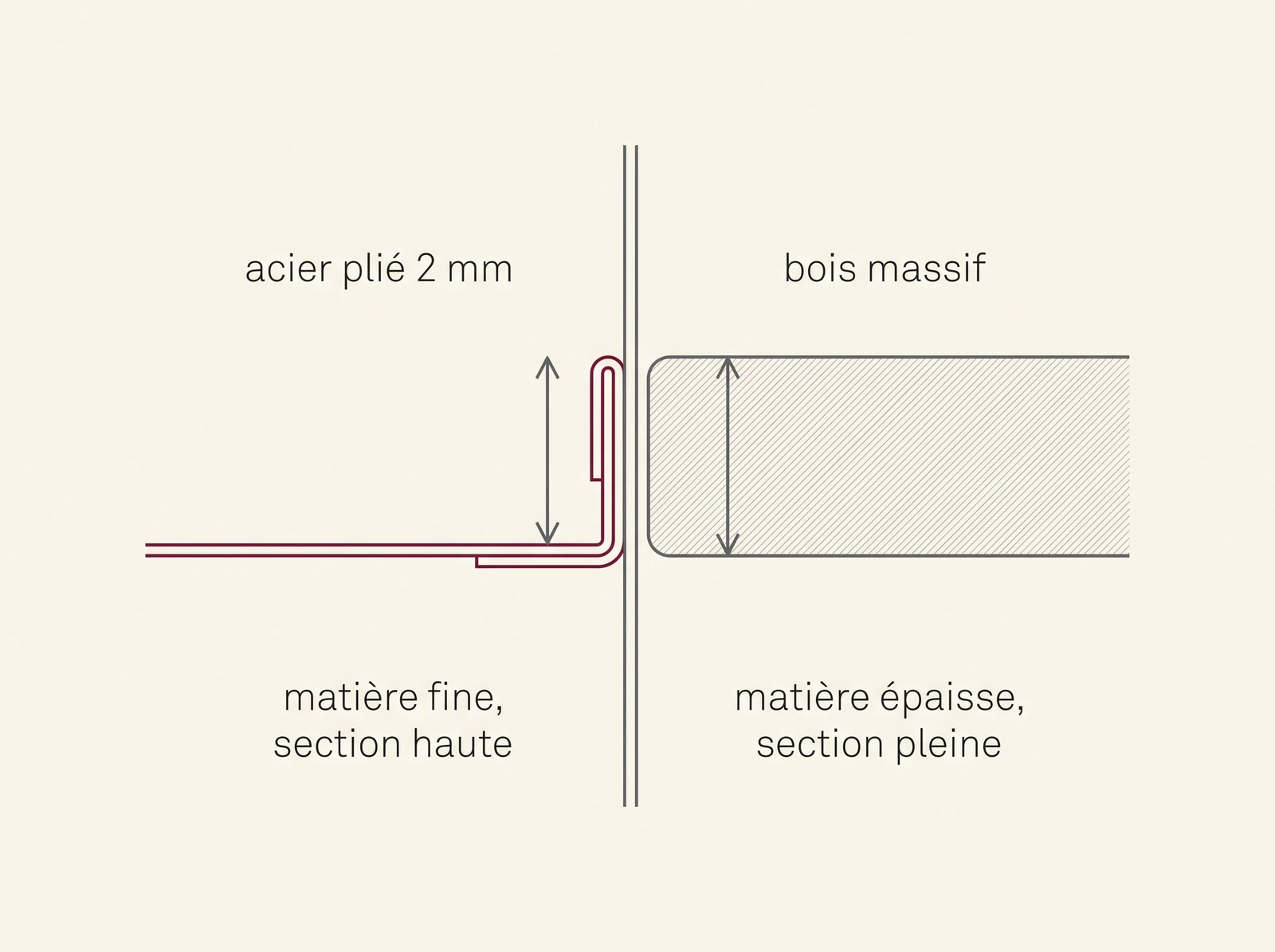
The same logic applies to durability. Wood is a living material: it absorbs moisture from the air, it expands and contracts, and a shelf that is constantly loaded will eventually warp. Steel retains its shape, without gradually warping under a constant load.
Another benefit of the openwork design is that air circulates freely around the bottles, whereas in a solid-wood design, each neck is enclosed within a closed compartment.
Is metal really resistant to moisture?
The moisture resistance applies to heat-treated steel. It does not apply to untreated steel.
A raw steel wine rack installed in a poorly ventilated underground cellar or against a cold wall that causes condensation—you can tell right away. The surface changes, becomes coated, and may discolor, starting at the edges and the points where it comes into contact with the bottles. The signs appear long before it becomes a problem.
A word about patina—the term can be misleading. On ordinary steel, the layer that forms on the surface does not prevent corrosion: it is porous, and oxidation resumes wherever it is scratched. What preserves raw steel over time is wax or a light oil applied from time to time.
As for the painted surface, the powder coating withstands moisture as long as its film remains intact: it acts as a surface protection.
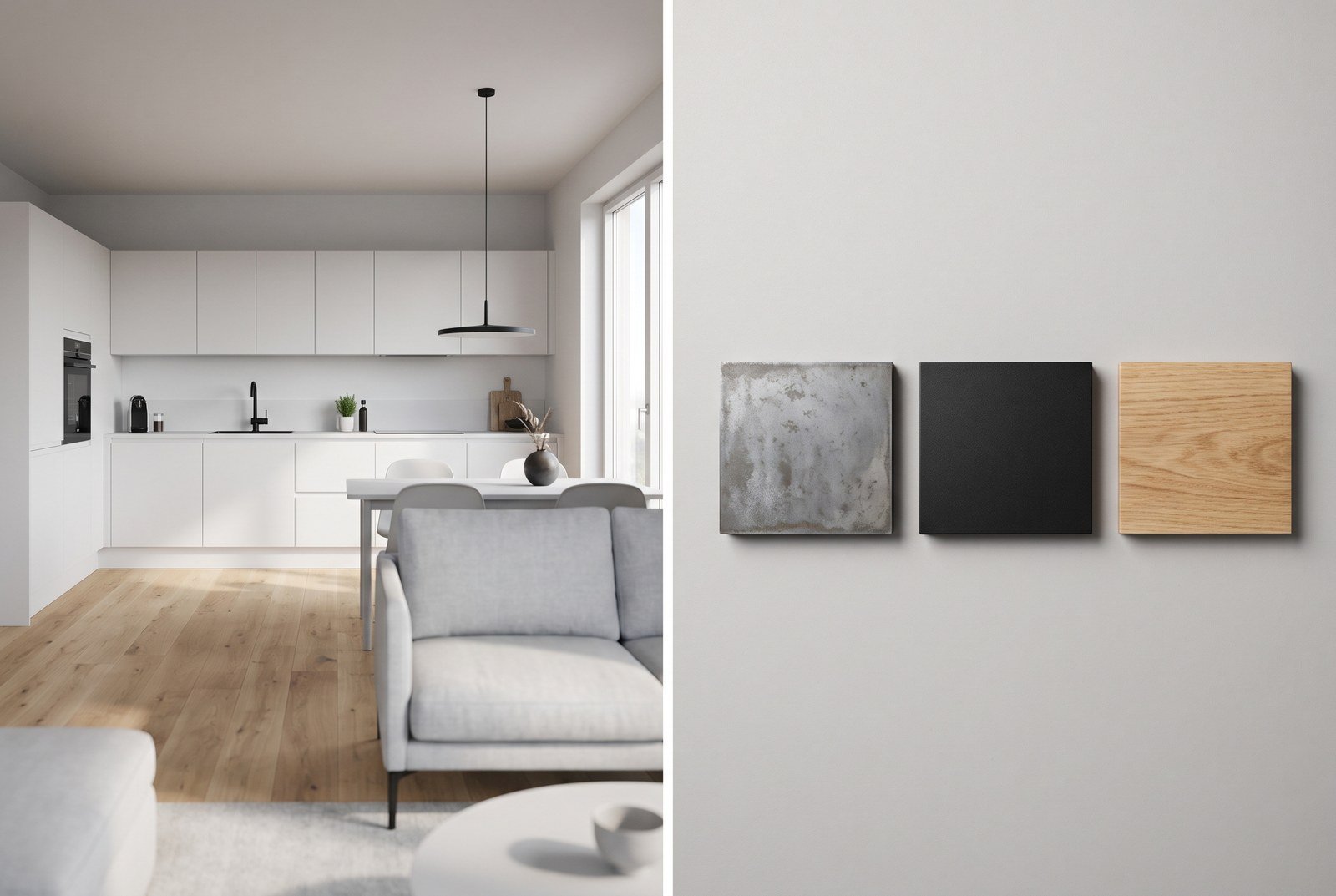
The rule applies in two situations. In dry living spaces—such as a living room, dining room, or office—raw steel is right at home, and its dark gray hue with a slight bluish tint, along with its rolling marks, are precisely what make the material appealing. However, in environments where the air remains consistently humid—such as a climate-controlled wine cellar—it requires regular maintenance. Otherwise, opt for a lacquered finish.
Which material is best for which room?
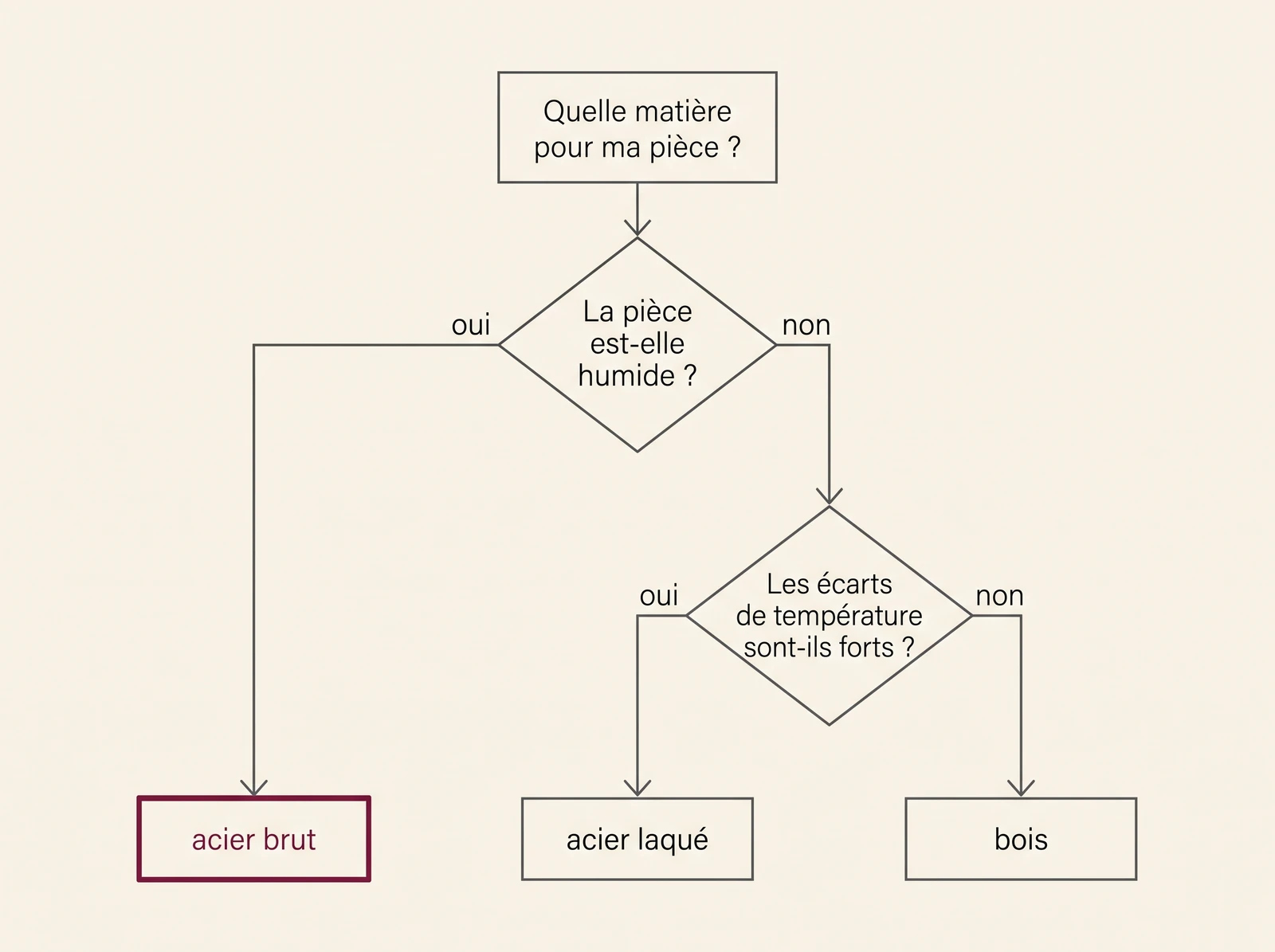
No shelf regulates anything. It stores items and displays them. It is the room that determines the temperature, humidity, and air circulation, so it is the room that dictates the choice of material.
- Underground wine cellar or poorly ventilated basement: painted steel. Wood warps; raw steel leaves marks.
- Serving cellar or temperature-controlled storage room: lacquered steel, for safety. Unfinished wine can be stored there if the air remains very dry, provided it is regularly polished.
- Kitchen: Preferably lacquered steel, due to cooking fumes and splatters. A damp cloth—that's all there is to it.
- Living room, dining room, home office: anything is possible; the choice comes down to aesthetics. Wood for a rustic look, raw steel for a contemporary feel.
- Uninsulated garage, sunroom, outbuilding: significant temperature fluctuations and unstable humidity levels. Powder-coated steel. And avoid a south-facing spot under a sunroom, since direct light is the enemy of wine bottles.
Sometimes, there isn't a wall available. In that case, it's worth taking a closer look at the differences between wall-mounted storage and freestanding models.
Raw Steel or Painted Steel: How to Decide
Then there's the look. The unpolished finish evolves over time, developing a patina and showing slight wear at points of contact—a change that some find appealing and others find annoying. The lacquered finish remains matte and even, with no surprises.
Raw steel package for €149, lacquered steel package for €199. Each module holds up to 11 bottles on single shelves, can be installed by one person using the included drilling template, and can be expanded later without making any changes to the existing setup. 2-year warranty.
View the raw steel package View the lacquered steel packageFrequently Asked Questions
Can you combine metal and wood?
Yes, in a dry room, where the contrast between the two materials works well and where the wood provides the warmth that steel lacks. No, in a damp room: the wood expands and contracts while the steel remains static, creating play at the joints, and the raw steel leaves its own mark.
How many bottles can you store on a wall?
It depends on the available floor space and ceiling height. A Wine Line module is 30 cm wide by 118 cm high and holds up to 11 bottles of wine on single shelves, or up to 22 on double shelves. The units are arranged side by side: capacity is calculated by multiplying the available width by the number of bottles a single module holds. This guide to choosing bottle storage explains the method in detail.
Does a raw steel shelf rust?
In a typically dry living space, no—it develops a patina, and that’s the desired effect. In a basement or damp room, the surface may discolor, starting with the edges and contact points. The patina alone isn’t enough to protect it: applying a thin coat of wax or oil from time to time preserves the raw steel. If you’re unsure about a piece, a lacquer finish eliminates any doubts.
How does the maintenance of wood differ from that of steel?
Wood requires re-oiling or re-varnishing at regular intervals, and more frequently if it is exposed to changes in humidity. Unfinished steel requires occasional waxing or a light oiling. Painted steel just needs a damp cloth—that’s all. Over time, a painted finish requires the least amount of maintenance, as long as the paint coating remains intact.
Solid wood or plywood: Does it make a difference?
A lot. Dense solid wood remains sturdy even when thick and ages well if treated. Soft pine plywood or particleboard bends quickly under the weight of a row of bottles and swells at the first sign of excess moisture. Plywood is in a class of its own: its cross-grain construction makes it the most stable of all panel types, and it supports weight far better than particleboard. For a budget-priced wooden wine rack, the type of panel and the wood species account for most of the price difference.
A wine collection that grows at your own pace.
Modular wall-mounted shelves in raw or lacquered steel. Holds up to 22 bottles per module, 2-year warranty, free shipping on orders over €350.
Explore the collectionExcessive alcohol consumption is harmful to your health. Please drink responsibly.