
Custom Wine Racks: Do You Really Need to Hire a Carpenter?
About six weeks. That’s the lead time listed in September 2026 by one of the top-ranking websites for “custom wine racks” to deliver a flat-pack unit, cut to the dimensions you entered yourself in its configurator. Six weeks for panels that are sawn, drilled, and packaged. The term “custom” has taken on a very different meaning in recent years. For this search query, the top-ranking pages sell online customization, delivered flat-packed. The craftsman who comes to take measurements of your wine cellar has been off the first page for a while now. It remains to be seen how much each option costs in terms of time and money—and how much freedom it leaves you with afterward. The shape of your wall will be the deciding factor sooner than your personal tastes.
"Custom-made" does not mean "made for you"
Look at the top of the page for this search query. A basement design specialist highlighting a 3D configurator. A furniture manufacturer selling custom-cut pieces ordered online. Catalogs with titles like “modular wine rack.” Just one artisan carpenter, visible through local search results, with no prices listed. Even he ends his titles with “modular wooden racks.”
“Custom-made” now refers to a promise of a perfect fit. The manufacturing process, however, has become industrialized. What the buyer is looking for is storage that fits their space perfectly: an 87-cm niche, a low ceiling, a long, bare wall. These are all needs that a system assembled on-site can meet just as well as a piece of furniture manufactured in a workshop.
Before choosing a storage solution, figure out what you need to store and how you want to access it. Our guide to choosing a bottle storage solution addresses these questions up front.
Three Ways to Get a Custom Wine Rack
Hire a carpenter or an interior designer
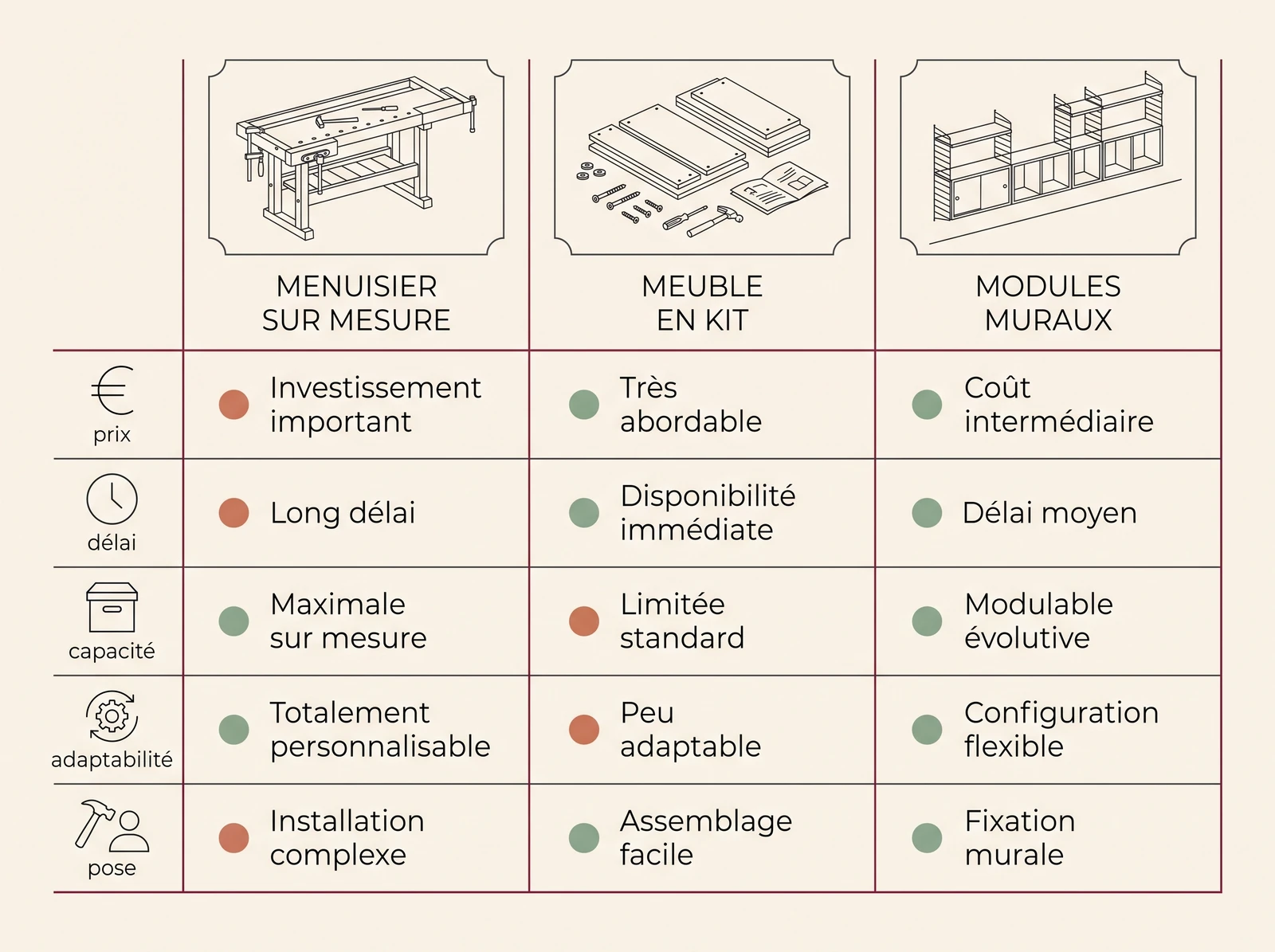
You describe the room; a professional takes measurements, draws up plans, builds the piece in the workshop, and installs it. This is the time-honored approach—the one that gave the term its meaning. Traditional woodworking produces a one-of-a-kind piece, fitted to the millimeter, often made of solid wood, that will remain in the home. It involves a quote, a waiting period, and a design that’s finalized before the first cut is made.
Order from a customizable furniture manufacturer
Online retailers have replaced price quotes with a configurator: you enter your measurements, choose a color, and the factory cuts the pieces. The package arrives flat-packed with assembly instructions. The fit is precise—often advertised down to the millimeter—but it’s still limited by the minimum and maximum dimensions of the template and by the options available in the catalog alone. And a configurator can’t handle a wall that isn’t square or a vaulted ceiling.
Build a modular system directly on the wall
Here, we think in terms of modules. A wall structure, clip-on shelves, a layout that’s decided right in front of the wall. Wine Line® operates on this principle: 2 mm steel, shelves that can be repositioned without tools, and modules that can be placed side by side to cover an entire section. There’s no need for a configurator beforehand; the setup is done right on the wall and can be rearranged whenever the collection changes.
A fourth option, often overlooked: building it yourself. Some boards, some battens, a saw, and a weekend. The materials are inexpensive; the finish depends on your skill. Our guide to building your own wine cellar details the steps and common pitfalls.
How the three approaches fare across five criteria
| Criterion | Carpenter or interior designer | Configurable Editor | Modular wall-mounted system |
|---|---|---|---|
| Deadline | Measurements, estimate, fabrication, installation: one to two months under normal circumstances; longer during busy periods | Approximately 6 weeks after production begins, as announced by dessinetonmeuble.fr (as of September 15, 2026) | Preparation: 24 to 48 hours; delivery: 2 to 5 business days (2 to 3 weeks for powder-coated steel with custom finishes); installation: less than 5 minutes on wood or OSB |
| Budget | Pricing is based on a quote and varies depending on the type of wood, the length, and the complexity | €606 to €2,489 for preconfigured models listed as of September 15, 2026; a configuration tailored to your specifications may exceed this upper limit | Raw Steel Package: €149; Lacquered Package: €199; Mixed Package: €199; Free shipping on orders of €350 or more (including tax); Pay in 1, 2, or 3 installments with no additional fees |
| Reversibility | Poor: The structure is fixed in place—sometimes recessed—and is difficult to dismantle | Average: The piece of furniture can be moved, but it is designed for a specific room. | Tall: The frame can be disassembled, and the shelves can be removed without tools |
| Scalability | New service call, new estimate | New order; compatibility with existing system is uncertain | Add a frame or a set of shelves; the rest stays the same |
| Property Value | Attached to the building, the structure is sold with the property and is included in the inspection; its impact on the price is not documented | "Neutral" refers to furniture | It doesn't affect the building, and you can take it with you when you move |
The modular option meets four out of five criteria but falls short on the last one. When it comes to the property’s value, the difference is primarily legal: a fixture attached to the building is sold with the home, while removable shelves go with you. In other areas, the gap is clear, and the turnaround time speaks volumes: a few days versus the advertised six weeks—all because of a need sparked by a box of bottles that’s been sitting on the floor for far too long. As for the DIY option, the raw materials cost a few dozen euros, and you’re responsible for assembly and finishing.
The material often determines the rest
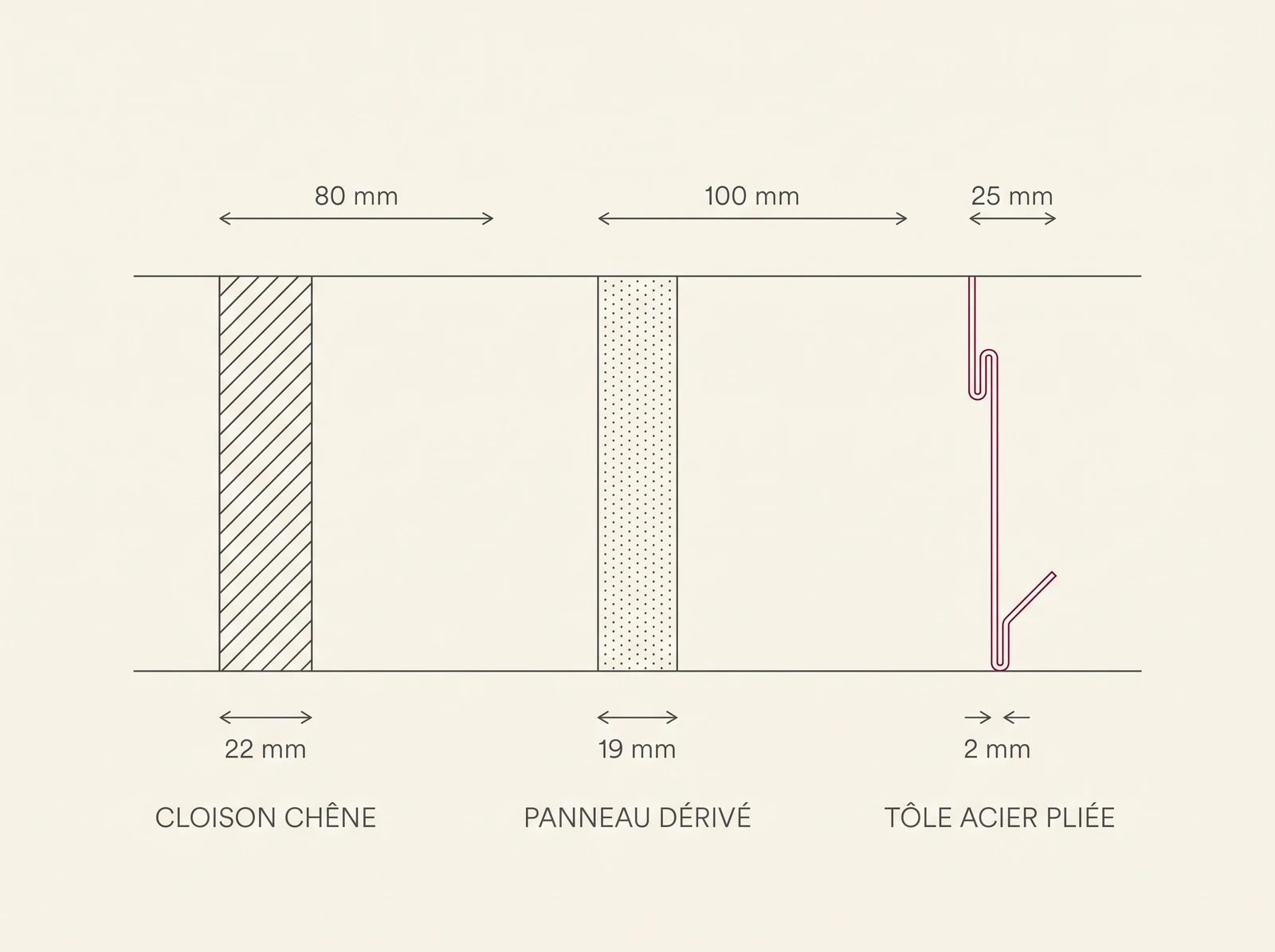
Before deciding between the different options, take a look at the material. For a solid-walled bottle rack, the material determines the thickness; the thickness determines the spacing between the compartments; and that spacing determines how many bottles you can fit per linear meter. This is the most concrete factor in the decision-making process—and the one that’s most often treated as a matter of personal preference.
Solid oak is the gold standard for traditional wine racks. Dense and, once properly dried, dimensionally stable, it ages well in the cellar and withstands ambient humidity better than most panels. It is expensive, heavy, and each partition adds to its thickness: commercially available racks are typically made from 18- to 22-mm-thick oak, with a 27-mm-thick sawn oak board yielding 22 to 24 mm after planing. Two centimeters per partition, repeated across a honeycomb rack, ultimately reduce the usable space.
Pine—whether Scots pine or maritime pine—remains the entry-level option for wooden crates. It is lightweight, easy to work with, and inexpensive. It shows marks from even the slightest impact; it bends more easily than other woods of equal cross-section when spanning a long distance; and its sapwood does not hold up well in humid conditions: it quickly turns blue and develops mold, whereas oak heartwood resists these issues thanks to its tannins. Catalogs often list both species side by side—a pine model and the same one in solid oak—with a price difference that speaks for itself.
Panels and their derivatives are what customizable manufacturers supply. They hold their shape well, come in dozens of colors, and lend themselves to parametric design. In a damp basement, not all are created equal: MDF, melamine, and particleboard swell along the edges as soon as the protective coating fails—unless they are water-resistant. Plywood, on the other hand, holds up much better, thanks to its cross-grain construction.
Steel offers a different approach. At 2 mm thick, a metal shelf supports a bottle with just a few millimeters of depth instead of a few centimeters. The benefit is evident in narrow spaces and rooms with low ceilings, where every centimeter saved on partition walls translates into usable space. The increase is modest: just a few extra bottles per linear meter. The advice can be summed up in one sentence: aesthetics follow the material—a wooden rack complements a traditional wine cellar, while a steel rack complements a modern interior.
When a Carpenter Is Still the Right Choice
There are times when nothing else works. A vaulted niche where none of the sides are at right angles. A 62-centimeter stone recess in a wall that is 70 centimeters wide. An old cellar with a sloping floor, where any vertical structure must be cut to fit. In such cases, on-site measurements and custom-built furniture are the only proper solution.
Then there’s the truly exceptional piece, and it deserves to be mentioned by name. A solid oak locker, built in the traditional style, with hand-carved compartments and an oiled finish, is as much a pleasure to look at as it is to use. The oak ages beautifully, and the craftsmanship stands the test of time. You buy it for the object itself, and that’s a perfectly valid reason.
Last scenario: full integration. When storage needs to blend seamlessly into a bookshelf, extend a wood paneling feature, or match a molding profile, a traditional workshop remains a step ahead. Plan for the site survey, the estimate, the manufacturing lead time, and the installation.
When the modular operation yields the same result
The wine rack market can be divided into five categories. Modular racks, which can be stacked or placed side by side. Freestanding racks, placed on the floor, that can be moved. Wall-mounted racks, which free up floor space. Built-in racks, installed in a niche or under a staircase. And cellar racks, designed for large volumes and high humidity. Custom-built racks are almost always designed to be built-in, whereas actual needs very often call for wall-mounted or modular racks.
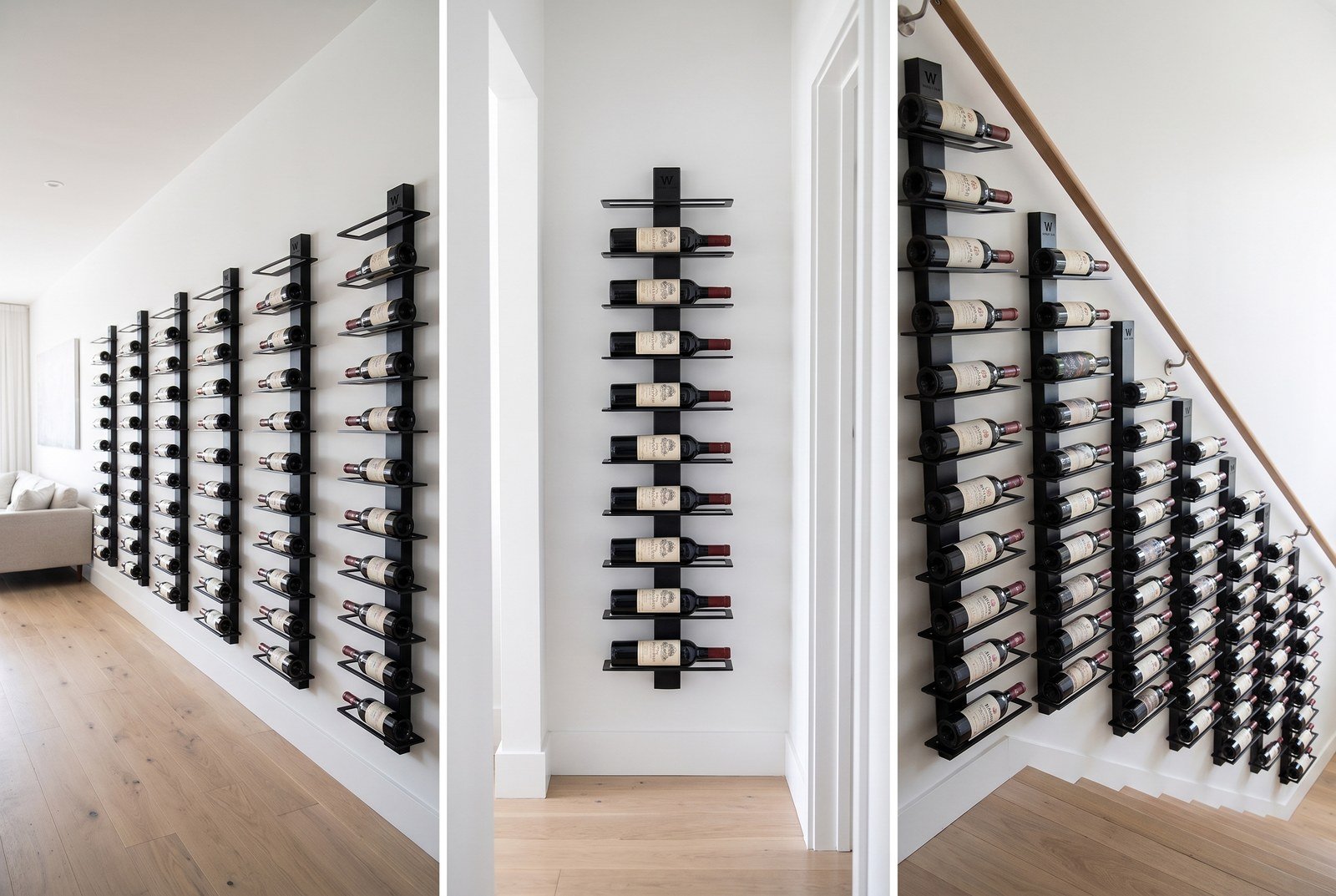
A straight, bare wall, a uniform sloped ceiling, a growing collection, a tight budget: in these scenarios, a modular system does the job just as well. A Wine Line® unit measuring 118 cm high by 30 cm wide holds up to 11 bottles with single shelves and up to 22 with double shelves, including magnums. You can place the units side by side to fill the available space and adjust the shelves as bottle sizes change. A drilling template is included; the 5 × 50 mm screws hold in concrete, brick, wood, or 22 mm OSB, while drywall requires 22 mm MDF or OSB backing or Moly screws.
One thing to make clear: a wine rack does not regulate the temperature of a room. It manages access, the organization of your wine cellar, and the positioning of the bottles—which should be stored on their sides if they have natural corks, with the labels facing forward. Temperature and humidity depend on the type of cellar—whether it’s a storage cellar or a serving cellar. In a very humid cellar, a lacquered finish is the safest choice: raw steel will eventually oxidize on the surface and will require occasional waxing or oiling.
Which Path Should Your Project Take?
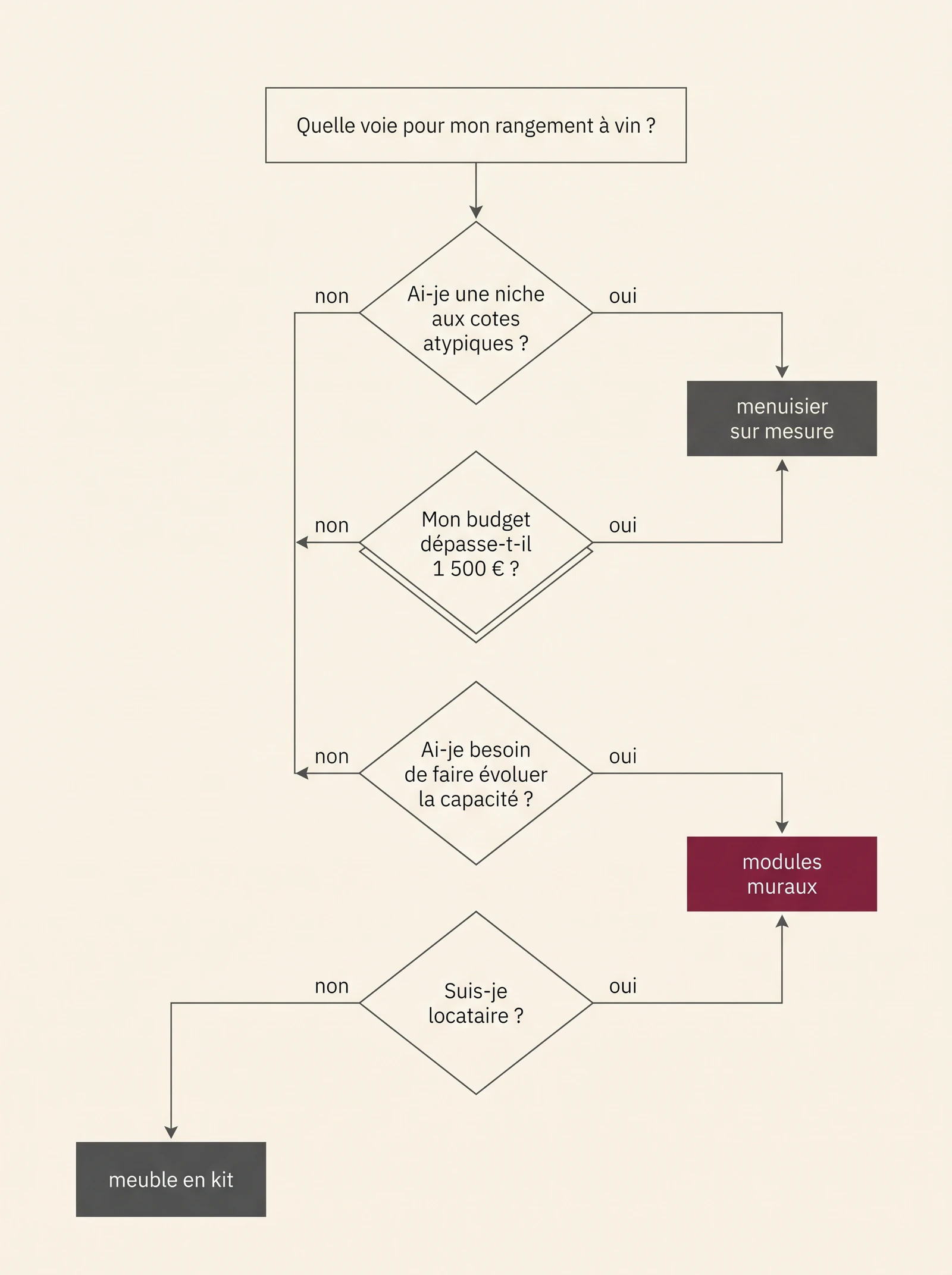
Four questions are all it takes to decide on most projects.
- Is your space square? No—if it has irregular angles or a vaulted ceiling, consult a carpenter. Yes—if it has straight walls or a regular sloped roof, all three options are still available.
- Will you stay in this home for more than ten years? No: skip the built-in units; modular or freestanding furniture will serve you well. Yes: built-in units become a viable option again.
- Will your collection grow? Yes: a modular system that expands as you add pieces. For a stable, fixed volume, a fixed-size piece of furniture works very well.
- How long can you wait? Less than two weeks: only the flexible route meets this deadline. After two months, all routes become viable again.
If “modular” comes up in most of your answers, your decision is made. If it comes up only once, ask for a quote before comparing options.
Three cases, three responses
A 92-cm niche in a stone wall, out of square. Carpenter. The on-site survey justifies the price, and the adjustment at the back of the niche isn’t something you can just cobble together.
Wasted space under the stairs. This is the most common scenario—and the one most often handled poorly. The height decreases step by step, making rectangular furniture impractical. Wall-mounted units of varying heights follow the slope without the need for cutting. You can find the complete method in our article on storing bottles under the stairs.
A long, bare wall—3.40 meters of empty plaster in a living room. No carpenter is needed. The linear display is divided into modules placed side by side at regular intervals, and the entire setup can be aligned perfectly in a single morning. Your wines on display, with legible labels, rather than in cardboard boxes.
Arrange your setup along a long wall
The central frames fit alongside your existing shelving; the single or double shelves clip into place and can be repositioned without tools as your product sizes change. Start with what you need to store today, and expand the following year without replacing anything.
Build your own system: Wine Line® central frames and compatible shelf sets. Free shipping on orders of €350 or more (including tax); pay in 1, 2, or 3 installments with no additional fees.
A wine collection that grows at your own pace.
Modular wall-mounted shelves in raw or lacquered steel. Holds up to 22 bottles per module, 2-year warranty, free shipping on orders over €350.
Explore the collectionExcessive alcohol consumption is harmful to your health. Please drink responsibly.